

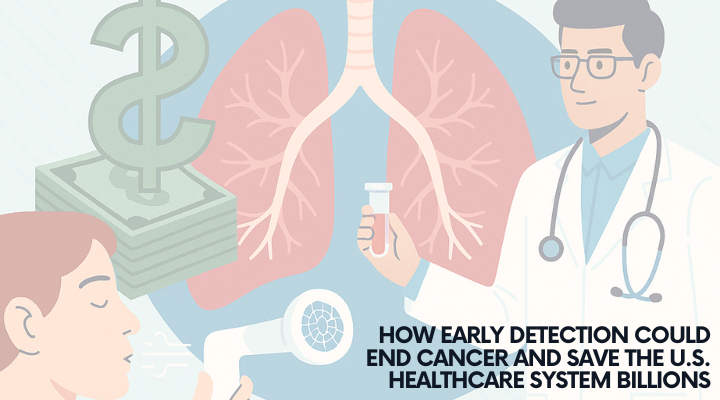
Let’s be honest: America doesn’t have a healthcare system… It has a sick care system.
We wait until people are coughing blood, limping into ERs, or collapsing at work before we intervene—and then we act shocked when the bill comes due.
Every year, we spend trillions of dollars patching people up when a fraction of that could’ve kept them healthy in the first place.
It’s like waiting for your car engine to seize before you ever think about changing the oil.
The problem can’t be completely blamed on a lack of medical innovation or political will, either. It’s that the entire system is reactive instead of proactive.
We treat disease after it happens, rather than preventing it from happening at all. And it’s killing both our citizens and our budget.
But that’s starting to change—and one of the biggest revolutions is happening in how we detect disease before it ever gets a chance to take root…
The Deadliest Cancer You Don’t See Coming
Take lung cancer…
It’s the leading cause of cancer deaths worldwide—responsible for more than 1.8 million deaths every year.
In the U.S. alone, it kills about 125,000 people annually. That’s one person every four minutes.
What makes lung cancer so devastating isn’t that it’s hard to treat—it’s that we rarely catch it early enough to treat at all.
When it’s found in its earliest stages—before it spreads beyond the lungs—patients have a five-year survival rate of over 60%. But once it advances, that number drops below 10%.
The tragedy is that those early-stage cancers can be detected. We have the technology.
We just don’t use it…
Why So Few Get Screened
Unlike breast cancer, where mammograms are easy, fast, and widely available, screening for lung cancer involves a low-dose CT scan.
That means radiation exposure, specialized machines, scheduling headaches, insurance approvals, and often an out-of-pocket bill that makes people think twice.
As a result, only about 6% of eligible Americans get screened for lung cancer. Compare that to the +75% compliance rate for breast cancer screening, and the gap is staggering.
It’s not that people don’t care—it’s that the system makes it inconvenient, intimidating, and sometimes expensive.
So, we wait. And by the time doctors do find the tumor, it’s often already spread too far to cure.
It’s a grim loop of human hesitation and logistical failure that costs tens of thousands of lives each year—and billions of dollars that could have been saved with earlier intervention.
The Financial Black Hole of Late Detection
The economics are brutal…The United States spends roughly $17 billion a year treating lung cancer. Globally, the cost exceeds $180 billion.
And that’s not counting lost productivity, family income, or the cost of long-term care for survivors.
What’s worse, the majority of this money goes to treating advanced disease—the hardest kind to cure and the most expensive kind to fight.
Late-stage lung cancer often requires surgery, radiation, chemotherapy, targeted therapies, immunotherapy—the full arsenal of modern medicine.
And even then, the results are often heartbreaking.
Meanwhile, the price of catching lung cancer early—when it’s a small, localized mass easily removed or targeted—is a fraction of that.
Every dollar spent on early detection saves three to five dollars in later treatment costs. Multiply that across millions of people, and the potential savings are staggering.
But this isn’t just about economics… It’s about human life.
The father who never got screened because he didn’t have time. The mother who thought her cough was allergies…
The millions of people who could’ve lived decades longer if only the tests were easier to take.
Making Screening Simple: The Next Great Breakthrough
That’s where the next wave of medical innovation comes in—not in miracle cures, but in better, simpler diagnostics.
Imagine being able to detect lung cancer from a quick breath test, or a drop of blood, or even a saliva sample…
No CT scans. No radiation. No insurance red tape.
Just a quick, painless test you could take during a regular doctor’s visitor even at home.
That’s the frontier researchers are racing toward right now.
They’re building technologies designed to find the earliest chemical signatures of disease—long before symptoms appear.
And if one of these breakthroughs proves reliable enough to replace or supplement CT scans, it could completely change how we fight not just lung cancer, but disease itself.
When testing becomes simple, compliance skyrockets. And when compliance skyrockets, early detection follows. That’s when survival rates soar—and costs plummet.
The Ripple Effect: Patients, Systems, and Investors Win
This isn’t just a medical milestone—it’s an economic one…
Healthcare spending in the U.S. now makes up nearly 20% of GDP. And most of that goes toward managing chronic and advanced disease.
If early detection technologies can shift even a portion of that spending toward prevention, the savings could reach hundreds of billions annually.
And it’s not just patients and taxpayers who benefit…
The companies pioneering these diagnostic tools stand on the edge of a potential gold rush in healthcare innovation.
Because when you create a test that saves both lives and money, you’re not selling a product—you’re reshaping an entire system.
These technologies could be deployed not just for lung cancer, but across the board—for heart disease, diabetes, Alzheimer’s, even viral outbreaks.
Early detection is the universal key to both longer life and lower costs.
The first company to make it truly practical could go down in history as the one that turned “healthcare” back into care for health.
The Beginning of the End—for Lung Cancer
For now, lung cancer remains a monster.
It’s stealthy, it’s deadly, and it’s been beating humanity for far too long. But the tide is turning. The tools to catch it early, cheaply, and easily are within reach.
When they arrive—and they will—the ripple effects will extend far beyond oncology.
We’re talking about the dawn of proactive medicine—a healthcare system built not around hospitals and disease, but around prevention…
One where the most common reason you visit a doctor isn’t to fix what’s broken, but to confirm you’re still running at peak performance.
That’s not just a better world—it’s a cheaper one, too. And for investors with the foresight to see where the future of medicine is heading, it could also be a much more profitable one.
Final Thoughts: Prevention Is the Real Cure
The political debates over healthcare will keep raging—who’s covered, who pays, who profits—but none of that changes the underlying truth:
If we want to cut costs and save lives, we must stop waiting for people to get sick.
Lung cancer is just the first battleground in this larger war. Win this one, and we unlock the blueprint for detecting—and eventually defeating—countless other diseases before they even begin.
Because in the end, the smartest investment any nation, company, or individual can make isn’t in treating disease… It’s in preventing it.
So, we urge you to learn more about the breakthroughs reshaping how we detect and prevent deadly diseases.
The end of lung cancer is only the beginning—and those who see this medical revolution coming could profit just as much as the patients who survive because of it.