The Investment Journal

Independent Research · Long-Term Plays

When most investors think about the future of artificial intelligence, they picture the same thing…

A massive data center campus. Endless rows of servers. Miles of cable. Huge substations. Dedicated power plants. Enough electricity demand to rival a small city.

That image isn’t wrong. The biggest AI models require enormous computing power, and the companies building them are already racing to secure land, transmission access, cooling capacity, and long-term energy contracts.

But that’s only one part of the story…

The market has become obsessed with the biggest version of the AI infrastructure buildout. 

And investors are focused on hyperscale campuses, giant nuclear projects, massive transmission upgrades, and small modular reactors capable of producing hundreds of megawatts of electricity.

Yet AI isn’t going to live only inside a handful of mega-complexes.

A growing share of AI will need to happen much closer to where the work is being done.

That means hospitals, factories, defense facilities, ports, financial centers, robotics hubs, autonomous vehicle networks, university research campuses, and eventually quantum-adjacent computing environments.

These sites may not need a 300-megawatt reactor.

But many of them will need far more power than the local grid can easily provide.

That gap — too small for a traditional power plant, too large for the existing grid — may become one of the most important overlooked opportunities in the AI boom.

The Shift No One’s Talking About

The first phase of AI has been dominated by training.

Training a large AI model requires huge clusters of chips running at full capacity for long stretches of time. 

That’s why the hyperscale campus became the symbol of this boom… 

You need land. You need cooling. You need fiber. And most of all, you need massive amounts of reliable power.

But once a model is trained, the next challenge is inference.

Inference is what happens when AI is actually used…

It’s the chatbot answering a question. The medical imaging system flagging a tumor. The robotic arm correcting itself in real time. The fraud detection system approving a transaction. The drone network processing battlefield data.

That work doesn’t always belong in a remote mega-campus.

In many cases, it needs to happen close to the user, the machine, the patient, the vehicle, the factory, or the secure facility. 

That reduces latency. It improves privacy. It makes real-time decisions possible. And it keeps sensitive data closer to where it’s created.

And that changes the geography of AI…

The next phase won’t be built only around a few enormous data center hubs. It’ll also require smaller, localized data centers spread across the country.

Not server closets… Real data centers.

But ones measured in single-digit megawatts, tens of megawatts, or perhaps low hundreds of megawatts — not sprawling gigawatt campuses.

And that creates a very different kind of power problem…

The Grid Wasn’t Built for This

Many investors assume that if a data center is smaller, the power problem goes away, but it doesn’t…

A smaller AI facility may still require more electricity than the surrounding grid can spare. 

And a hospital system using AI for diagnostics can’t wait a decade for new transmission lines. 

Similarly, a defense contractor can’t rely on unstable power. And a factory running AI-powered robotics can’t shut down every time the local grid gets stressed.

These facilities need firm, reliable, always-on electricity.

And in many parts of the country, the grid is already under pressure from population growth, electrification, manufacturing reshoring, electric vehicles, industrial expansion, and the first wave of data center demand.

That’s the real bottleneck.

The issue isn’t whether America can build more data centers…

The issue is whether America can power them in the right places, on the right timeline, with the right level of reliability.

For smaller localized AI centers, the answer may increasingly be, “not from the grid alone.”

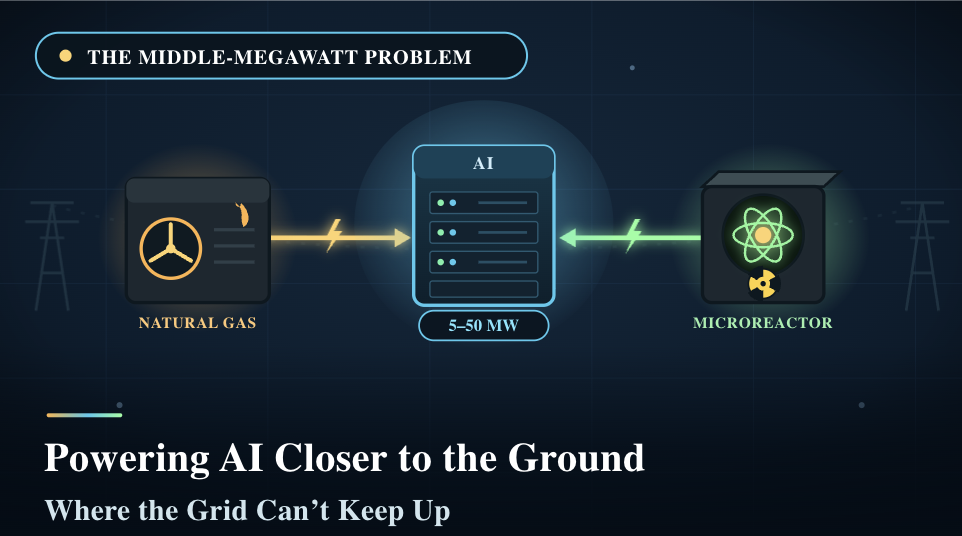
And that creates what I like to call the middle-megawatt problem…

A hyperscale AI campus may eventually justify a dedicated nuclear project, a full gas-fired power plant, or a major renewable-plus-storage buildout.

A normal office building can rely on the grid and backup generators.

But what about a 10-megawatt AI center next to a robotics factory?

What about a 25-megawatt secure compute facility serving a defense contractor?

What about a 50-megawatt regional inference center supporting hospitals, logistics networks, and industrial automation?

Those projects sit in an awkward middle ground…

They need more power than the local grid may be able to provide. They need reliability that intermittent power alone can’t deliver. 

But they may not be large enough to justify a full small modular reactor project.

And that leaves a much narrower list of practical options…

The first is onsite natural gas generation.

The second is batteries, fuel cells, and hybrid microgrids.

The third — still early, but potentially enormous — is the micro modular reactor.

Natural Gas Gets There First

Natural gas obviously isn’t the futuristic answer we’re all hoping for. But it’s the answer that can be deployed now.

That’s why generator companies, turbine manufacturers, and microgrid developers are suddenly becoming part of the AI story. 

Data center operators need power faster than utilities can always provide it. 

Natural gas systems can be installed behind the meter, paired with batteries, used as backup, or even serve as the primary power source for facilities that can’t wait on the grid.

That matters for investors.

The AI power shortage is moving from theory to procurement. And companies aren’t just talking about the problem anymore. 

They’re ordering turbines, generators, transformers, switchgear, and microgrid systems.

Natural gas has obvious advantages in this environment… 

It can be deployed faster than new transmission. It provides firm power. It can run day and night. It can support facilities that need reliability above all else.

But that doesn’t make it perfect…

Gas projects face emissions concerns, permitting challenges, fuel supply questions, and political opposition in certain markets. 

But the AI buildout is moving faster than the clean power buildout. 

And when developers are forced to choose between delaying a project for years or installing onsite generation, many will choose the option that gets the servers running.

That creates near-term tailwinds for companies tied to gas turbines, reciprocating engines, backup generators, microgrids, electrical equipment, grid controls, and power infrastructure.

This is the first wave of the localized AI power trade.

Microreactors Could Be the Second Wave

The longer-term opportunity may be even more interesting for investors…

Small modular reactors get most of the headlines because they could provide hundreds of megawatts of clean, reliable power and that makes them a logical fit for the biggest AI campuses.

But many localized AI centers don’t need hundreds of megawatts…

They need 5, 10, 25, or 50.

And that’s the microreactor market.

Micro modular reactors are designed to be much smaller than traditional nuclear plants. 

Some concepts are intended to produce only a few megawatts of electricity. Others could support industrial sites, military bases, remote facilities, mining operations, or small data centers.

For localized AI, that’s exactly the point…

A microreactor doesn’t need to power an entire city. It only needs to provide clean, reliable, compact power to a specific site that can’t depend on the grid alone.

This market is still early. Regulatory approval, fuel supply, cost, waste handling, security, and public acceptance all remain real hurdles. 

So, investors shouldn’t treat microreactors as if they’re already rolling off assembly lines and powering AI inference centers across the country.

But the direction is clear…

The more AI spreads beyond mega-campuses, the more demand there will be for compact, reliable onsite power. 

Natural gas gets there first. Microreactors seem likely to follow.

And when they do, the opportunity won’t be limited to reactor developers… 

It’ll extend to uranium miners, nuclear fuel processors, advanced materials companies, component suppliers, engineering firms, and manufacturers that help turn reactor concepts into deployable power systems.

Quantum Makes the Trade Even Bigger

Quantum computing adds another layer to this story…

Quantum machines are still highly specialized, difficult to scale, and often dependent on unusual cooling and operating conditions. 

But as quantum computing moves from laboratories toward commercial and national-security applications, it’ll require secure, reliable, power-dense infrastructure.

Some of that infrastructure will be centralized.

But some of it will likely sit near universities, government labs, defense facilities, financial institutions, and industrial research centers.

That means quantum doesn’t replace the localized AI power thesis; it strengthens it.

The future of computing won’t be one giant cloud… 

It’ll be a layered system made up of hyperscale training campuses, regional inference centers, edge facilities, secure compute nodes, and eventually quantum-linked infrastructure.

Every layer needs power.

And the most overlooked layer may be the one too small for Wall Street’s current nuclear obsession but too large for the local grid to handle.

The Misunderstanding Creates the Opportunity

The investment opportunity here isn’t simply “buy data center stocks.”

That trade is already crowded.

The better question is: Who benefits when data centers can no longer wait for the grid?

That points investors toward a different group of companies…

Natural gas generator makers, turbine suppliers, microgrid developers, battery storage providers, fuel cell companies, transformer manufacturers, switchgear suppliers, cooling specialists, engineering firms, advanced nuclear developers, uranium miners, and nuclear fuel processors.

Some of these companies are mature industrial giants. Others are small, speculative firms. 

Some are public. Many are still private. Some will become major winners. Others won’t make it.

That’s why this trade requires selectivity… Because the mistake is assuming every AI power company will win.

But the opportunity is realizing that the market is still underestimating how many different kinds of power AI will require.

The mega-campuses will need huge amounts of electricity.

But the smaller, localized AI centers may need something different: compact, modular, onsite power that can be deployed where the grid can’t keep up.

That’s the misunderstanding…

Investors are looking for the biggest data centers. But some of the best returns may come from powering the smaller ones.

Because the next phase of AI won’t just be built in the cloud… It’ll be built closer to the ground.

And wherever AI goes, power has to get there first.
When most people think about nuclear power, they imagine massive cooling towers rising above the horizon.

They picture billion-dollar construction projects, decades-long permitting battles, and reactors capable of powering entire metropolitan areas.

Even today’s much-discussed small modular reactors (SMRs) somewhat fit that basic mold…

Yes. They’re smaller than conventional reactors, but they’re still utility-scale assets designed to serve regional grids.

Micro modular reactors, however, are different…

In fact, they may represent one of the most overlooked investment opportunities in the entire energy sector.

While investors focus on the race to build the next generation of SMRs, a smaller and potentially more disruptive technology is quietly advancing through testing, licensing, and early deployment.

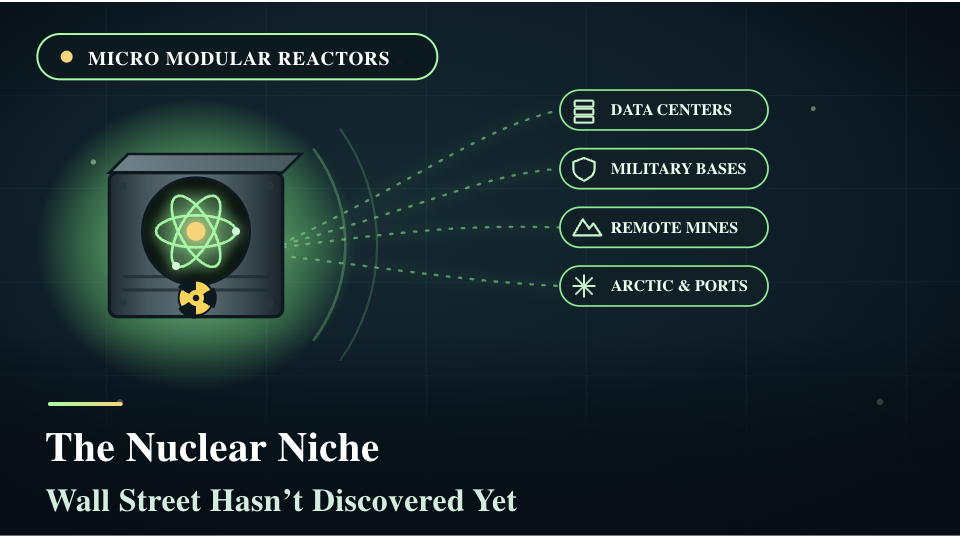
You see, these reactors aren’t being designed to power cities. They’re being designed to power everything else…

Remote mines. Military bases. Data centers. Ports. Arctic communities. Oil and gas operations. Desalination facilities. Critical infrastructure.

And perhaps someday, even the Moon.

Because the companies pursuing this technology believe the future of nuclear energy isn’t just bigger…

It’s smaller. Much smaller.

And that distinction could create an entirely new market worth hundreds of billions of dollars over the coming decades.

A Different Kind of Nuclear Revolution

Most advanced reactor companies are chasing a familiar goal: they want to build power plants.

But microreactor developers are chasing something entirely different…

They want to replace diesel generators.

That may sound less exciting, but it could ultimately prove more profitable.

You see, today, thousands of remote operations around the world rely on diesel fuel because they have no practical alternative. 

Mines in northern Canada. Military installations in remote regions. Islands disconnected from major grids. Arctic settlements. Energy projects far from transmission infrastructure.

The fuel must be shipped, trucked, flown, stored, protected, and eventually burned.

Every step adds cost. Every step adds risk. And every step creates an opportunity for disruption.

But micro modular reactors offer a radically different approach…

Many designs are intended to operate for years before requiring refueling. 

Some can be transported in shipping containers, while others are designed to be factory-built and deployed almost like industrial equipment rather than traditional power plants.

The Department of Energy has repeatedly identified remote communities, defense installations, and industrial facilities as among the most promising early markets for microreactors. 

Meanwhile, developers are increasingly targeting another customer that barely existed a decade ago: Artificial intelligence.

As AI infrastructure expands, data centers are becoming some of the largest electricity consumers on Earth. But the challenge isn’t simply finding power.

It’s finding reliable power. Twenty-four hours a day. Seven days a week.

Regardless of weather. Regardless of grid congestion. Regardless of geography.

And that is exactly the kind of problem nuclear power was built to solve.

The Hidden Connection to the Commodity Supercycle

Regular readers know we’ve spent years discussing what we believe is a developing commodity supercycle.

The world is demanding more copper. More uranium. More silver. More aluminum. More nickel. More rare earths. More energy.

But what often gets overlooked is where those materials come from…

The next generation of critical mineral deposits won’t necessarily be located beside major population centers or existing power infrastructure.

Many will be developed in remote regions where electricity is scarce, unreliable, or prohibitively expensive.

And that creates an interesting feedback loop…

The commodity boom requires more mines. Those mines require more power. Microreactors could provide that power.

Which in turn enables the production of more commodities needed to build AI infrastructure, electrical systems, advanced manufacturing facilities, and additional nuclear reactors.

The result is a self-reinforcing cycle that shows the commodity story and the nuclear story may be far more connected than most investors realize.

The Military Opportunity

Historically, military spending has often accelerated technological development.

The internet. GPS. Jet engines. Semiconductors. Nuclear energy itself.

Well, microreactors may eventually join that list…

The U.S. Department of Defense has emerged as one of the most important early customers for advanced nuclear technologies.

Project Pele, one of the Pentagon’s flagship microreactor initiatives, is designed to demonstrate transportable nuclear power for military operations. 

BWX Technologies is currently manufacturing the reactor core for the project, with power generation expected later this decade.

The appeal is obvious…

Modern military operations consume enormous amounts of energy. Fuel convoys remain vulnerable. Remote bases often depend on diesel generators.

Communications networks, sensors, and advanced weapons systems require increasingly reliable power sources.

And a compact reactor that can operate for years with minimal fuel requirements offers strategic advantages that traditional generators simply can’t match.

For investors, military adoption matters for another reason, too…

Government customers often help technologies survive long enough to reach commercial scale.

The Public Companies Investors Can Watch

The most direct publicly traded microreactor exposure today is probably BWX Technologies…

Unlike many advanced reactor developers, BWXT already operates a substantial business supplying nuclear technology to the U.S. government and naval nuclear programs. 

Its involvement in Project Pele gives investors exposure to one of the most visible microreactor demonstrations currently underway.

Another important name is Oklo…

While Oklo is often grouped with the broader advanced reactor industry, its Aurora system targets many of the same end markets that make microreactors attractive: industrial facilities, data centers, remote sites, and military applications. Investors increasingly view the company as a potential bridge between the AI boom and advanced nuclear power.

Then there is NANO Nuclear Energy…

NANO has become one of the purest public microreactor stories available to retail investors. 

The company describes itself as the first publicly listed U.S. microreactor developer and is pursuing multiple reactor concepts, including the KRONOS MMR platform. 

Its recent regulatory progress at the University of Illinois represents one of the more tangible milestones in the sector.

Investors should understand that NANO remains highly speculative. Like many early-stage reactor developers, it is years away from large-scale commercialization.

But that doesn’t necessarily make it a bad investment. It simply makes it a venture-style investment masquerading as a public stock.

That’s a very different risk profile from a company like BWXT.

Finally, investors should not overlook the picks-and-shovels side of the industry…

Companies such as Centrus Energy and Cameco Corp. will ultimately benefit regardless of which reactor developer wins.

Because nearly all advanced reactor pathways require specialized fuel, enrichment capacity, transportation infrastructure, and fuel-cycle services.

The Private Company That Caught My Attention

Among the private companies pursuing microreactor technology, one stands out because of its unusually asymmetric setup…

That company is Nuclea Energy. And we’ve discussed Nuclea before, but its story deserves another look.

Because it is developing what it calls the Morpheus reactor, a microreactor specifically designed for some of the most compelling early-use cases in the industry…

Remote communities, mining operations, AI data centers, and military installations.

But what makes Nuclea interesting isn’t simply the technology…

It’s the market selection.

Many advanced reactor companies are competing for utility contracts that may take years or even decades to materialize.

Nuclea appears focused on customers who already have an expensive power problem today.

Mining companies don’t need convincing that electricity matters.

Data center operators don’t need convincing that reliability matters.

Military planners don’t need convincing that energy security matters.

The demand already exists. The challenge is delivering a solution.

That’s why I view Nuclea as an asymmetric opportunity…

If microreactors fail to gain widespread adoption, companies like Nuclea may never become major businesses.

But if even a fraction of the targeted markets adopt nuclear microreactors, the addressable opportunity becomes enormous.

The risk is obvious. But the potential reward is difficult to quantify.

And those are often the characteristics that define the most interesting early-stage opportunities.

Why Investors Should Pay Attention Now

Microreactors remain years away from widespread deployment.

Many designs will fail. Some companies will disappear.

Licensing challenges remain significant. Fuel supply remains a bottleneck.

Economics still need to be proven at scale.

Those are real risks.

But that is precisely why the opportunity exists.

Investors tend to notice trends only after they become obvious.

Today, most discussions about nuclear power revolve around large reactors, SMRs, and AI-driven electricity demand.

Microreactors rarely make headlines.

Yet they may ultimately become the technology that extends nuclear power into places it has never reached before.

Not because they replace traditional reactors. Because they serve markets traditional reactors never could.

That distinction may prove far more important than investors currently appreciate.

And if the next decade unfolds the way many energy experts expect, micro modular reactors may become one of the most fascinating—and potentially profitable—corners of the entire nuclear renaissance.

The future of energy probably won’t be won by a single fuel, a single technology, or a single giant utility. 

It will be shaped by whichever solutions can deliver dependable electricity at scale, under pressure, in a world that suddenly needs a lot more power than most people expected. 

And that’s a big reason nuclear energy is finding its way back into the conversation… 

Global electricity demand rose 4.3% in 2024, according to the International Energy Agency…

Which sounds small until you realize it was equivalent to nearly 30% of all the energy the US generated that year

Then you’ve got the U.S. Department of Energy pointing to data centers as a major driver of future consumption, with estimates that they could account for up to 9% of U.S. electricity generation by 2030. 

That kind of demand growth changes the way investors ought to think about power generation. It’s no longer enough to ask what is cheap, fashionable, or politically popular. 

The real question is what can reliably keep the lights on while feeding AI infrastructure, industrial facilities, and increasingly electrified economies. 

Nuclear already supplies a meaningful share of U.S. electricity, and global policy ambition around nuclear buildouts has been rising sharply. 

World Nuclear Association said in January that government ambitions for nuclear deployment now exceed the tripling goal for 2050.

And the IAEA continues to frame small modular reactors as a flexible option for a wider range of users and applications. 

Why Small Reactors Could Become a Very Big Deal

What makes this next chapter especially interesting is that it may not be driven only by giant, traditional nuclear plants. 

Small modular reactors, or SMRs, are designed to be smaller, more flexible, and potentially easier to deploy than conventional reactors. 

The IAEA describes SMRs as reactors that can be deployed as single or multi-module plants and paired with other energy sources. 

And World Nuclear’s SMR tracker shows just how broad and active the development pipeline has become around the world. 

World Nuclear Association’s SMR Global Project Tracker map shows how widespread the global race to develop small modular reactors has become. Source: World Nuclear Association 

That matters because the old knock on nuclear was always the same: too expensive, too slow, too cumbersome, too hard to site, and too difficult to finance. 

And while SMRs don’t eliminate those challenges, they do offer a different path… 

Factory-built components, modular deployment, smaller footprints, and the ability to serve remote sites, industrial campuses, military installations, or grid-constrained regions all make the concept more attractive than the old all-or-nothing nuclear model. 

And the DOE’s Reactor Pilot Program is built around that idea, aiming to fast-track advanced reactor demonstrations and help push multiple concepts toward criticality. 

As The Grid Gets More Stressed, Nuclear Starts Looking More Practical

That’s why nuclear suddenly feels less like a legacy technology and more like a practical answer to a modern problem. 

Wind and solar will continue to play important roles, but they are not always available when power demand peaks. 

Natural gas is useful, but fuel markets and emissions concerns can complicate the picture. 

But nuclear’s appeal is that it offers firm, dispatchable, low-carbon power in a world that increasingly values reliability as much as ideology. 

DOE has also stepped up its support for American-made SMRs, including an $800 million award announced in late 2025 to TVA and Holtec to advance deployment. 

For investors, though, the real opportunity may not be in the giant incumbent names everybody already knows. 

Instead, it may be in the smaller public companies trying to carve out a niche in reactor design, microreactors, advanced fuel, and domestic nuclear supply. 

These aren’t risk-free stories. In fact, they’re exactly the kind of stories that can get messy, volatile, and speculative. 

But that’s also where the asymmetry can show up when a major industry is still in its early innings.

NANO Nuclear Is Trying to Turn Microreactors Into A Public-Market Story

One of the more intriguing names in the group is NANO Nuclear Energy. 

It’s a small public company built around advanced microreactor development, and it has been steadily trying to position itself as one of the purest public-market plays on compact nuclear systems. 

The company says its lead technology is the KRONOS MMR, a stationary high-temperature gas-cooled microreactor that is already in construction permit pre-application with the NRC, alongside other designs including ZEUS and LOKI. 

Early in April 2026, NANO said a construction permit application was submitted by the University of Illinois Urbana-Champaign for the KRONOS deployment partnership, giving the company a real regulatory milestone instead of just a PowerPoint dream. 

That doesn’t mean commercial success is guaranteed. 

But It does mean NANO is moving through the kinds of steps that separate serious developers from the crowd of companies simply hoping to catch a hot theme. 

And for speculative investors, that’s important. 

You don’t need a company like this to have all the answers yet. You just need to see signs that it is advancing from concept toward legitimacy. NANO seems to be doing that.

Eagle Nuclear Energy Brings Fuel Security Into the Same Bet

Eagle Nuclear Energy adds a different twist to the story, and that’s what makes it compelling…

Instead of offering only a reactor narrative, Eagle is pitching a more vertically integrated nuclear future. 

The company says it is pairing its SMR technology ambitions with the Aurora uranium project, which it describes as the nation’s largest conventional uranium deposit. 

In early April 2026, Eagle announced plans for a 27,000-foot drill program to move Aurora toward a pre-feasibility study, calling it one of the largest undeveloped uranium deposits in the United States. 

Eagle also only recently entered the public markets, beginning Nasdaq trading under the ticker NUCL in February 2026. 

That combination makes Eagle more interesting than a simple uranium exploration story… 

If advanced nuclear really is going to expand, the market will not just need reactors. It will need fuel, domestic supply chains, and credible North American resource leverage. 

Eagle is trying to sit in both worlds at once. That’s ambitious, and ambition in small-cap land always comes with real risk. 

But if the thesis works, it could also give investors exposure to both sides of the nuclear buildout: the fuel side and the technology side.

BWX Technologies Offers A More Grounded Way to Play the Same Trend

BWX Technologies is not as tiny or as speculative as NANO or Eagle, but it still belongs in this conversation because it gives investors a more established public foothold in advanced nuclear development. 

BWXT is deeply involved in Project Pele, the U.S. Department of Defense effort to develop a transportable microreactor. 

And the company says the Pele prototype is being designed and manufactured at its Innovation Campus in Lynchburg, and in December it announced delivery of the full core of TRISO fuel for the microreactor. 

Why does that matter? Because markets often get carried away with the pure-concept names while underestimating the companies that actually know how to build hard things. 

Project Pele is not a vague white paper. It is a real microreactor effort with government backing, tangible engineering work, and a use case centered on resilient energy supply. 

So, BWXT may not have the same lottery-ticket feel as the smaller names, but sometimes the companies that quietly execute wind up being the most durable winners.

Lightbridge Could Win Even If Someone Else Builds the Best Reactor

Then there’s Lightbridge, which is not really a reactor company at all. It is a fuel technology company, and that may be precisely why it deserves attention. 

Lightbridge says it is developing proprietary next-generation nuclear fuel for existing light-water reactors and future SMRs, with the goal of improving safety, economics, and proliferation resistance. 

The company has continued presenting technical research in 2026 and has explicitly framed its fuel as relevant to both current reactors and new SMRs. 

That creates an attractive “picks and shovels” angle…

In every major industrial buildout, some of the best opportunities come not from the final branded product, but from the enabling technology that many players may need. 

If the advanced nuclear market grows, better fuel could become one of the critical bottlenecks. That gives Lightbridge a lane, even if it never becomes a household name.

The Best Opportunities Often Show Up Before the Crowd Believes

The point here is not that every small nuclear stock is destined to soar…

Some will fail. Some will dilute shareholders. Some will take far longer than expected to hit key milestones. This is still an emerging market, and emerging markets are rarely tidy. 

But the larger trend looks increasingly real. 

Governments are pushing advanced reactor programs forward, global nuclear ambitions are climbing, and the energy needs of AI, industry, defense, and grid resilience are making dependable power more valuable by the quarter. 

That’s why this space is worth watching now, before it becomes obvious. 

Nuclear power’s role in the future energy mix is likely to be much larger than many investors currently assume, and small modular reactors could become one of the biggest reasons why. 

The lesser-known public companies chasing that future are risky, early, and imperfect. They are also exactly the kind of problem-solvers that can create outsized returns when a giant market begins to take shape.

So, start doing the homework today. Dig into the small companies trying to move advanced nuclear from idea to infrastructure. 

Learn more about the firms building microreactors, strengthening domestic uranium supply, and developing the fuels and systems that could make the whole market work. 

The next great energy story may not belong only to the giants. It may belong to the smaller public companies bold enough to build what the future suddenly needs.

If you think ChatGPT, Google Bard, or that AI-generated image of a cat wearing a spacesuit costs next to nothing to create, think again. Artificial intelligence might feel digital and intangible, but it’s powered by an energy-hungry physical infrastructure: data centers.

And as AI scales up, so does the electricity bill.

In fact, the International Energy Agency projects that by 2026, data centers could consume 20% of the total electricity supply in the U.S.

That’s not just a big number – it’s a total transformation of the energy market.

How Much Power Are We Talking?

A single large data center can consume 700,000 kilowatt-hours (kWh) per week. 

For context, the average U.S. home uses about 210 kWh per week. That means one data center can burn through as much electricity as 3,300 homes per week. 

Multiply that by thousands of facilities, and you begin to understand why utilities are starting to panic.

Add to that the fact that AI workloads (especially training large models like GPT-4 or Meta’s LLaMA) require 10x to 100x more energy than standard cloud computing tasks. 

The power demand isn’t just growing – it’s accelerating exponentially.

Why Data Centers Can’t Run on Intermittent Energy

Unlike your Netflix stream or your smart fridge, data centers can’t afford to blink. They need constant, uninterrupted power 24/7/365. 

That rules out intermittent energy sources like wind and solar. Even with large battery installations, renewables can’t provide consistent baseload power at the scale AI requires.

That means we need energy sources that are always on. We’re talking about baseload power.

What Counts as Baseload Power?

There are only a few options that deliver this kind of reliability:

  • Natural Gas: Highly flexible, relatively clean, and quick to ramp up.
  • Coal: Still in the mix, though declining due to emissions and regulatory pressure.
  • Nuclear: Clean and powerful, but slow and expensive to build.

So where does that leave us?

Why Nuclear Isn’t Ready (Yet)

Traditional nuclear reactors take 7 to 15 years to build. The only major nuclear project in the U.S. in recent memory—Vogtle Units 3 and 4—took 14+ years and cost over $30 billion.

Small modular reactors (SMRs) are the exciting future of nuclear energy. But the key word is future…

While Canada has started construction on its first BWRX-300 and the U.S. has approved designs from NuScale and Holtec, none will be online in time to meet the surge in demand that’s happening NOW…

SMRs will most likely play a growing role in the energy mix by the 2030s. But they’re not here now. 

And the AI energy crunch is happening now.

The Case for Oil and Gas

So, if nuclear can’t help in time, and renewables can’t provide uninterrupted power, who’s left to carry the load?

You guessed it: oil and gas.

Oil, in particular, is already the top source of U.S. electricity generation, followed closely by natural gas… 

They’re both abundant, fast to scale, and can be deployed flexibly to meet surging demand. 

And natural gas is also increasingly paired with carbon capture and other innovations that improve its environmental profile.

Here’s what makes oil and gas the best bet for meeting AI-driven power demand over the next decade:

  • Speed: New gas plants can come online in 2–3 years, far faster than nuclear.
  • Scalability: U.S. shale formations offer massive untapped reserves.
  • Infrastructure: Pipelines, LNG terminals, and gas turbines are already in place.

Where the Smart Money Is Going

Big investors are already piling into energy infrastructure to support AI…

Warren Buffett, for example, has been doubling down on oil and gas. He knows what we’re all starting to realize: without a strong energy backbone, the AI revolution stalls.

And while the majors like Exxon and Chevron will benefit, the real upside is in the smaller exploration and production companies with high growth potential.

One to Watch: Prairie Operating Company (NASDAQ: PROP)

Prairie Operating Company is a nimble, fast-growing U.S.-based oil and gas company focused on efficient, low-cost production from domestic shale assets. 

With oil and natural gas demand booming from AI data centers, power-hungry crypto, and LNG exports, companies like PROP are positioned to thrive.

What sets Prairie apart is its strategic location and focus on scalable development… 

The company holds thousands of acres of high-potential leases in energy-rich basins and has streamlined operations to keep drilling costs low while maximizing output. 

That means more cash flow when prices are high—and a leaner break-even point when prices dip.

PROP also benefits from existing infrastructure, which means it can bring production online faster than many of its competitors. It’s the kind of operational agility that institutional investors look for when power demand – and energy prices – are about to spike.

In short, Prairie Operating Company (NASDAQ: PROP) is the kind of early-stage energy play that could grow significantly as the AI power demand story unfolds.

The Bottom Line

The AI boom is driving an energy crisis that most investors haven’t priced in yet. With nuclear still years away and renewables unable to deliver reliable baseload power, oil and gas will do the heavy lifting for at least the next decade.

That makes now the perfect time to look into small oil and gas producers set to benefit from this megatrend.

Learn more about Prairie Operating Company (NASDAQ: PROP) and how you can position your portfolio to profit from the explosive growth of AI…

Because the next part of this revolution isn’t about software or hardware. It’s about the energy systems that make it all possible.


Neither The Investment Journal nor the author have a financial position in any of the companies mentioned in this article. An affiliate of The Investment Journal has been retained for marketing services by Prairie Operating Co. between June and August, 2025; however, this is not a sponsored post. This content is for informational purposes only and should not be considered investment advice or a solicitation to buy or sell any securities.