

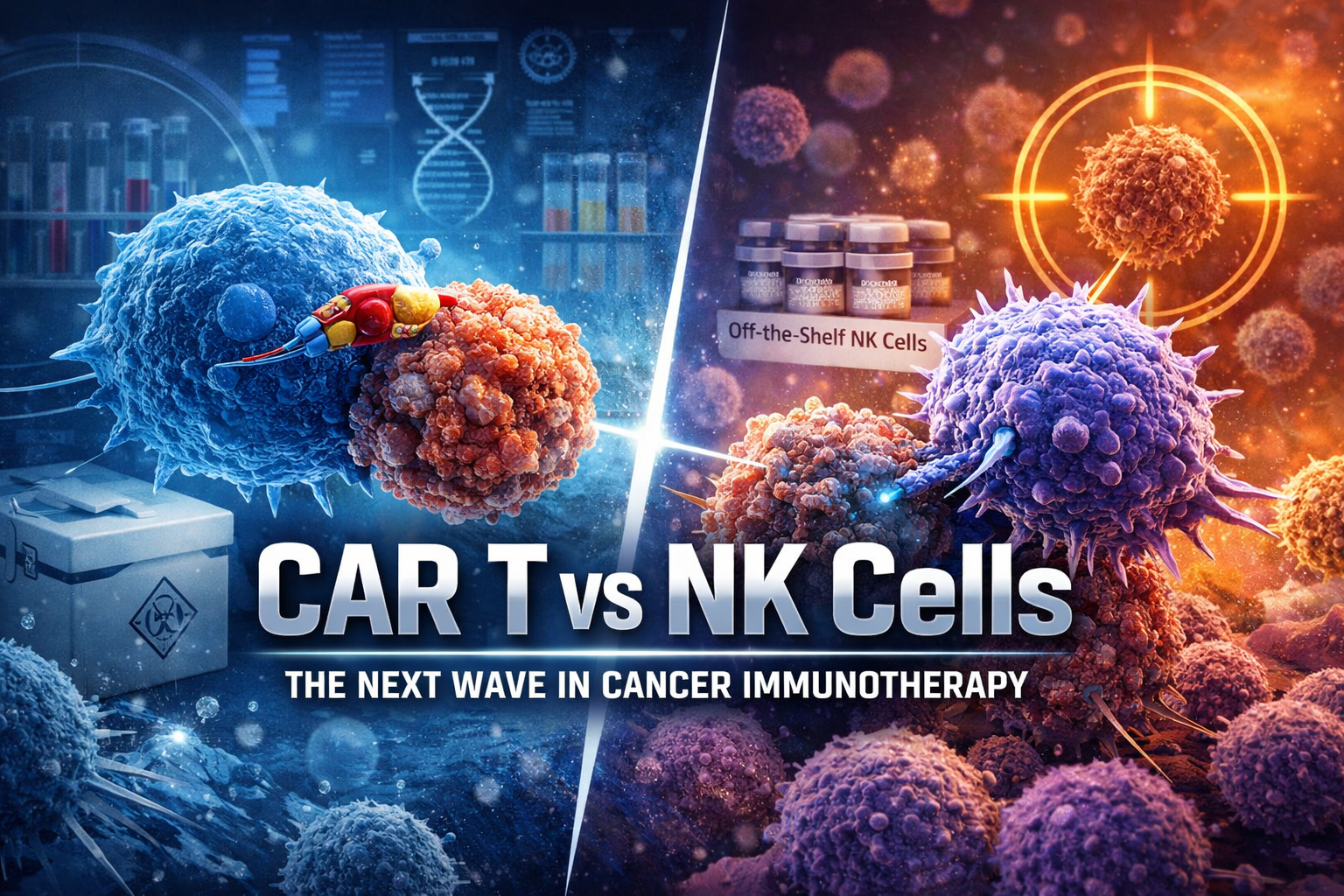
If you want a modern cancer story with real “before and after” chapters, CAR T-cell therapy deserves top billing…
It’s one of the clearest demonstrations we’ve ever seen that the immune system can be reprogrammed to identify and destroy malignant cells—especially in certain blood cancers.
CAR T: The Miracle That Comes with a Catch
Major cancer centers now describe CAR T as a treatment that can deliver dramatic responses for patients who have exhausted conventional options.
But the magic trick has a price tag, and it’s not just financial—it’s logistical.
You see, most of the widely used CAR T approaches are autologous, meaning the therapy begins with yourT-cells, collected from your bloodstream, shipped to specialized facilities, genetically modified, expanded, tested, and shipped back for infusion.
That personalization is part of what makes CAR T powerful… and part of what makes it painfully inefficient.
Manufacturing and quality control can create a long “vein-to-vein” timeline that’s often measured in weeks or even months.
And the complexity of producing patient-specific batches is one of the core reasons CAR T is so expensive.
In other words: CAR T is a breakthrough, but it’s a breakthrough that behaves like a bespoke luxury product when what patients really need is something that scales like a modern medicine.
Why CAR T Is So Hard to Scale
CAR T isn’t “one therapy.” It’s closer to a category of therapies…
They have different targets, different cancers, different constructs, and different manufacturing steps. And the body doesn’t always react quietly.
CAR T’s potency is tied to immune activation, which is why serious toxicities like cytokine release syndrome (CRS) and neurologic effects (ICANS) have been major areas of monitoring and management.
That doesn’t necessarily make CAR T “bad.” It just means we’re dealing with a therapy that can be so powerful it sometimes kicks off an immune storm.
Then there’s the practical reality: many patients who need these therapies are very sick, and time is not a friendly variable…
Even if manufacturing only takes weeks (and not months), you’re still asking a patient’s disease to pause politely while the therapy is being built.
So the field has been chasing the obvious next question:
What if we could get most of the cancer-killing punch without rebuilding the therapy from scratch for every single patient?
Enter NK Cells: The Immune System’s Built-In Hit Squad
Natural Killer (NK) cells are part of the immune system’s innate “rapid response” team…
While T-cells are often framed as the highly trained detectives—slow to mobilize but incredibly specific—NK cells behave more like highly armed patrol units.
They can recognize signs of cellular stress and abnormality and respond quickly.
Here’s why that matters for the next wave of “cancer hunting” therapies…
Researchers have been exploring allogeneic approaches (donor-derived, standardized) using NK cells because NK biology tends to carry a lower risk of some of the most feared complications seen with T-cell approaches.
A major review in Blood notes that, compared with T cells, NK cells show remarkably reduced CRS and neurotoxicity signals in many settings.
And importantly, NK cells do not cause graft-versus-host disease the way donor T-cell therapies can.
That’s the north star… An immune therapy that can be produced in larger standardized lots, deployed more quickly, and potentially delivered with a friendlier safety profile.
GT Biopharma’s Angle: Don’t Replace the Immune System—Aim It
When people hear “NK therapy,” they often imagine “CAR-NK” cells—NK cells engineered with CAR receptors, similar in spirit to CAR T. And that is one branch of the field.
But it’s not the only one…
Companies like GT Biopharma (NASDAQ: GTBP) are taking a different, very “engineering” approach.
GT Bio calls this TriKE® molecules—short for Tri-specific Killer Engagers—designed to bring NK cells and tumor cells into the same fight and keep NK cells activated.
According to GT Biopharma’s pipeline overview, one of its lead programs, GTB-3650, is built from three functional parts:
- a binding domain aimed at CD16 on NK cells,
- a tumor-targeting domain aimed at CD33 (common in certain leukemias), and
- IL-15, an immune cytokine meant to help activate and expand NK function.
The concept is simple to describe but difficult to perfect: create a bridge that physically links NK cells to cancer cells…
And include a “battery pack” (IL-15) that helps keep the NK cell switched on.
GT has also described additional TriKE candidates in development that aim at other targets, including B7H3 (often discussed in solid tumor contexts) and CD19 (a well-known target in blood cancers).
That’s important, because it reveals a much bigger ambition…
If the platform works, it can potentially be re-aimed across multiple disease settings without reinventing the whole wheel every time.
The Core Contrast: Custom-Built Cellular Weapons vs. Scalable Immune “Guidance Systems”
So how do you frame CAR T vs NK-focused approaches like this?
CAR T is like building a custom guided missile from the patient’s own materials…
It’s highly specific, often extremely potent, but slow and expensive to manufacture at individual scale.
The complexity and patient-specific nature are central to the cost and access barriers.
NK strategies—especially those aiming for “off-the-shelf” scalability—are trying to deliver something closer to a mass-producible system
These are therapies that could be standardized, distributed, and administered without rebuilding the product for every patient.
Broader clinical research coverage continues to emphasize the promise and momentum around off-the-shelf NK approaches.
And GT Biopharma’s TriKE concept, specifically, is less about manufacturing a patient-specific cell product and more about deploying a biologic “connector + activator” that recruits the patient’s existing NK cells (and potentially improves their kill function) against a defined cancer target.
If that works at scale—if the efficacy holds up and safety remains manageable—it could represent a very different access curve than autologous CAR T.
Why This Could Be the Bigger Breakthrough
If CAR T proved immune engineering can work, NK-based “hunter” strategies could prove immune engineering can work for far more people.
The “bigger breakthrough” isn’t necessarily about replacing CAR T or claiming NK strategies are automatically superior in every cancer. Instead, the breakthrough would be this:
- Faster deployment (less waiting for bespoke manufacturing)
- Potentially improved tolerability compared with T-cell driven approaches in many settings
- Broader scalability that could expand patient access in real-world healthcare systems (where a “miracle therapy” doesn’t help much if only a small slice of patients can realistically receive it)
And beyond the patient impact, there’s a commercial reality…
Therapies that can be produced and delivered more like conventional medicines tend to have clearer paths to distribution, reimbursement, and global scaling.
Now, none of that guarantees success…
These are still developing programs, and oncology has a long history of “promising mechanisms” that stumble in trials.
But the direction of travel is clear: the field wants the power of CAR T without the bottlenecks.
Our Advice: Follow the Hunters
We’re watching the immune system get upgraded in real time.
CAR T-cells opened the door—showing that cellular therapies can produce real, durable outcomes.
Now the next wave is trying to make “cancer hunting” immune therapies faster, more scalable, and potentially safer, with NK-cell approaches…
Like off-the-shelf NK therapies broadly and NK-engager platforms like GT Biopharma’s TriKE programs—pushing the frontier forward.
So, if you want to stay ahead of where cancer treatment is heading, don’t just follow the next drug…
Follow the platforms—the teams building these cellular and immune-engaging systems, the trial readouts, and the partnerships that signal real momentum.
Bottom line: learn the difference between CAR T and NK-based approaches and keep a close eye on who’s turning “immune miracles” into scalable medicine.