

Article:
Every few years, Wall Street falls in love with a new biotechnology buzzword.
First it was gene therapy. Then CAR-T cells.
And more recently, it’s been natural killer cells, or NK cells, the immune system’s first responders that patrol the body looking for infected or cancerous cells to destroy.
Investors have poured billions of dollars into companies developing NK cell therapies, convinced they could become the next major breakthrough in oncology.
But there’s a problem…
Most of these treatments are incredibly complicated.
Doctors must collect living immune cells from donors or patients, expand or genetically engineer them inside specialized laboratories, freeze them, ship them across the country, thaw them, and finally infuse them back into the patient.
It’s as much a manufacturing business as it is a pharmaceutical business.
And that complexity drives up costs, limits availability, and creates logistical nightmares that have prevented many promising cell therapies from reaching large numbers of patients.
But one tiny biotech is taking a completely different approach…
Rather than building a better NK cell factory, GT Biopharma (NASDAQ: GTBP) is trying to eliminate the factory altogether.
Recruiting the Army That’s Already There
Instead of manufacturing billions of natural killer cells outside the body…
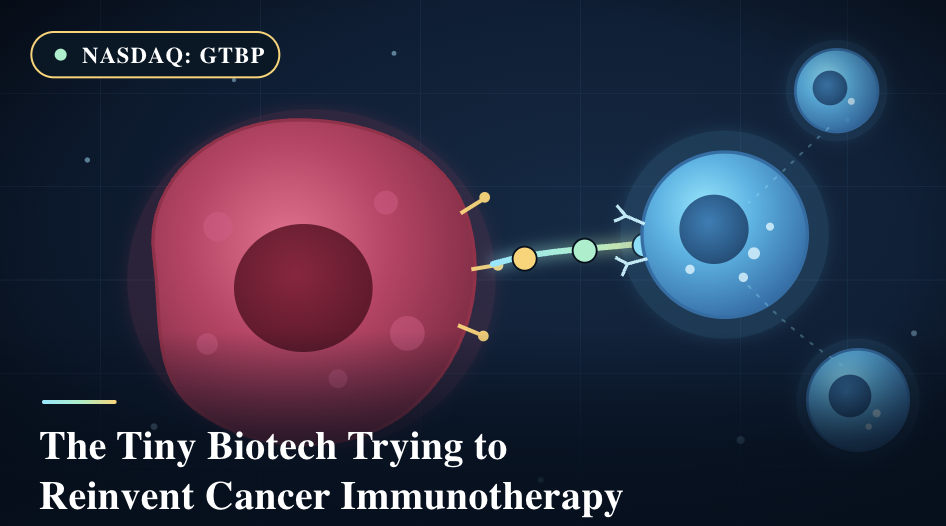
GT Biopharma’s proprietary TriKE platform is designed to recruit and activate the NK cells that already exist inside every patient.
Think of it as the difference between building an entirely new army and simply giving better weapons and clearer instructions to the soldiers already on the battlefield…
You see, each TriKE molecule contains three distinct components working together.
One end attaches to CD16 receptors found on natural killer cells.
The opposite end attaches to proteins expressed on cancer cells.
Between them sits wild-type IL-15, an immune signaling protein that stimulates NK cell proliferation, survival, and persistence.
So, rather than simply telling immune cells where to attack, the molecule also encourages them to multiply and remain active longer.
And that distinction may sound subtle, but it represents an entirely different philosophy of cancer treatment…
GT Biopharma isn’t developing a cell therapy.
It’s developing what could become an off-the-shelf immune engager.
A Simpler Path to Scale
If successful, this approach could solve one of the biggest challenges facing cellular immunotherapy…
Traditional NK cell companies must manufacture living products that require specialized facilities, cold-chain transportation, and careful handling from production to infusion.
But GT Biopharma’s TriKE molecules are recombinant proteins.
That means doctors could theoretically administer them much like other biologic drugs without waiting weeks for customized cell manufacturing.
For investors, that means the company isn’t simply competing with other NK cell developers…
It’s attempting to create a pharmaceutical product that could be easier to manufacture, distribute, and scale worldwide.
And that’s a very different investment thesis…
The Secret Hidden in a Llama
One of the more fascinating aspects of the platform has nothing to do with cancer at all.
It has to do with camels…
More specifically, camelids such as llamas and alpacas naturally produce unusually small antibodies known as nanobodies.
Because they’re significantly smaller than traditional antibodies, these nanobodies can remain stable while reaching biological targets that larger molecules sometimes struggle to access.
GT Biopharma built its second-generation TriKE platform around these camelid nanobodies, creating compact molecules designed to engage natural killer cells while simultaneously targeting cancer cells and delivering IL-15 stimulation.
It’s an unusual technological foundation that differentiates the company from many other small immunotherapy developers.
From Blood Cancers to Solid Tumors
The company’s first clinical efforts focused on blood cancers like acute myeloid leukemia and high-risk myelodysplastic syndrome using GTB-3650.
But now that the groundwork has been laid, management is pursuing a much larger opportunity…
Its newest candidate, GTB-5550, targets B7-H3, a protein expressed across numerous difficult-to-treat solid tumors including prostate, ovarian, pancreatic, breast, bladder, head and neck, and non-small cell lung cancers.
The first patient entered the Phase 1 basket study in May 2026, making GTB-5550 the first dual nanobody TriKE tested using subcutaneous dosing rather than intravenous administration.
And that may not grab headlines today, but it dramatically expands the company’s addressable market…
Instead of pursuing one rare blood cancer indication, GT Biopharma is building a platform that could be adapted across numerous solid tumor types.
A Platform Rather Than a Product
And that’s perhaps the most overlooked aspect of GT Biopharma…
Investors aren’t simply buying a single experimental drug. They’re buying a modular technology platform.
The TriKE architecture allows researchers to swap different tumor-targeting components while preserving the same natural killer cell activation mechanism.
The company already has multiple clinical and preclinical programs targeting blood cancers and solid tumors, illustrating how the platform can be adapted to a wide range of malignancies.
For a micro-cap biotechnology company, that provides multiple shots on goal rather than relying entirely on one make-or-break clinical program.
Why Investors Should Pay Attention
Small biotechnology companies are always speculative investments, and GT Biopharma remains an early-stage clinical company with all the risks that implies…
Clinical failures, financing needs, and regulatory setbacks are common throughout the industry.
But investors looking at GT Biopharma should resist the temptation to classify it as simply another NK cell developer…
The more interesting story is that the company is attempting to remove one of immunotherapy’s biggest bottlenecks.
If today’s generation of NK therapies depends on building immune cells in factories, GT Biopharma is betting tomorrow’s therapies may simply recruit the army already living inside the patient.
That’s an ambitious vision.
And if it works, this little-known biotech could end up changing not just who wins the NK cell race, but how the whole race is run.