It’s not often a budget line item tells you where the world is headed.

But when the U.S. Department of Defense requests $66 billion in IT spending for fiscal 2026 — up $1.8 billion from the prior year — and places artificial intelligence at the top of the priority list across every service branch, it signals something bigger than an incremental upgrade cycle. It signals a strategic shift.

At the same time, industry forecasters are projecting the global AI in defense and aerospace market could expand from $4.2 billion to $42.8 billion by 2036—a tenfold increase powered by autonomous systems and real-time intelligence processing.

Against that backdrop, five companies operating at the intersection of aerospace, AI, and national security are drawing attention: Starfighters Space (NYSE American: FJET), Archer Aviation (NYSE: ACHR), AeroVironment (NASDAQ: AVAV), Redwire (NYSE: RDW), and V2X (NYSE: VVX).

The broader playing field is expanding too. The global space economy reached $626 billion in 2025 and is projected to surpass $1 trillion by 2034, with defense and sovereignty emerging as the dominant growth engines.

Meanwhile, NASA continues building the knowledge base needed for long-duration missions: ISS crew members are conducting real-time cardiovascular monitoring and psychological assessments aimed at preparing humans for deeper spaceflight.

In other words: the intelligence stack is rising, the operational demands are growing, and the aerospace layer is becoming more strategic by the quarter.

Starfighters Space (NYSE American: FJET): From wind tunnel validation to Critical Design Review

Starfighters Space recently announced it is moving forward to a Critical Design Review (CDR) for STARLAUNCH 1, with support from GE Aerospace. The purpose of the CDR is to confirm design maturity and support the program’s transition into its next phase of build and test planning.

In aerospace development, a CDR functions as a structured milestone—an integrated, detailed review of the system’s design—before a program proceeds to full-scale fabrication, integration, and formal test execution. In this case, the review will evaluate design documentation for the launch vehicle and its interfaces with the carrier aircraft, emphasizing configuration control, manufacturability, verification plans, and test readiness.

The CDR milestone builds on Starfighters’ recently completed subsonic and supersonic wind tunnel testing for STARLAUNCH 1. The testing demonstrated clean separation behavior at Mach 0.85 and Mach 1.3 across ten successful runs, with results showing strong agreement between computational fluid dynamics predictions and experimental data. The company has also initiated procurement of instrumented drop test articles to evaluate separation dynamics under actual flight conditions.

“We execute StarLaunch as a series of practical, documented steps to space,” said Tim Franta, Director and VP Development at Starfighters. “A critical design review is where we confirm that the design is ready for the next phase. Our team is dedicated and focused on the mission, and we are staying disciplined as we progress STARLAUNCH 1.”

GE Aerospace support and a supersonic test campaign from Kennedy Space Center

GE Aerospace has supported Starfighters’ StarLaunch development through prior engineering work and flight test activities, including a recent supersonic flight test campaign carrying an advanced propulsion test vehicle during three captive carry missions from Kennedy Space Center. That work supports GE Aerospace’s Atmospheric Test of Launched Air-breathing System (ATLAS) program, focused on advancing solid fuel ramjet propulsion technology, funded by the U.S. Department of Defense under Title III of the Defense Production Act.

STARLAUNCH 1 is being developed as a sub-orbital vehicle designed to support short-duration microgravity missions, serving as a pathfinder for future air-launched concepts. In parallel, Starfighters’ validated separation work supports its broader aerospace testing services, including programs requiring clean separation for advanced and hypersonic vehicle testing.

The company also states it operates the only commercial fleet in the free world capable of carrying underwing test payloads at speeds greater than Mach 2 (more than 1,500 mph)—positioning its F-104 platform as a high-performance testbed for both government and commercial partners.

Archer Aviation (NYSE: ACHR): NVIDIA compute, aviation AI, and “autonomy-ready” controls

Archer Aviation recently announced plans to develop and deploy next-generation AI technologies for aviation using the NVIDIA IGX Thor platform. At CES 2026 in Las Vegas, Archer unveiled three core development areas:

• Real-time sensor fusion for enhanced pilot situational awareness

• Predictive health monitoring for proactive aircraft system maintenance

• Autonomy-ready flight controls pairing IGX Thor computing architecture with Archer’s proprietary avionics and control software to support future autonomous and semi-autonomous operations

“CES has always been a launchpad for technologies that reshape industries, so we’re proud to announce our AI collaboration with NVIDIA here,” said Adam Goldstein, Founder and CEO of Archer Aviation. “NVIDIA’s AI compute capabilities and software stack give us the foundation to accelerate toward safer, smarter aircraft systems and modernize how aviation interfaces with the world’s airspace.”

The company is developing Midnight, a piloted electric vertical takeoff and landing aircraft intended for commercial urban air mobility. Archer holds FAA Part 135 air carrier certification and has secured commercial launch agreements with partners including United Airlines and Soracle, targeting initial commercial operations in select U.S. metro markets.

AeroVironment (NASDAQ: AVAV): AI-accelerated materials and biotech work under a $75M Air Force task order

AeroVironment recently received a $75 million task order from the U.S. Air Force to advance biotechnology and smart materials under the Functional Responsive Experimentation for Systems and Humans (FRESH) program at Wright Patterson Air Force Base in Dayton, Ohio. The period of performance is 60 months.

The effort involves developing and evaluating new materials, processing methods, and modeling techniques to create advanced polymers and responsive materials designed to enhance the performance and resilience of Air Force assets across air, space, and weapons systems, expanding the company’s ongoing work with the Air Force Research Laboratory.

“We’re entering an era where biology and materials science are converging,” said Dr. John Hogan, Vice President of Defense and Interagency Services at AeroVironment. “Our work under this program explores that frontier, creating responsive systems that enhance human performance, reduce maintenance burdens, and ensure operational dominance for the Air Force.”

The company’s research will leverage AI to speed discovery, testing, and environmental evaluation, with applications spanning cognitive and physiological monitoring, flexible electronics, additive smart materials, and synthetic biology. AeroVironment continues expanding its defense technology portfolio beyond its established Switchblade loitering munition and Puma unmanned aircraft platforms.

Redwire (NYSE: RDW): Positioning for homeland defense modernization under SHIELD

Redwire recently announced its selection for the Missile Defense Agency’s Scalable Homeland Innovative Enterprise Layered Defense (SHIELD) contract—an indefinite-delivery/indefinite-quantity contract vehicle with a ceiling of $151 billion.

“Redwire’s proven space and defense technologies, including unmanned aerial systems, advanced sensors, maneuverable spacecraft platforms, and agent-based modeling and simulation, position us to deliver resilient, multi-domain solutions for national security missions,” said Peter Cannito, Chairman and CEO of Redwire. “We are excited to continue advancing capabilities that help protect the homeland and support mission partners across the Department of Defense.”

The company employs approximately 1,300 people across the United States and Europe, focused on aerospace infrastructure, autonomous systems, and multi-domain operations leveraging digital engineering and AI automation, with capabilities spanning unmanned platforms, advanced sensors, and maneuverable spacecraft for government and commercial partners.

V2X (NYSE: VVX): ATSP5 access and defense microelectronics modernization pathways

V2X recently secured a position on Advanced Technology Support Program 5 (ATSP5), a $25 billion multiple-award contract administered by the Defense Microelectronics Activity under the Office of the Secretary of Defense. The program scope includes engineering development from system studies and prototyping through testing, integration, and limited production—covering lifecycle technology support for embedded systems, network-centric warfare systems, and large-scale defense integrations.

“Winning a position on the ATSP5 enables V2X as a leader in transformative engineering solutions,” said Jeremy C. Wensinger, President and Chief Executive Officer of V2X. “Our selection places us at the forefront of defense modernization, allowing us to deliver advanced capabilities that don’t simply respond to threats and system obsolescence, but anticipate and evolve with them.”

The company brings decades of expertise in rapid acquisition, systems engineering, microelectronics supply assurance, and the application of advanced technologies including AI. The ATSP5 program creates pathways for modernization, overcoming obsolescence challenges, extending lifecycle of aging defense equipment, and advancing AI-optimized systems and large-scale AI orchestration capabilities to address emerging threats.


DISCLAIMER: Nothing in this publication should be considered as personalized financial advice. The publisher is not licensed under securities laws to address individual financial situations. This is a digital media distribution and is neither an offer nor recommendation to buy or sell any security. Additional conflict-of-interest and risk disclosures apply.

When Jensen Huang, the CEO of NVIDIA, says something matters, I pay attention…

Not because he’s charismatic or because NVIDIA stock has become a market legend — but because he sits at the choke point of the AI economy. 

He sees what’s coming before almost anyone else.

And recently, Huang said the quiet part out loud: AI doesn’t scale without energy

Data centers can be built. Chips can be produced. Software can iterate at light speed. 

But if the electrons don’t show up on time — reliably, affordably, and in massive quantities — the whole AI boom hits a wall.

That single observation reframes everything…

This isn’t just an AI story anymore. It’s an infrastructure story. 

And not a small one…

What’s unfolding now looks eerily similar to the last time America realized it needed to rewire itself to stay competitive: the birth of the Interstate Highway System.

Back then, the challenge was physical mobility. Today, it’s digital intelligence. 

And just like the highways, whoever builds and controls the infrastructure underneath the transformation will quietly mint fortunes.

From Chips to Kilowatts: The Constraint Nobody Can Ignore

For the last two years, investors have obsessed over GPUs, models, and hyperscalers.

That made sense — at first…

But AI workloads are fundamentally different from anything that came before them. 

Training and inference at scale require constant, uninterrupted, energy-dense power. 

Not occasionally. Not theoretically. Every second of every day.

A single large AI data center can consume as much electricity as a mid-sized American city. 

Now multiply that by hundreds — soon thousands — of facilities.

This is why the conversation has shifted. Quietly at first. Now unmistakably.

AI isn’t compute-limited. It’s power-limited.

And the companies that solve that problem aren’t just supporting the AI boom — they’re defining how big it can get.

The New Interstate System Runs on Electrons

When President Eisenhower pushed the interstate highway vision in the 1950s, it wasn’t framed as an “infrastructure trade.” 

It was framed as national competitiveness, economic efficiency, and security. But those roads also unlocked decades of growth most people now take for granted.

AI infrastructure plays the same role today…

Data centers are the factories of the intelligence age. 

Power generation, transmission, and fuel supply are the highways that connect them. 

And just like the original buildout, this one will favor companies that already own hard assets, permitting expertise, and real-world operating experience.

This isn’t a science project. It’s heavy industry.

Natural Gas: The Backbone Nobody Wants to Admit Is Essential

For all the talk about futuristic energy solutions, the truth is simple: AI needs power now, not in ten years

That’s why natural gas has become the default solution for next-generation data centers.

Gas turbines are dispatchable. They’re scalable. They can be colocated directly next to data centers. 

And — critically — they can be connected straight into existing pipeline infrastructure.

This is why you’re seeing partnerships between data center developers and energy giants like EQT, Williams Companies, and Kinder Morgan. 

These firms don’t just produce gas. They move it, store it, and deliver it with industrial precision.

Some data centers are now being designed with dedicated gas hookups and on-site turbines, bypassing strained electrical grids entirely. 

That’s not a temporary workaround. It’s a structural shift.

In the AI age, energy independence isn’t just geopolitical. It’s computational.

Geothermal: Old Technology, Perfect Timing

If natural gas is the backbone, geothermal may become the sleeper hit…

Geothermal offers something AI desperately needs: constant, baseload power with minimal variability. 

No sun cycles. No wind forecasts. Just heat from the Earth, converted into electricity 24/7.

Companies like Ormat Technologies have been quietly operating geothermal plants for decades. 

And what’s changed isn’t just the technology — it’s the demand profile. AI data centers are uniquely suited to geothermal’s strengths.

Even oil and gas expertise is bleeding into this space, with drilling techniques originally developed for hydrocarbons now being repurposed to unlock deeper geothermal resources. 

This is where the optimistic futurist in me gets excited: legacy energy know-how powering next-generation intelligence.

The result? Cleaner power, long asset lives, and predictable output — exactly what hyperscale AI requires.

Hydropower: Where AI Meets Pure Physics

Hydropower doesn’t get headlines. It doesn’t trend on social media. 

But it works. And it always has.

And for energy-hungry data centers, it’s nearly perfect.

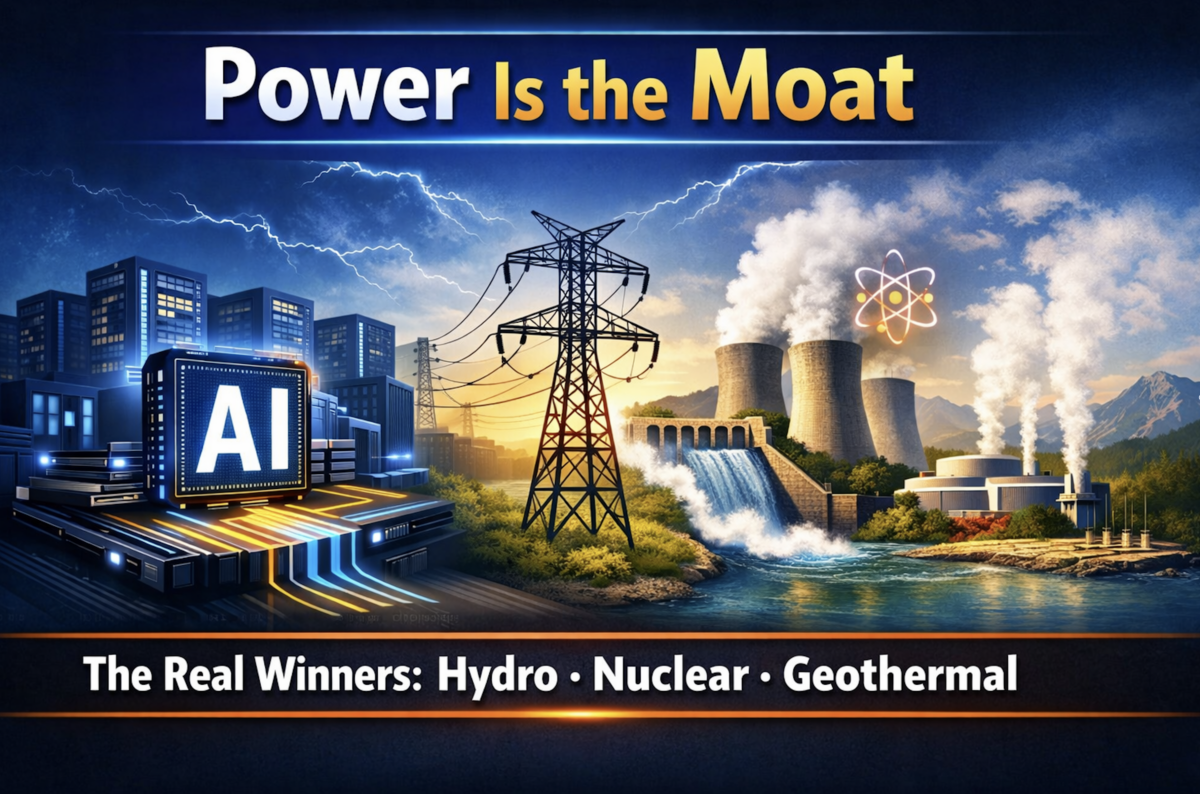
That’s why firms like Brookfield Renewable and NextEra Energy are suddenly far more relevant to the AI story than most investors realize. 

Their hydro assets generate steady, low-cost electricity at scale — exactly what advanced computing needs.

This isn’t about virtue signaling. It’s about physics and economics aligning.

Which brings us to one of the most fascinating examples in the entire space.

Bitzero: Building AI on Water, Not Words

One of the most compelling case studies in AI-powered infrastructure is Bitzero.

Bitzero is building data centers powered primarily by hydropower — clean, consistent, and abundant. 

Instead of fighting grid congestion or scrambling for gas supply, Bitzero situates its operations where energy is already flowing.

This model flips the script…

Rather than asking, “How do we get power to the data center?” Bitzero asks, “Where does the power already exist in excess — and how do we bring AI to it?”

That’s not just smart. It’s inevitable.

As AI workloads expand, data centers will increasingly migrate toward energy sources rather than forcing energy sources to migrate toward them. 

Bitzero is early — but it’s early in the right direction.

The Winners Won’t Look Like Traditional Tech Stocks

Here’s the part most investors still miss…

The biggest winners of the AI age won’t all look like software companies or chip designers. 

Some will look like utilities. Others will look like pipeline operators. A few will look like strange hybrids of energy producer and digital landlord.

Companies like Digital Realty are already repositioning themselves as energy infrastructure platforms as much as real estate plays. 

Hyperscalers like Microsoft are locking in long-term power agreements and even investing directly in generation capacity.

This is what a true platform shift looks like… 

It pulls in industries that once felt boring and makes them mission-critical overnight.

Why This Buildout Will Be Bigger Than Anyone Expects

The Interstate Highway System didn’t just enable transportation. It reshaped cities, commerce, defense, and culture. 

AI infrastructure will do the same.

Energy demand from AI won’t plateau quickly…

Models will get larger. Applications will multiply. Entire industries will become compute-native. 

And every step of that journey pulls more electrons through wires, pipes, turbines, dams, and wells.

That’s why this isn’t a trade. It’s a generational investment theme.

The optimistic futurist in me sees something profound here: a reindustrialization of America driven not by fear, but by ambition. By the desire to build intelligence at scale. 

And by the realization that the future still runs on very real, very physical infrastructure.

The Quiet Conclusion Most Investors Haven’t Reached Yet

AI is not just software eating the world.

It’s energy reshaping it.

Those who understand that now — before the headlines catch up — have a rare opportunity to position themselves on the right side of history. 

The companies supplying the power behind artificial intelligence won’t just benefit from the boom.

They’ll define how big it can become.

And that’s where some of the most enduring fortunes of the next decade will be built.

The last two weeks were a textbook example of silver has always been a metal of extremes

After surging above $100 an ounce in late January, silver suffered one of the sharpest reversals in modern market history. Futures plunged more than 30% in a single session — its steepest daily drop since 1980— falling into the high-$70s and low-$80s. The move was violent enough to feel less like an ordinary correction and more like a market clearing event.

For mining investors, the key question is not whether silver is volatile. It always is.

The question is whether this kind of flush marks the end of a speculative episode or the beginning of the more durable part of the cycle, when equities finally start to reflect fundamentals.

The Blowoff Top Nobody Missed

Silver’s Epic Washout May Be the Setup Investors Wait For

Silver didn’t simply drift upward. 

It went parabolic.

Reuters noted that silver vaulted above $100 amid a mix of retail enthusiasm, momentum-driven buying, and ongoing tightness in physical markets—conditions that technicians warned were positioning the metal for a “major correction.”

That correction arrived on cue.

Barron’s tied the selloff to shifting macro expectations after President Trump’s announcement of Kevin Warsh as his nominee for Federal Reserve Chair, which strengthened the U.S. dollar and triggered a sharp reassessment of the “hard asset” trade. 

Gold also fell heavily, but silver — more speculative and thinner — broke hardest.

In other words, this wasn’t fundamentally about solar panels or jewelry demand on a given Tuesday. 

It was positioning plus macro.

Silver tends to behave that way at inflection points: part money, part commodity, part casino chip.

The Important Point: The Metal Crashed, But the Story Didn’t

Silver’s fundamentals did not suddenly flip from deficit to surplus because the price dropped.

Silver remains constrained by a structural problem: it is not primarily mined for itself. 

Most silver production comes as a byproduct of lead-zinc, copper, and gold mining. 

That means supply doesn’t respond quickly to price spikes. 

You can’t just “turn on” silver production the way you might with a pure-play shale patch.

At the same time, industrial demand has become the dominant driver. 

Barron’s recently highlighted that industrial use now accounts for roughly 60% of silver demand, tying the market increasingly to electronics, solar, medical applications, and electrification rather than purely monetary hoarding.

The market has also been running persistent deficits. 

Multiple industry analyses put the annual shortfall in the neighborhood of 160–200 million ounces in recent years—large enough that it can’t be dismissed as noise.

That’s the underlying tension: a metal with an industrial bid and constrained supply, trading in a market that periodically becomes overwhelmed by speculative leverage.

Miners: The Mispriced Second Derivative

This is where the investor’s pimary opportunity often lies — not in predicting silver’s next $10 move, but in understanding operating leverage.

Even after the crash, silver is still vastly above the cost structure of primary miners.

Barron’s notes that major silver producers are already highly profitable, with average all-in sustaining costs (AISC) in the range of roughly $20–$25 per ounce.

Do the math.

At $80 silver, a miner with $25 AISC is printing margins that most commodity producers can only dream of. 

Even at much lower prices, quality assets remain cash-flow positive. 

This is not the 2015 silver bear market where producers were scraping by.

That’s why these washouts can create a disconnect: the metal price collapses, but the underlying economics of the mining business remain extremely strong.

And crucially, equities often lag in both directions.

During the blowoff phase, miners may not keep up because investors distrust the sustainability of the price. Then, during the crash, miners get hit as if profitability disappeared overnight.

That’s when the risk/reward starts to tilt.

This Was a Leverage Event, Not a Mining Event

It’s important to separate silver’s macro drivers from mining fundamentals.

The recent plunge was tied to monetary expectations, dollar strength, and the unwinding of the “debasement trade,” according to coverage of the Fed chair nomination shock.

The deficit narrative, industrialization of demand, and high profitability of producers remain intact.

So for investors, the question becomes: are you trading silver as a macro instrument, or investing in miners as businesses?

Those are different games.

If you’re a trader, you care about technical damage, liquidation cascades, and whether the metal can reclaim key psychological levels like $100.

If you’re an investor, you care whether the selloff hands you strong assets at discounted multiples while margins remain historically extreme.

The Cleanest Way to Think About Silver Miners Now

There are three buckets:

  1. Streamers and royalty companies (the defensive core)
    Lower operational risk, steadier economics, and built-in diversification. These businesses don’t face the same cost inflation, permitting friction, or execution risk as operators. They offer durability across cycles, with meaningful exposure to higher silver prices—but typically with less explosive upside torque than miners.
  2. Tier-one producers with strong balance sheets (the quality compounders)
    These are the anchors of the sector: profitable operators with long-life assets, disciplined capital allocation, and the ability to self-fund expansion. In downturns, they can buy distressed projects instead of diluting shareholders. In upcycles, they generate enormous free cash flow and often lead the institutional bid.
  3. High-quality juniors and emerging developers (the asymmetric upside tier)
    This is where the upside can become truly explosive. Smaller miners and late-stage developers often get punished most during volatility—not because their projects are broken, but because risk capital exits indiscriminately. In a sustained silver upcycle, that dynamic can reverse fast. The right junior—with scale, permitting momentum, credible management, and a clear path to production—can rerate by multiples, not percentages.

A post-bubble flush isn’t the time to chase weak stories. It is the time to identify the juniors with real ounces, real economics, and a realistic runway—because that’s where the next leg of the silver cycle can create outsized equity returns.

Bottom Line

Silver just delivered one of its most dramatic reversals in decades, with a one-day collapse rivaling historic episodes.

But mining investors should not confuse volatility with fundamentals.

The physical market still shows signs of tightness. Structural deficits remain widely cited. Industrial demand is now the center of gravity. And primary miners, even after the crash, are operating with cost structures that leave them deeply profitable.

The metal had a speculative blowoff. The air came out violently.

Now comes the more interesting phase: whether disciplined capital starts flowing into the companies that can turn $80 silver into real cash flow rather than hype.

That’s usually where mining fortunes are made.

When U.S. special operations forces moved into Venezuela to capture long-time strongman and narcoterrorist Nicolás Maduro, the most important part of the operation didn’t involve a rifle, a missile, or even a drone…

It happened quietly, invisibly, and instantly. Venezuela’s electric grid went dark. 

Communications failed. Confusion spread. The battlefield was shaped before most people even realized a battle had begun.

Whether the blackout was caused by a direct cyberattack, electronic warfare, or a coordinated mix of digital and physical actions almost doesn’t matter. 

When the Lights Go Out, Wars Are Already Being Won

What matters is what it represented: the modern battlefield opens in cyberspace… 

Control the data, the power, and the networks, and everything else becomes easier. 

Soldiers move faster. Aircraft fly safer. Resistance collapses before it can organize.

This wasn’t science fiction. It wasn’t a movie plot. 

It was a real-world demonstration of how wars are fought in the 21st century — and why investors who still think defense is only about tanks and jets are missing the bigger picture.

From Bullets to Bits: Why the Battlefield Has Gone Digital

Every modern society runs on software… 

Electricity grids, pipelines, ports, hospitals, financial systems, transportation networks, and military command structures all depend on interconnected digital systems. 

And that reality has quietly rewritten the rules of conflict.

You no longer need to invade a country to cripple it… 

You don’t need to bomb a power plant if you can shut it down remotely. You don’t need to destroy a communications hub if you can blind it digitally. 

Cyberwarfare allows states to project power with deniability, speed, and scale that conventional weapons simply can’t match.

The United States understands this. So do its adversaries… 

China, Russia, Iran, and North Korea have spent years building cyber units designed not just to steal data, but to disrupt daily life in rival nations if conflict escalates. 

The Venezuelan operation wasn’t an anomaly. It was a preview.

The Double-Edged Sword: How AI Supercharges Both Attack and Defense

Artificial intelligence has poured gasoline on this fire in the past few years… 

On offense, AI can automate reconnaissance, identify system vulnerabilities, generate adaptive malware, and evolve attacks in real time to evade detection. 

Tasks that once required teams of human hackers can now be executed at machine speed, around the clock.

On defense, AI is just as transformative…

Machine-learning systems can analyze vast oceans of network traffic, detect subtle anomalies humans would never notice, and respond instantly to threats before damage spreads. 

AI doesn’t get tired. It doesn’t miss patterns. And it doesn’t wait for permission when milliseconds matter.

This is what makes cyberwarfare so dangerous — and so investable… 

The arms race isn’t slowing down. It’s accelerating. 

Every advancement on offense forces an equal or greater investment on defense, and that cycle feeds capital into cybersecurity and AI platforms year after year.

America’s Advantage — and Its Greatest Vulnerability

The United States currently holds a significant advantage in cyber capabilities… 

It has the deepest talent pool, the most advanced AI ecosystem, and the tightest integration between military, intelligence, and private-sector innovation. 

That’s what makes operations like Venezuela possible.

But that same technological openness is also America’s greatest vulnerability… 

The more digitized the economy becomes, the more surface area exists for attack. 

Power grids, pipelines, hospitals, financial networks, and data centers are all attractive targets precisely because they are essential to daily life.

That means cyber defense is no longer a military-only concern…

It’s a national economic priority. And increasingly, it’s a boardroom issue for every major corporation.

China, Russia, Iran, and North Korea Aren’t Catching Up — They’re Already Here

One of the biggest mistakes investors make is assuming cyber threats are hypothetical or futuristic. They’re not… 

State-sponsored hacking groups tied to U.S. adversaries are already probing American infrastructure every single day. 

Most of those attempts fail. But some don’t. And the ones you hear about publicly are usually the least damaging compared to what remains classified.

Cyber conflict rarely comes with a declaration of war. 

It arrives quietly, persistently, and asymmetrically. That makes it harder to price into markets — and more valuable for investors who understand the trend early.

As geopolitical tensions rise, cyber retaliation becomes the lowest-cost, highest-impact response. 

That reality virtually guarantees sustained spending on digital defense, regardless of which party controls Congress or the White House.

Critical Infrastructure Is the New Front Line

In traditional wars, civilians were often collateral damage. In cyberwarfare, civilian infrastructure is the battlefield. 

Power, water, healthcare, transportation, and communications systems are not side targets — they are primary objectives.

That changes how governments think about security spending… 

Protecting infrastructure isn’t optional. It’s existential. 

And because most infrastructure is operated by private companies, those companies are now effectively part of national defense strategy.

For investors, this matters deeply… 

Cybersecurity is no longer discretionary IT spending that gets cut during downturns. 

It’s becoming a permanent line item, embedded into operating budgets the same way insurance once was.

Cybersecurity Becomes Non-Discretionary Spending

Every successful cyberattack strengthens the investment case for defense. 

Boards don’t ask whether they should spend on cybersecurity anymore. They ask whether they’re spending enough. 

Regulators demand it. Insurers require it. Customers expect it.

Add AI into the mix, and the moat around leading cybersecurity platforms gets wider… 

Companies that can integrate AI into threat detection, response, and resilience become deeply embedded in their customers’ operations.

Switching costs rise. Contracts get longer. Revenues become stickier.

That’s exactly the kind of setup long-term investors should be looking for.

Defense Spending Is Evolving — Not Shrinking

There’s a persistent myth that defense spending is cyclical or politically fragile. 

In reality, it evolves. Money doesn’t disappear. It moves. 

And today, it’s flowing toward software, AI, cloud security, data analytics, and cyber resilience.

Jets and missiles still matter, but wars are increasingly won before those are even fired. 

Digital dominance sets the stage. That’s why governments are pouring money into cyber commands, AI research, and partnerships with private cybersecurity firms.

This isn’t a temporary surge. It’s a structural shift.

The Investor’s Dilemma: Ignore the Invisible War or Profit from It

Cyberwarfare doesn’t look dramatic on the evening news until something breaks. 

But by the time it does, the investment opportunity is already well underway. The quiet wars create the loudest profits for those positioned early.

If the lights going out in Caracas taught us anything, it’s that power in the modern world isn’t just measured in firepower… 

It’s measured in code. And code, increasingly, is where capital is flowing.

The Bottom Line: The Quiet Wars Create the Loudest Profits

Cyberwarfare and AI are not fringe technologies. They are the backbone of modern security and modern markets. 

As nations race to protect themselves and project power digitally, investors have a rare chance to align with an unstoppable trend.

The next great defense boom won’t be announced with explosions… 

It will unfold quietly, line by line, in software updates, AI models, and secured networks. 

Those who understand that shift — and invest accordingly — stand to benefit long before the rest of the world catches on.

If you want a modern cancer story with real “before and after” chapters, CAR T-cell therapy deserves top billing… 

It’s one of the clearest demonstrations we’ve ever seen that the immune system can be reprogrammed to identify and destroy malignant cells—especially in certain blood cancers. 

CAR T: The Miracle That Comes with a Catch

Major cancer centers now describe CAR T as a treatment that can deliver dramatic responses for patients who have exhausted conventional options. 

But the magic trick has a price tag, and it’s not just financial—it’s logistical.

You see, most of the widely used CAR T approaches are autologous, meaning the therapy begins with yourT-cells, collected from your bloodstream, shipped to specialized facilities, genetically modified, expanded, tested, and shipped back for infusion. 

That personalization is part of what makes CAR T powerful… and part of what makes it painfully inefficient.

Manufacturing and quality control can create a long “vein-to-vein” timeline that’s often measured in weeks or even months.

And the complexity of producing patient-specific batches is one of the core reasons CAR T is so expensive. 

In other words: CAR T is a breakthrough, but it’s a breakthrough that behaves like a bespoke luxury product when what patients really need is something that scales like a modern medicine.

Why CAR T Is So Hard to Scale

CAR T isn’t “one therapy.” It’s closer to a category of therapies…

They have different targets, different cancers, different constructs, and different manufacturing steps. And the body doesn’t always react quietly.

CAR T’s potency is tied to immune activation, which is why serious toxicities like cytokine release syndrome (CRS) and neurologic effects (ICANS) have been major areas of monitoring and management. 

That doesn’t necessarily make CAR T “bad.” It just means we’re dealing with a therapy that can be so powerful it sometimes kicks off an immune storm.

Then there’s the practical reality: many patients who need these therapies are very sick, and time is not a friendly variable… 

Even if manufacturing only takes weeks (and not months), you’re still asking a patient’s disease to pause politely while the therapy is being built.

So the field has been chasing the obvious next question:

What if we could get most of the cancer-killing punch without rebuilding the therapy from scratch for every single patient?

Enter NK Cells: The Immune System’s Built-In Hit Squad

Natural Killer (NK) cells are part of the immune system’s innate “rapid response” team… 

While T-cells are often framed as the highly trained detectives—slow to mobilize but incredibly specific—NK cells behave more like highly armed patrol units. 

They can recognize signs of cellular stress and abnormality and respond quickly.

Here’s why that matters for the next wave of “cancer hunting” therapies…

Researchers have been exploring allogeneic approaches (donor-derived, standardized) using NK cells because NK biology tends to carry a lower risk of some of the most feared complications seen with T-cell approaches. 

A major review in Blood notes that, compared with T cells, NK cells show remarkably reduced CRS and neurotoxicity signals in many settings.

And importantly, NK cells do not cause graft-versus-host disease the way donor T-cell therapies can. 

That’s the north star… An immune therapy that can be produced in larger standardized lots, deployed more quickly, and potentially delivered with a friendlier safety profile.

GT Biopharma’s Angle: Don’t Replace the Immune System—Aim It

When people hear “NK therapy,” they often imagine “CAR-NK” cells—NK cells engineered with CAR receptors, similar in spirit to CAR T. And that is one branch of the field.  

But it’s not the only one…

Companies like GT Biopharma (NASDAQ: GTBP) are taking a different, very “engineering” approach.

GT Bio calls this TriKE® molecules—short for Tri-specific Killer Engagers—designed to bring NK cells and tumor cells into the same fight and keep NK cells activated.

According to GT Biopharma’s pipeline overview, one of its lead programs, GTB-3650, is built from three functional parts:

  1. a binding domain aimed at CD16 on NK cells,
  2. a tumor-targeting domain aimed at CD33 (common in certain leukemias), and
  3. IL-15, an immune cytokine meant to help activate and expand NK function. 

The concept is simple to describe but difficult to perfect: create a bridge that physically links NK cells to cancer cells…

And include a “battery pack” (IL-15) that helps keep the NK cell switched on. 

GT has also described additional TriKE candidates in development that aim at other targets, including B7H3 (often discussed in solid tumor contexts) and CD19 (a well-known target in blood cancers). 

That’s important, because it reveals a much bigger ambition…

If the platform works, it can potentially be re-aimed across multiple disease settings without reinventing the whole wheel every time.

The Core Contrast: Custom-Built Cellular Weapons vs. Scalable Immune “Guidance Systems”

So how do you frame CAR T vs NK-focused approaches like this?

CAR T is like building a custom guided missile from the patient’s own materials…

It’s highly specific, often extremely potent, but slow and expensive to manufacture at individual scale. 

The complexity and patient-specific nature are central to the cost and access barriers. 

NK strategies—especially those aiming for “off-the-shelf” scalability—are trying to deliver something closer to a mass-producible system

These are therapies that could be standardized, distributed, and administered without rebuilding the product for every patient. 

Broader clinical research coverage continues to emphasize the promise and momentum around off-the-shelf NK approaches. 

And GT Biopharma’s TriKE concept, specifically, is less about manufacturing a patient-specific cell product and more about deploying a biologic “connector + activator” that recruits the patient’s existing NK cells (and potentially improves their kill function) against a defined cancer target.

If that works at scale—if the efficacy holds up and safety remains manageable—it could represent a very different access curve than autologous CAR T.

Why This Could Be the Bigger Breakthrough

If CAR T proved immune engineering can work, NK-based “hunter” strategies could prove immune engineering can work for far more people.

The “bigger breakthrough” isn’t necessarily about replacing CAR T or claiming NK strategies are automatically superior in every cancer. Instead, the breakthrough would be this:

  • Faster deployment (less waiting for bespoke manufacturing) 
  • Potentially improved tolerability compared with T-cell driven approaches in many settings 
  • Broader scalability that could expand patient access in real-world healthcare systems (where a “miracle therapy” doesn’t help much if only a small slice of patients can realistically receive it)

And beyond the patient impact, there’s a commercial reality…

Therapies that can be produced and delivered more like conventional medicines tend to have clearer paths to distribution, reimbursement, and global scaling.

Now, none of that guarantees success… 

These are still developing programs, and oncology has a long history of “promising mechanisms” that stumble in trials. 

But the direction of travel is clear: the field wants the power of CAR T without the bottlenecks.

Our Advice: Follow the Hunters

We’re watching the immune system get upgraded in real time.

CAR T-cells opened the door—showing that cellular therapies can produce real, durable outcomes. 

Now the next wave is trying to make “cancer hunting” immune therapies faster, more scalable, and potentially safer, with NK-cell approaches…

Like off-the-shelf NK therapies broadly and NK-engager platforms like GT Biopharma’s TriKE programs—pushing the frontier forward. 

So, if you want to stay ahead of where cancer treatment is heading, don’t just follow the next drug… 

Follow the platforms—the teams building these cellular and immune-engaging systems, the trial readouts, and the partnerships that signal real momentum.

Bottom line: learn the difference between CAR T and NK-based approaches and keep a close eye on who’s turning “immune miracles” into scalable medicine.

Let’s be honest: America doesn’t have a healthcare system… It has a sick care system.

We wait until people are coughing blood, limping into ERs, or collapsing at work before we intervene—and then we act shocked when the bill comes due. 

Every year, we spend trillions of dollars patching people up when a fraction of that could’ve kept them healthy in the first place.

It’s like waiting for your car engine to seize before you ever think about changing the oil.

The problem can’t be completely blamed on a lack of medical innovation or political will, either. It’s that the entire system is reactive instead of proactive. 

We treat disease after it happens, rather than preventing it from happening at all. And it’s killing both our citizens and our budget.

But that’s starting to change—and one of the biggest revolutions is happening in how we detect disease before it ever gets a chance to take root…

The Deadliest Cancer You Don’t See Coming

Take lung cancer… 

It’s the leading cause of cancer deaths worldwide—responsible for more than 1.8 million deaths every year. 

In the U.S. alone, it kills about 125,000 people annually. That’s one person every four minutes.

What makes lung cancer so devastating isn’t that it’s hard to treat—it’s that we rarely catch it early enough to treat at all.

When it’s found in its earliest stages—before it spreads beyond the lungs—patients have a five-year survival rate of over 60%. But once it advances, that number drops below 10%.

The tragedy is that those early-stage cancers can be detected. We have the technology. 

We just don’t use it…

Why So Few Get Screened

Unlike breast cancer, where mammograms are easy, fast, and widely available, screening for lung cancer involves a low-dose CT scan. 

That means radiation exposure, specialized machines, scheduling headaches, insurance approvals, and often an out-of-pocket bill that makes people think twice.

As a result, only about 6% of eligible Americans get screened for lung cancer. Compare that to the +75% compliance rate for breast cancer screening, and the gap is staggering.

It’s not that people don’t care—it’s that the system makes it inconvenient, intimidating, and sometimes expensive.

So, we wait. And by the time doctors do find the tumor, it’s often already spread too far to cure.

It’s a grim loop of human hesitation and logistical failure that costs tens of thousands of lives each year—and billions of dollars that could have been saved with earlier intervention.

The Financial Black Hole of Late Detection

The economics are brutal…The United States spends roughly $17 billion a year treating lung cancer. Globally, the cost exceeds $180 billion.

And that’s not counting lost productivity, family income, or the cost of long-term care for survivors.

What’s worse, the majority of this money goes to treating advanced disease—the hardest kind to cure and the most expensive kind to fight.

Late-stage lung cancer often requires surgery, radiation, chemotherapy, targeted therapies, immunotherapy—the full arsenal of modern medicine. 

And even then, the results are often heartbreaking.

Meanwhile, the price of catching lung cancer early—when it’s a small, localized mass easily removed or targeted—is a fraction of that.

Every dollar spent on early detection saves three to five dollars in later treatment costs. Multiply that across millions of people, and the potential savings are staggering.

But this isn’t just about economics… It’s about human life. 

The father who never got screened because he didn’t have time. The mother who thought her cough was allergies… 

The millions of people who could’ve lived decades longer if only the tests were easier to take.

Making Screening Simple: The Next Great Breakthrough

That’s where the next wave of medical innovation comes in—not in miracle cures, but in better, simpler diagnostics.

Imagine being able to detect lung cancer from a quick breath test, or a drop of blood, or even a saliva sample… 

No CT scans. No radiation. No insurance red tape. 

Just a quick, painless test you could take during a regular doctor’s visitor even at home.

That’s the frontier researchers are racing toward right now.

They’re building technologies designed to find the earliest chemical signatures of disease—long before symptoms appear. 

And if one of these breakthroughs proves reliable enough to replace or supplement CT scans, it could completely change how we fight not just lung cancer, but disease itself.

When testing becomes simple, compliance skyrockets. And when compliance skyrockets, early detection follows. That’s when survival rates soar—and costs plummet.

The Ripple Effect: Patients, Systems, and Investors Win

This isn’t just a medical milestone—it’s an economic one…

Healthcare spending in the U.S. now makes up nearly 20% of GDP. And most of that goes toward managing chronic and advanced disease.

If early detection technologies can shift even a portion of that spending toward prevention, the savings could reach hundreds of billions annually.

And it’s not just patients and taxpayers who benefit…

The companies pioneering these diagnostic tools stand on the edge of a potential gold rush in healthcare innovation. 

Because when you create a test that saves both lives and money, you’re not selling a product—you’re reshaping an entire system.

These technologies could be deployed not just for lung cancer, but across the board—for heart disease, diabetes, Alzheimer’s, even viral outbreaks.

Early detection is the universal key to both longer life and lower costs. 

The first company to make it truly practical could go down in history as the one that turned “healthcare” back into care for health.

The Beginning of the End—for Lung Cancer

For now, lung cancer remains a monster.

It’s stealthy, it’s deadly, and it’s been beating humanity for far too long. But the tide is turning. The tools to catch it early, cheaply, and easily are within reach. 

When they arrive—and they will—the ripple effects will extend far beyond oncology.

We’re talking about the dawn of proactive medicine—a healthcare system built not around hospitals and disease, but around prevention…

One where the most common reason you visit a doctor isn’t to fix what’s broken, but to confirm you’re still running at peak performance.

That’s not just a better world—it’s a cheaper one, too. And for investors with the foresight to see where the future of medicine is heading, it could also be a much more profitable one.

Final Thoughts: Prevention Is the Real Cure

The political debates over healthcare will keep raging—who’s covered, who pays, who profits—but none of that changes the underlying truth:

If we want to cut costs and save lives, we must stop waiting for people to get sick.

Lung cancer is just the first battleground in this larger war. Win this one, and we unlock the blueprint for detecting—and eventually defeating—countless other diseases before they even begin.

Because in the end, the smartest investment any nation, company, or individual can make isn’t in treating disease… It’s in preventing it.

So, we urge you to learn more about the breakthroughs reshaping how we detect and prevent deadly diseases. 

The end of lung cancer is only the beginning—and those who see this medical revolution coming could profit just as much as the patients who survive because of it.

We’re entering an era where the most valuable doctor in the room may not have a stethoscope slung around their neck — but rather a processor humming away in the background. 

Artificial intelligence, once dismissed as a tech-sector curiosity, has officially broken into one of humanity’s most sacred institutions: healthcare.

The Doctor (and the Algorithm) Will See You Now

And it’s not dipping its toes in either. AI is diving headfirst into everything from patient care to drug development… 

Imagine a physician’s assistant that never forgets a single detail about your medical history. 

Or an AI-powered system that flags a potential heart condition before it turns into a heart attack. 

That’s not science fiction anymore — that’s Tuesday morning in the not-so-distant future.

And for investors who know how to spot generational opportunities, this isn’t just exciting. It’s potentially lucrative on a scale we haven’t seen since the birth of biotech.

Data Doctors: The Rise of AI-Enhanced Care

Think about what overwhelms the average physician: mountains of patient data, lab results, scans, treatment notes, insurance claims. 

No human can realistically process and recall every byte of data for every patient they’ve ever seen. But an AI can.

Companies like Tempus are leading the way here, building platforms that harness vast amounts of clinical and molecular data to help doctors make better treatment decisions in real time. 

This isn’t a theory, either… 

Tempus is already working with thousands of physicians and hospitals, turning raw data into personalized insights that improve cancer treatment outcomes.

That’s like having Dr. House, Watson, and your personal health coach rolled into one — except without the grumpy bedside manner. 

The result? Doctors making better decisions faster, and patients receiving care that’s tailored with surgical precision.

Supercharged Research: How AI is Accelerating Drug Discovery

If AI in the doctor’s office sounds revolutionary, wait until you step into the laboratory… 

Traditional drug development is notoriously slow and expensive. On average, it can take a decade and billions of dollars to bring a single new drug to market.

But AI is rewriting that timeline in real time… 

Exscientia, a U.K.-based biotech firm, has already advanced multiple AI-designed drug candidates into clinical trials. Its algorithms can run through trillions of molecular combinations, narrowing down to the handful most likely to work in the real world.

Meanwhile, tech giants are also muscling in… 

NVIDIA, the same company that powers the AI boom in data centers, is now powering healthcare innovation through its BioNeMo platform. 

This suite of AI models is designed specifically for drug discovery and genomics, making it possible to simulate how drugs might interact with the body — at a speed no traditional lab can match.

We’re talking about turning what used to be years of trial-and-error into months of targeted discovery. 

The ripple effect? Treatments for diseases that once looked impossible to crack suddenly come into reach… 

And investors backing the right companies could see biotech-level returns at AI speeds.

Early Warnings, Lifesaving Outcomes

Perhaps the most heartening role AI plays in healthcare is in disease detection…

Algorithms are being trained to spot patterns in scans, blood tests, and even subtle changes in voice or movement that humans might miss.

AI can already detect certain cancers at earlier stages than traditional methods…

It can predict complications in diabetic patients before they spiral… 

It can even flag heart irregularities before they turn deadly.

In fact, tech leaders like Google’s DeepMind have demonstrated AI systems that outperform radiologists in reading mammograms, while startups are focusing on everything from stroke detection to rare neurological diseases.

This isn’t just about cutting costs or improving efficiency. It’s about saving lives on a massive scale. 

Imagine a healthcare system where diseases are treated before they become life-threatening. That’s not just good medicine — it’s a revolution.

And revolutions, as history shows us, tend to create outsized profit opportunities for those who get in early.

Why Investors Should Pay Attention Now

Every so often, a new technology comes along that redefines an entire industry. 

The internet did it for media. Smartphones did it for communications. AI is about to do it for healthcare.

And the market potential is staggering… 

We’re talking about a global healthcare industry worth trillions — one that’s being systematically reshaped by AI’s ability to process, predict, and personalize. 

Big pharma is already partnering with AI companies — Pfizer, Sanofi, and Roche have all inked deals with AI startups to speed up drug discovery.

Right now, investor participation is still relatively small…

Many people see “AI in healthcare” as buzzwords instead of bottom lines. That’s the exact kind of misunderstanding that creates early-stage opportunities for bold investors.

The Optimistic Future of Medicine

Here’s the most exciting part: AI in healthcare isn’t about replacing doctors. 

It’s about empowering them — giving every physician the memory of a supercomputer, the research speed of a thousand labs, and the diagnostic accuracy of a million second opinions.

It’s about reducing costs while improving outcomes. It’s about a world where your doctor doesn’t just know your medical history — they can use AI to predict your medical future.

And it’s about ensuring that diseases which once carried a death sentence may soon be managed, treated, or even cured.

That’s a future worth investing in.

The Bottom Line

Artificial intelligence is no longer confined to data centers and tech startups. It’s operating in hospitals, labs, and research institutions across the world. 

From AI-powered physician assistants like Tempus, to drug discovery engines like Exscientia, to computing giants like NVIDIA building the digital foundation, this technology is quietly building the framework for a healthier tomorrow.

Investors who see the writing on the wall — and more importantly, the code on the screen — have a rare chance to back companies that will not only make fortunes but also improve millions of lives.

So don’t stop here. Dig deeper. 

Keep learning about the ways AI is reshaping healthcare, and keep your eyes on the companies leading this charge. 

Because in this future, health is wealth — and AI is the bridge between the two.

While missiles were in the air, Israeli and Iranian cyber units were busy probing each other’s networks, searching for vulnerabilities, and in some cases, landing devastating blows.

Iran, long accused of sponsoring cyber campaigns across the Middle East, attempted to disrupt Israeli infrastructure, targeting both civilian and military systems.

Israeli cybersecurity officials reported waves of denial-of-service (DDoS) attacks on public institutions, phishing attempts aimed at military personnel, and probing strikes on critical infrastructure like power grids and water systems.

But Israel was hardly just playing defense…

For years, its military doctrine has treated cyberspace as a central battlefield, no different than land, air, or sea. In this latest confrontation, that investment paid off. 

Israeli cyber units are believed to have infiltrated Iranian communications networks, disrupted drone command systems, and even tampered with logistics software that slowed Iran’s ability to coordinate retaliatory strikes.

Cyber Strikes in the Shadows

Let’s zoom in on some of the action:

  • Iran’s Opening Salvos: Early in the conflict, Iranian hackers tried to flood Israel’s financial networks with traffic designed to shut down trading systems. It made headlines but fizzled quickly. Israel’s digital defenses absorbed the blow without significant disruption.
  • Israel’s Counterpunch: Within days, reports surfaced of major outages in Iranian government websites, particularly those connected to its defense apparatus. These weren’t random takedowns; they were precision strikes aimed at paralyzing Tehran’s response capabilities.
  • The Infrastructure Gambit: Iran attempted to compromise Israel’s water system controls — a repeat of earlier efforts that once tried to poison municipal supplies with chemical overflows. This time, Israeli cyber teams spotted the breach and neutralized it in real time. The attempted strike made headlines, but the failure underscored just how far ahead Israel remains.
  • Drone Disruption: Perhaps most crucially, Israeli cyber specialists are believed to have hacked into Iranian drone communications mid-flight, jamming signals and forcing them to crash harmlessly in the desert. Shooting down drones with missiles is expensive. Crashing them with code? That’s cost-effective genius.

What emerged from these tit-for-tat attacks was a clear narrative: Iran could launch plenty of cyber missiles, but Israel could shoot them down — and fire back with smarter, sharper ones.

Why Israel Won the Digital Battle

Israel’s advantage didn’t come overnight, mind you. It’s the result of years — decades, really — of investment in cybersecurity as a pillar of national defense. 

The country has cultivated one of the most advanced cyber ecosystems on the planet, blending military training, academic research, and private-sector innovation.

The Israeli Defense Forces’ fabled Unit 8200, its elite cyber intelligence division, has produced not only state-of-the-art military hackers but also the founders of countless successful cybersecurity startups. 

These companies, from Check Point Software to newer players in cloud and network defense, don’t just make products — they train the very people who defend Israel’s digital borders.

That synergy between the private and public sectors explains why, when the digital bullets started flying this summer, Israel could repel Iran’s strikes and respond with pinpoint precision. 

Iran has hackers. Israel has a cyberwarfare machine.

Cybersecurity Is National Security

Now, let’s bring it back home… 

For nearly a decade, we’ve been hammering away at one simple message: cybersecurity isn’t just about stolen passwords, hacked email accounts, or some poor sap losing his crypto wallet. It’s about national security.

The summer’s Iran-Israel conflict proved that point in real time.

Think about it: If an adversary can shut down a power grid, poison a water supply, cripple financial exchanges, or blind military radar systems — they don’t need to fire a single missile to inflict chaos. 

Cyberwarfare is cheaper, stealthier, and in many cases more devastating than traditional weapons.

And while Israel has shown how effective a strong cyber shield can be, the United States is staring at its own vulnerabilities… 

Our electric grid, our healthcare networks, our transportation systems — all increasingly connected, all increasingly exposed. 

The Colonial Pipeline hack a few years back was just a taste of what could happen in a real war.

The Coming Surge in Cyber Defense Spending

Here’s the takeaway investors need to leave with: Washington is watching.

Every Pentagon strategist who reviewed this summer’s conflict came away with the same conclusion — future wars will be fought on two fronts: the physical battlefield and the digital one. 

And if the U.S. doesn’t harden its cyber defenses now, it risks being caught flat-footed when the next digital blitz arrives.

That means money. Lots of it. 

Defense budgets will increasingly funnel toward companies that can secure communications, harden infrastructure, and build tools to repel cyberattacks. 

It’s not just about tanks and planes anymore. It’s about firewalls, AI-powered detection systems, and software that can jam enemy drones before they even take off.

We’ve already seen hints of this shift, with federal contracts flowing toward big cybersecurity names like Palo Alto Networks, Leidos, and SentinelOne. 

But the bigger wave is still coming. As the Iran-Israel cyberwar showed, digital readiness isn’t optional. It’s existential.

Investors Take Note

If you’ve been reading these pages for any length of time, you know where this is going…

Cybersecurity isn’t just a line item in a corporate IT budget anymore. It’s a matter of survival for nations. 

That means demand is essentially infinite — and growing. Companies that can deliver the tools, services, and innovations to defend critical infrastructure are going to find themselves at the center of a spending boom unlike anything the sector has ever seen.

The irony? Most retail investors are still asleep on this… 

They’re chasing the latest AI trend or the next shiny electric vehicle stock, while cybersecurity quietly builds the foundations of 21st-century defense. 

And by the time the herd catches on, the biggest gains will already be spoken for.

Final Word

The missiles and drones were just half the story this summer. The real clash — the one that tipped the scales — happened in silence, on keyboards and servers, deep inside the networks that power nations. 

Israel proved what superior cyberwarfare capabilities can do in a modern conflict.

And the U.S., along with every other nation paying attention, just got the message loud and clear: the next war won’t just be fought on land, sea, and air. It’ll be fought in code.

That’s why we’re telling you now — before the crowd figures it out — to dig deeper into the companies arming us for the digital battlefield. 

Because when the cyber bullets start flying, you’ll want to own the firms that can shoot them down.

The next war will be fought across physical and digital battlegrounds. Make sure your portfolio is ready.

For decades, the internet revolved around a simple idea: all the heavy lifting happened in centralized data centers, also known as “the cloud.”

Every search, transaction, and video call ran through giant server farms that sat hundreds or thousands of miles away. Edge computing changes that dynamic entirely…

What Is Edge Computing and Why Does It Matter for Cybersecurity?

Instead of sending every piece of information across long distances, processing happens close to where the data is generated—at the “edge” of the network.

If that sounds abstract, think about your smart home camera…

In the old model, it would stream everything it saw straight to the cloud. Now, with edge computing, it analyzes footage locally, figures out whether it’s your dog or a porch pirate, and only sends the important clips. 

That local analysis saves bandwidth, speeds up responses, and makes the user experience seamless. 

The same principle applies to self-driving cars that need to make split-second decisions when a kid runs out into the street, to medical devices that can’t afford lag when a patient’s vitals drop precipitously, and to retail systems that must process thousands of transactions in real time. 

The edge is here, and it’s growing fast.

Edge Computing Vulnerabilities in an AI Hacking Era

The benefits of edge computing are obvious. But so are the vulnerabilities… 

Unlike fortified data centers with layers of defenses, edge devices are often scattered across vast geographies and built with limited computing resources. 

They may run stripped-down firmware, lag behind on updates, or operate in places where maintenance is sporadic. Each one becomes a potential crack in the wall.

And right now, there are more cracks than ever… 

Analysts estimate that by the end of this year, three-quarters of enterprise data will be processed at the edge. In 2018, that figure was barely 10%. 

That kind of growth multiplies the attack surface exponentially:

Hackers no longer need to storm the castle gates when they can quietly slip through any one of thousands of unguarded side doors.

What makes this even more dangerous is the rise of AI cybercriminals… 

Attackers are already using tools like HexStrike-AI, which combines the raw power of large language models with penetration software. 

These systems can scan networks, identify weaknesses, and launch automated attacks in minutes. 

What once took human hackers days or weeks can now be executed at machine speed. 

It’s like handing a burglar the keys to every door in your neighborhood and a GPS to every house.

And security professionals are sounding alarms… 

Surveys show that 93% of organizations expect to face daily AI cybersecurity threats this year, while two-thirds believe AI will shape the entire security landscape in 2025. 

The arms race is officially underway: AI-powered defenders going head-to-head with AI-powered attackers, with edge computing right in the middle of the battlefield.

Why Companies Must Strengthen Edge Security Against AI Cybercriminals

This isn’t an academic discussion. The edge is where business actually happens. 

It’s where customer data gets processed at checkout counters, where factory sensors keep assembly lines running, and where hospitals rely on connected devices to keep patients alive. 

A breach in any of these environments could cause not just financial losses but real-world damage… 

Imagine ransomware shutting down city traffic lights or a manipulated algorithm changing readings on medical monitors. The stakes are enormous.

For companies, edge computing cybersecurity has to be more than a line item in the IT budget. It needs to be part of the business DNA. 

That means adopting zero-trust frameworks where no user or device is assumed safe, building monitoring systems that watch for anomalies in real time, and deploying AI to counter AI. 

The patching cycle has to speed up, because waiting weeks for a fix is no longer an option when attackers can exploit weaknesses in hours.

It’s also a cultural shift… 

Decisions about rolling out new IoT devices, upgrading retail systems, or linking supply chains to edge platforms must come with security questions baked in from the very start. 

The edge is not an afterthought. It’s the front line, and it demands first-line defenses.

Cybersecurity Stocks Positioned to Protect Edge Computing

For investors, this battle is creating opportunities. Several major cybersecurity companies are already positioning themselves as defenders of the edge.

Zscaler is one of the leaders in cloud-native security and edge access… 

The company has seen double-digit revenue growth and continues to expand its reach through acquisitions and AI partnerships. Its focus is on making edge connections as secure as traditional networks used to be.

Cloudflare is another heavyweight… 

Often described as the internet’s Swiss Army knife, it now manages around twenty percent of all internet traffic. The company has been aggressive in deploying edge security, AI-powered threat detection, and even post-quantum cryptography. 

Its stock has surged in 2025 as analysts upgrade their expectations for its role in the future of cybersecurity.

Then there’s Fortinet, which has been steadily expanding into Secure Access Service Edge—or SASE—architectures. 

This matters because SASE is tailor-made for edge environments, combining network and security functions into a single framework.

Fortinet’s earnings growth and billion-dollar investment pipeline show just how seriously it takes the coming wave of edge-based threats.

Together, these companies represent the blue-chip side of edge computing cybersecurity. 

They have scale, resources, and the ability to absorb new technologies into their platforms. 

For investors looking to play the theme, these names are hard to ignore.

Cybersecurity Innovation: Why Startups May Outpace Giants

But here’s the caveat… 

History tells us that the most important breakthroughs in technology rarely come from the incumbents. It’s usually the smaller, more nimble innovators who change the game. 

Edge computing vulnerabilities are evolving quickly, and AI cybercriminals are moving even faster. That environment favors agility.

Startups with small teams can pivot overnight, experiment with radical new defense strategies, and push updates without layers of bureaucracy slowing them down. 

That means thee next must-have cybersecurity tool for edge networks could easily be born in a garage or a stealth-mode lab, not a Fortune 500 headquarters. 

And investors who keep their eyes only on the biggest public companies risk missing the innovators who could eventually become acquisition targets or market leaders in their own right.

That doesn’t mean ignoring Zscaler, Cloudflare, or Fortinet…

It means acknowledging that the real story of cybersecurity stocks might come from names we haven’t heard yet. 

The edge is unpredictable, and the innovators who thrive there will be the ones who combine creativity with speed.

The Bottom Line

Edge computing cybersecurity is no longer a distant concern.

It’s the reality of how modern business operates, and it’s under siege by AI cybercriminals who are faster, smarter, and more automated than anything we’ve faced before. 

The vulnerabilities are real, the threats are escalating, and the need for defense is urgent.

For businesses, that means designing security into every edge deployment from the start. 

For investors, it means paying attention not just to the big public players that already dominate the headlines but also to the startups and private firms working on the next wave of defenses. 

The edge is where the digital and physical worlds collide, and the fight to secure it will define the future of cybersecurity.

Now is the time to stay vigilant, stay informed, and dig deeper into the companies—large and small—that are working to protect data, business, and public safety from hostile actors. 

The battle at the edge has already begun, and those who prepare will be the ones who prosper.

The announcement wasn’t just a gentle reminder to update your passwords, either. 

It was a flashing red light over Washington and Wall Street: cyberwarfare isn’t coming—it’s already here.

But, as every successful investor knows, where there’s a growing national security threat, there’s also an emerging investment opportunity.

The Shadow Sovereign Wealth Fund

If you’ve been watching the moves the U.S. government has made recently, you’ve probably noticed something unusual… 

Washington has been taking equity stakes in publicly traded companies tied to national defense.

Remember when the Pentagon quietly grabbed a piece of MP Materials, the rare earth mining company? 

An image of a chart showing MP Materials’ stock price jumping 333.92% in 2025 after the Pentagon announced its investment. Source: Google Finance

Investors who were early in that trade saw the stock skyrocket once the government’s involvement was revealed. 

That wasn’t a one-off—it was a test run. The U.S. has started assembling what we’ve taken to calling a shadow sovereign wealth fund—a collection of strategic stakes in companies that are vital to America’s survival in an era of geopolitical tension.

So far, most of these investments have been in areas like mining, energy, and defense hardware. 

But if the NSA is right—and they usually are—cybersecurity is the next logical step… 

After all, missiles and tanks don’t mean much if hackers can shut them down from thousands of miles away.

Cybersecurity as National Defense

The NSA announcement spells out in plain language what many of us already suspected:

China is running full-spectrum cyber campaigns against U.S. networks, targeting everything from private businesses to government systems.

Think about the implications… 

In today’s world, a cyberattack on an energy grid can be just as destructive as a missile strike. A hack on a financial system can do more damage than a bombing raid. 

And a compromise of defense contractors? That’s practically handing blueprints of our military arsenal to a rival.

That’s why the U.S. government—and by extension, investors—needs to treat cybersecurity companies with the same urgency as weapons manufacturers. 

They aren’t just providing software. They’re providing shields, fortifications, and countermeasures in a new kind of war.

Three Cybersecurity Titans to Watch

Now, let’s talk stocks… 

If the government does decide to bring cybersecurity firms into its shadow fund, the biggest and most battle-tested names are the obvious starting point.

Palo Alto Networks (PANW)

If there’s a household name in cybersecurity, it’s Palo Alto Networks. The company is a market leader with a broad product portfolio, covering everything from firewalls to cloud-native security. 

And its client list includes major corporations and government agencies alike. 

Palo Alto is the kind of firm that benefits directly when cybersecurity spending spikes—and let’s be real, that spending isn’t slowing down anytime soon.

SentinelOne (S)

While younger and leaner than Palo Alto, SentinelOne has made a name for itself by being at the cutting edge of AI-driven threat detection… 

Its software autonomously identifies and neutralizes malicious activity across devices and networks. 

With the AI boom reshaping every industry, SentinelOne is positioned as the “smart missile” in the cybersecurity arsenal. 

And if Washington wants to back a next-generation cyber defense champion, this one is a prime candidate.

Leidos Holdings (LDOS)

Leidos is a bit different from the pure-play cybersecurity firms, but it deserves a seat at the table, nonetheless… 

The company already works closely with the Pentagon and the intelligence community, providing everything from IT modernization to classified defense contracts. 

That means cybersecurity is a core part of its portfolio, and given its deep ties to government agencies, Leidos is a natural partner for any official U.S. effort to secure the digital battlefield.

The Real Opportunity: Smaller, More Agile Players

Now, here’s where things get exciting… 

Palo Alto, SentinelOne, and Leidos are big, established names. They’ll benefit from rising demand, and if the government starts buying in, they could surge even higher.

But history tells us that the biggest gains often come from the smaller, lesser-known players. 

Think of how investors who got into tiny defense contractors ahead of the Iraq War saw explosive returns, while the big primes like Lockheed Martin moved more steadily.

Cybersecurity is no different. 

There are dozens of small-cap firms innovating in niches like zero-trust architecture, quantum encryption, and AI-powered detection. 

These companies are agile, fast-moving, and often overlooked by Wall Street until they land a big contract—or become acquisition targets for the giants.

If Palo Alto, SentinelOne, and Leidos represent the fortress walls, these smaller firms are the nimble scouts racing ahead to identify threats before they reach the gates.

Why Now?

Timing matters in investing. And right now, the timing for cybersecurity couldn’t be better:

  • Geopolitical Tension: From Beijing to Moscow to Tehran, rival states are using cyber campaigns as a daily tactic.
  • AI Acceleration: As attackers get smarter with AI-driven tools, defenders must scale up their technology just as fast.
  • Government Spending: Washington has already signaled that national defense includes cyber defense. Trillions are on the line in long-term budgets.
  • Corporate Urgency: Private companies know that one successful breach can destroy their brand overnight. Spending on security isn’t optional—it’s existential.

In other words, the stars are aligning for a MAJOR cybersecurity boom.

Final Word

The NSA announcement wasn’t just a press release—it was a shot across the bow… 

It confirmed what investors should already suspect: cybersecurity is moving from a “nice to have” expense to a core pillar of national defense.

Palo Alto Networks, SentinelOne, and Leidos are three of the biggest names set to ride this wave. 

But don’t make the mistake of thinking only the giants will profit… 

Smaller, more agile firms are out there right now, quietly building the tools and platforms that could make them tomorrow’s leaders—or today’s acquisition targets.

If the government really is building a shadow sovereign wealth fund, it’s only a matter of time before cybersecurity stocks get their turn in the spotlight. 

And when they do, you’ll want to be ahead of that trade.

So here’s your call to action: keep an eye on this market, stay educated, and don’t just stop with the big names. 

The next wave of cybersecurity winners is forming right now—and the investors who take them seriously today could be the ones cashing out big tomorrow.