
Let’s be honest: America doesn’t have a healthcare system… It has a sick care system.

We wait until people are coughing blood, limping into ERs, or collapsing at work before we intervene—and then we act shocked when the bill comes due. 

Every year, we spend trillions of dollars patching people up when a fraction of that could’ve kept them healthy in the first place.

It’s like waiting for your car engine to seize before you ever think about changing the oil.

The problem can’t be completely blamed on a lack of medical innovation or political will, either. It’s that the entire system is reactive instead of proactive. 

We treat disease after it happens, rather than preventing it from happening at all. And it’s killing both our citizens and our budget.

But that’s starting to change—and one of the biggest revolutions is happening in how we detect disease before it ever gets a chance to take root…

The Deadliest Cancer You Don’t See Coming

Take lung cancer… 

It’s the leading cause of cancer deaths worldwide—responsible for more than 1.8 million deaths every year. 

In the U.S. alone, it kills about 125,000 people annually. That’s one person every four minutes.

What makes lung cancer so devastating isn’t that it’s hard to treat—it’s that we rarely catch it early enough to treat at all.

When it’s found in its earliest stages—before it spreads beyond the lungs—patients have a five-year survival rate of over 60%. But once it advances, that number drops below 10%.

The tragedy is that those early-stage cancers can be detected. We have the technology. 

We just don’t use it…

Why So Few Get Screened

Unlike breast cancer, where mammograms are easy, fast, and widely available, screening for lung cancer involves a low-dose CT scan. 

That means radiation exposure, specialized machines, scheduling headaches, insurance approvals, and often an out-of-pocket bill that makes people think twice.

As a result, only about 6% of eligible Americans get screened for lung cancer. Compare that to the +75% compliance rate for breast cancer screening, and the gap is staggering.

It’s not that people don’t care—it’s that the system makes it inconvenient, intimidating, and sometimes expensive.

So, we wait. And by the time doctors do find the tumor, it’s often already spread too far to cure.

It’s a grim loop of human hesitation and logistical failure that costs tens of thousands of lives each year—and billions of dollars that could have been saved with earlier intervention.

The Financial Black Hole of Late Detection

The economics are brutal…The United States spends roughly $17 billion a year treating lung cancer. Globally, the cost exceeds $180 billion.

And that’s not counting lost productivity, family income, or the cost of long-term care for survivors.

What’s worse, the majority of this money goes to treating advanced disease—the hardest kind to cure and the most expensive kind to fight.

Late-stage lung cancer often requires surgery, radiation, chemotherapy, targeted therapies, immunotherapy—the full arsenal of modern medicine. 

And even then, the results are often heartbreaking.

Meanwhile, the price of catching lung cancer early—when it’s a small, localized mass easily removed or targeted—is a fraction of that.

Every dollar spent on early detection saves three to five dollars in later treatment costs. Multiply that across millions of people, and the potential savings are staggering.

But this isn’t just about economics… It’s about human life. 

The father who never got screened because he didn’t have time. The mother who thought her cough was allergies… 

The millions of people who could’ve lived decades longer if only the tests were easier to take.

Making Screening Simple: The Next Great Breakthrough

That’s where the next wave of medical innovation comes in—not in miracle cures, but in better, simpler diagnostics.

Imagine being able to detect lung cancer from a quick breath test, or a drop of blood, or even a saliva sample… 

No CT scans. No radiation. No insurance red tape. 

Just a quick, painless test you could take during a regular doctor’s visitor even at home.

That’s the frontier researchers are racing toward right now.

They’re building technologies designed to find the earliest chemical signatures of disease—long before symptoms appear. 

And if one of these breakthroughs proves reliable enough to replace or supplement CT scans, it could completely change how we fight not just lung cancer, but disease itself.

When testing becomes simple, compliance skyrockets. And when compliance skyrockets, early detection follows. That’s when survival rates soar—and costs plummet.

The Ripple Effect: Patients, Systems, and Investors Win

This isn’t just a medical milestone—it’s an economic one…

Healthcare spending in the U.S. now makes up nearly 20% of GDP. And most of that goes toward managing chronic and advanced disease.

If early detection technologies can shift even a portion of that spending toward prevention, the savings could reach hundreds of billions annually.

And it’s not just patients and taxpayers who benefit…

The companies pioneering these diagnostic tools stand on the edge of a potential gold rush in healthcare innovation. 

Because when you create a test that saves both lives and money, you’re not selling a product—you’re reshaping an entire system.

These technologies could be deployed not just for lung cancer, but across the board—for heart disease, diabetes, Alzheimer’s, even viral outbreaks.

Early detection is the universal key to both longer life and lower costs. 

The first company to make it truly practical could go down in history as the one that turned “healthcare” back into care for health.

The Beginning of the End—for Lung Cancer

For now, lung cancer remains a monster.

It’s stealthy, it’s deadly, and it’s been beating humanity for far too long. But the tide is turning. The tools to catch it early, cheaply, and easily are within reach. 

When they arrive—and they will—the ripple effects will extend far beyond oncology.

We’re talking about the dawn of proactive medicine—a healthcare system built not around hospitals and disease, but around prevention…

One where the most common reason you visit a doctor isn’t to fix what’s broken, but to confirm you’re still running at peak performance.

That’s not just a better world—it’s a cheaper one, too. And for investors with the foresight to see where the future of medicine is heading, it could also be a much more profitable one.

Final Thoughts: Prevention Is the Real Cure

The political debates over healthcare will keep raging—who’s covered, who pays, who profits—but none of that changes the underlying truth:

If we want to cut costs and save lives, we must stop waiting for people to get sick.

Lung cancer is just the first battleground in this larger war. Win this one, and we unlock the blueprint for detecting—and eventually defeating—countless other diseases before they even begin.

Because in the end, the smartest investment any nation, company, or individual can make isn’t in treating disease… It’s in preventing it.

So, we urge you to learn more about the breakthroughs reshaping how we detect and prevent deadly diseases. 

The end of lung cancer is only the beginning—and those who see this medical revolution coming could profit just as much as the patients who survive because of it.


We’re entering an era where the most valuable doctor in the room may not have a stethoscope slung around their neck — but rather a processor humming away in the background. 

Artificial intelligence, once dismissed as a tech-sector curiosity, has officially broken into one of humanity’s most sacred institutions: healthcare.

The Doctor (and the Algorithm) Will See You Now

And it’s not dipping its toes in either. AI is diving headfirst into everything from patient care to drug development… 

Imagine a physician’s assistant that never forgets a single detail about your medical history. 

Or an AI-powered system that flags a potential heart condition before it turns into a heart attack. 

That’s not science fiction anymore — that’s Tuesday morning in the not-so-distant future.

And for investors who know how to spot generational opportunities, this isn’t just exciting. It’s potentially lucrative on a scale we haven’t seen since the birth of biotech.

Data Doctors: The Rise of AI-Enhanced Care

Think about what overwhelms the average physician: mountains of patient data, lab results, scans, treatment notes, insurance claims. 

No human can realistically process and recall every byte of data for every patient they’ve ever seen. But an AI can.

Companies like Tempus are leading the way here, building platforms that harness vast amounts of clinical and molecular data to help doctors make better treatment decisions in real time. 

This isn’t a theory, either… 

Tempus is already working with thousands of physicians and hospitals, turning raw data into personalized insights that improve cancer treatment outcomes.

That’s like having Dr. House, Watson, and your personal health coach rolled into one — except without the grumpy bedside manner. 

The result? Doctors making better decisions faster, and patients receiving care that’s tailored with surgical precision.

Supercharged Research: How AI is Accelerating Drug Discovery

If AI in the doctor’s office sounds revolutionary, wait until you step into the laboratory… 

Traditional drug development is notoriously slow and expensive. On average, it can take a decade and billions of dollars to bring a single new drug to market.

But AI is rewriting that timeline in real time… 

Exscientia, a U.K.-based biotech firm, has already advanced multiple AI-designed drug candidates into clinical trials. Its algorithms can run through trillions of molecular combinations, narrowing down to the handful most likely to work in the real world.

Meanwhile, tech giants are also muscling in… 

NVIDIA, the same company that powers the AI boom in data centers, is now powering healthcare innovation through its BioNeMo platform. 

This suite of AI models is designed specifically for drug discovery and genomics, making it possible to simulate how drugs might interact with the body — at a speed no traditional lab can match.

We’re talking about turning what used to be years of trial-and-error into months of targeted discovery. 

The ripple effect? Treatments for diseases that once looked impossible to crack suddenly come into reach… 

And investors backing the right companies could see biotech-level returns at AI speeds.

Early Warnings, Lifesaving Outcomes

Perhaps the most heartening role AI plays in healthcare is in disease detection…

Algorithms are being trained to spot patterns in scans, blood tests, and even subtle changes in voice or movement that humans might miss.

AI can already detect certain cancers at earlier stages than traditional methods…

It can predict complications in diabetic patients before they spiral… 

It can even flag heart irregularities before they turn deadly.

In fact, tech leaders like Google’s DeepMind have demonstrated AI systems that outperform radiologists in reading mammograms, while startups are focusing on everything from stroke detection to rare neurological diseases.

This isn’t just about cutting costs or improving efficiency. It’s about saving lives on a massive scale. 

Imagine a healthcare system where diseases are treated before they become life-threatening. That’s not just good medicine — it’s a revolution.

And revolutions, as history shows us, tend to create outsized profit opportunities for those who get in early.

Why Investors Should Pay Attention Now

Every so often, a new technology comes along that redefines an entire industry. 

The internet did it for media. Smartphones did it for communications. AI is about to do it for healthcare.

And the market potential is staggering… 

We’re talking about a global healthcare industry worth trillions — one that’s being systematically reshaped by AI’s ability to process, predict, and personalize. 

Big pharma is already partnering with AI companies — Pfizer, Sanofi, and Roche have all inked deals with AI startups to speed up drug discovery.

Right now, investor participation is still relatively small…

Many people see “AI in healthcare” as buzzwords instead of bottom lines. That’s the exact kind of misunderstanding that creates early-stage opportunities for bold investors.

The Optimistic Future of Medicine

Here’s the most exciting part: AI in healthcare isn’t about replacing doctors. 

It’s about empowering them — giving every physician the memory of a supercomputer, the research speed of a thousand labs, and the diagnostic accuracy of a million second opinions.

It’s about reducing costs while improving outcomes. It’s about a world where your doctor doesn’t just know your medical history — they can use AI to predict your medical future.

And it’s about ensuring that diseases which once carried a death sentence may soon be managed, treated, or even cured.

That’s a future worth investing in.

The Bottom Line

Artificial intelligence is no longer confined to data centers and tech startups. It’s operating in hospitals, labs, and research institutions across the world. 

From AI-powered physician assistants like Tempus, to drug discovery engines like Exscientia, to computing giants like NVIDIA building the digital foundation, this technology is quietly building the framework for a healthier tomorrow.

Investors who see the writing on the wall — and more importantly, the code on the screen — have a rare chance to back companies that will not only make fortunes but also improve millions of lives.

So don’t stop here. Dig deeper. 

Keep learning about the ways AI is reshaping healthcare, and keep your eyes on the companies leading this charge. 

Because in this future, health is wealth — and AI is the bridge between the two.

While missiles were in the air, Israeli and Iranian cyber units were busy probing each other’s networks, searching for vulnerabilities, and in some cases, landing devastating blows.

Iran, long accused of sponsoring cyber campaigns across the Middle East, attempted to disrupt Israeli infrastructure, targeting both civilian and military systems.

Israeli cybersecurity officials reported waves of denial-of-service (DDoS) attacks on public institutions, phishing attempts aimed at military personnel, and probing strikes on critical infrastructure like power grids and water systems.

But Israel was hardly just playing defense…

For years, its military doctrine has treated cyberspace as a central battlefield, no different than land, air, or sea. In this latest confrontation, that investment paid off. 

Israeli cyber units are believed to have infiltrated Iranian communications networks, disrupted drone command systems, and even tampered with logistics software that slowed Iran’s ability to coordinate retaliatory strikes.

Cyber Strikes in the Shadows

Let’s zoom in on some of the action:

  • Iran’s Opening Salvos: Early in the conflict, Iranian hackers tried to flood Israel’s financial networks with traffic designed to shut down trading systems. It made headlines but fizzled quickly. Israel’s digital defenses absorbed the blow without significant disruption.
  • Israel’s Counterpunch: Within days, reports surfaced of major outages in Iranian government websites, particularly those connected to its defense apparatus. These weren’t random takedowns; they were precision strikes aimed at paralyzing Tehran’s response capabilities.
  • The Infrastructure Gambit: Iran attempted to compromise Israel’s water system controls — a repeat of earlier efforts that once tried to poison municipal supplies with chemical overflows. This time, Israeli cyber teams spotted the breach and neutralized it in real time. The attempted strike made headlines, but the failure underscored just how far ahead Israel remains.
  • Drone Disruption: Perhaps most crucially, Israeli cyber specialists are believed to have hacked into Iranian drone communications mid-flight, jamming signals and forcing them to crash harmlessly in the desert. Shooting down drones with missiles is expensive. Crashing them with code? That’s cost-effective genius.

What emerged from these tit-for-tat attacks was a clear narrative: Iran could launch plenty of cyber missiles, but Israel could shoot them down — and fire back with smarter, sharper ones.

Why Israel Won the Digital Battle

Israel’s advantage didn’t come overnight, mind you. It’s the result of years — decades, really — of investment in cybersecurity as a pillar of national defense. 

The country has cultivated one of the most advanced cyber ecosystems on the planet, blending military training, academic research, and private-sector innovation.

The Israeli Defense Forces’ fabled Unit 8200, its elite cyber intelligence division, has produced not only state-of-the-art military hackers but also the founders of countless successful cybersecurity startups. 

These companies, from Check Point Software to newer players in cloud and network defense, don’t just make products — they train the very people who defend Israel’s digital borders.

That synergy between the private and public sectors explains why, when the digital bullets started flying this summer, Israel could repel Iran’s strikes and respond with pinpoint precision. 

Iran has hackers. Israel has a cyberwarfare machine.

Cybersecurity Is National Security

Now, let’s bring it back home… 

For nearly a decade, we’ve been hammering away at one simple message: cybersecurity isn’t just about stolen passwords, hacked email accounts, or some poor sap losing his crypto wallet. It’s about national security.

The summer’s Iran-Israel conflict proved that point in real time.

Think about it: If an adversary can shut down a power grid, poison a water supply, cripple financial exchanges, or blind military radar systems — they don’t need to fire a single missile to inflict chaos. 

Cyberwarfare is cheaper, stealthier, and in many cases more devastating than traditional weapons.

And while Israel has shown how effective a strong cyber shield can be, the United States is staring at its own vulnerabilities… 

Our electric grid, our healthcare networks, our transportation systems — all increasingly connected, all increasingly exposed. 

The Colonial Pipeline hack a few years back was just a taste of what could happen in a real war.

The Coming Surge in Cyber Defense Spending

Here’s the takeaway investors need to leave with: Washington is watching.

Every Pentagon strategist who reviewed this summer’s conflict came away with the same conclusion — future wars will be fought on two fronts: the physical battlefield and the digital one. 

And if the U.S. doesn’t harden its cyber defenses now, it risks being caught flat-footed when the next digital blitz arrives.

That means money. Lots of it. 

Defense budgets will increasingly funnel toward companies that can secure communications, harden infrastructure, and build tools to repel cyberattacks. 

It’s not just about tanks and planes anymore. It’s about firewalls, AI-powered detection systems, and software that can jam enemy drones before they even take off.

We’ve already seen hints of this shift, with federal contracts flowing toward big cybersecurity names like Palo Alto Networks, Leidos, and SentinelOne. 

But the bigger wave is still coming. As the Iran-Israel cyberwar showed, digital readiness isn’t optional. It’s existential.

Investors Take Note

If you’ve been reading these pages for any length of time, you know where this is going…

Cybersecurity isn’t just a line item in a corporate IT budget anymore. It’s a matter of survival for nations. 

That means demand is essentially infinite — and growing. Companies that can deliver the tools, services, and innovations to defend critical infrastructure are going to find themselves at the center of a spending boom unlike anything the sector has ever seen.

The irony? Most retail investors are still asleep on this… 

They’re chasing the latest AI trend or the next shiny electric vehicle stock, while cybersecurity quietly builds the foundations of 21st-century defense. 

And by the time the herd catches on, the biggest gains will already be spoken for.

Final Word

The missiles and drones were just half the story this summer. The real clash — the one that tipped the scales — happened in silence, on keyboards and servers, deep inside the networks that power nations. 

Israel proved what superior cyberwarfare capabilities can do in a modern conflict.

And the U.S., along with every other nation paying attention, just got the message loud and clear: the next war won’t just be fought on land, sea, and air. It’ll be fought in code.

That’s why we’re telling you now — before the crowd figures it out — to dig deeper into the companies arming us for the digital battlefield. 

Because when the cyber bullets start flying, you’ll want to own the firms that can shoot them down.

The next war will be fought across physical and digital battlegrounds. Make sure your portfolio is ready.

For decades, the internet revolved around a simple idea: all the heavy lifting happened in centralized data centers, also known as “the cloud.”

Every search, transaction, and video call ran through giant server farms that sat hundreds or thousands of miles away. Edge computing changes that dynamic entirely…

What Is Edge Computing and Why Does It Matter for Cybersecurity?

Instead of sending every piece of information across long distances, processing happens close to where the data is generated—at the “edge” of the network.

If that sounds abstract, think about your smart home camera…

In the old model, it would stream everything it saw straight to the cloud. Now, with edge computing, it analyzes footage locally, figures out whether it’s your dog or a porch pirate, and only sends the important clips. 

That local analysis saves bandwidth, speeds up responses, and makes the user experience seamless. 

The same principle applies to self-driving cars that need to make split-second decisions when a kid runs out into the street, to medical devices that can’t afford lag when a patient’s vitals drop precipitously, and to retail systems that must process thousands of transactions in real time. 

The edge is here, and it’s growing fast.

Edge Computing Vulnerabilities in an AI Hacking Era

The benefits of edge computing are obvious. But so are the vulnerabilities… 

Unlike fortified data centers with layers of defenses, edge devices are often scattered across vast geographies and built with limited computing resources. 

They may run stripped-down firmware, lag behind on updates, or operate in places where maintenance is sporadic. Each one becomes a potential crack in the wall.

And right now, there are more cracks than ever… 

Analysts estimate that by the end of this year, three-quarters of enterprise data will be processed at the edge. In 2018, that figure was barely 10%. 

That kind of growth multiplies the attack surface exponentially:

Hackers no longer need to storm the castle gates when they can quietly slip through any one of thousands of unguarded side doors.

What makes this even more dangerous is the rise of AI cybercriminals… 

Attackers are already using tools like HexStrike-AI, which combines the raw power of large language models with penetration software. 

These systems can scan networks, identify weaknesses, and launch automated attacks in minutes. 

What once took human hackers days or weeks can now be executed at machine speed. 

It’s like handing a burglar the keys to every door in your neighborhood and a GPS to every house.

And security professionals are sounding alarms… 

Surveys show that 93% of organizations expect to face daily AI cybersecurity threats this year, while two-thirds believe AI will shape the entire security landscape in 2025. 

The arms race is officially underway: AI-powered defenders going head-to-head with AI-powered attackers, with edge computing right in the middle of the battlefield.

Why Companies Must Strengthen Edge Security Against AI Cybercriminals

This isn’t an academic discussion. The edge is where business actually happens. 

It’s where customer data gets processed at checkout counters, where factory sensors keep assembly lines running, and where hospitals rely on connected devices to keep patients alive. 

A breach in any of these environments could cause not just financial losses but real-world damage… 

Imagine ransomware shutting down city traffic lights or a manipulated algorithm changing readings on medical monitors. The stakes are enormous.

For companies, edge computing cybersecurity has to be more than a line item in the IT budget. It needs to be part of the business DNA. 

That means adopting zero-trust frameworks where no user or device is assumed safe, building monitoring systems that watch for anomalies in real time, and deploying AI to counter AI. 

The patching cycle has to speed up, because waiting weeks for a fix is no longer an option when attackers can exploit weaknesses in hours.

It’s also a cultural shift… 

Decisions about rolling out new IoT devices, upgrading retail systems, or linking supply chains to edge platforms must come with security questions baked in from the very start. 

The edge is not an afterthought. It’s the front line, and it demands first-line defenses.

Cybersecurity Stocks Positioned to Protect Edge Computing

For investors, this battle is creating opportunities. Several major cybersecurity companies are already positioning themselves as defenders of the edge.

Zscaler is one of the leaders in cloud-native security and edge access… 

The company has seen double-digit revenue growth and continues to expand its reach through acquisitions and AI partnerships. Its focus is on making edge connections as secure as traditional networks used to be.

Cloudflare is another heavyweight… 

Often described as the internet’s Swiss Army knife, it now manages around twenty percent of all internet traffic. The company has been aggressive in deploying edge security, AI-powered threat detection, and even post-quantum cryptography. 

Its stock has surged in 2025 as analysts upgrade their expectations for its role in the future of cybersecurity.

Then there’s Fortinet, which has been steadily expanding into Secure Access Service Edge—or SASE—architectures. 

This matters because SASE is tailor-made for edge environments, combining network and security functions into a single framework.

Fortinet’s earnings growth and billion-dollar investment pipeline show just how seriously it takes the coming wave of edge-based threats.

Together, these companies represent the blue-chip side of edge computing cybersecurity. 

They have scale, resources, and the ability to absorb new technologies into their platforms. 

For investors looking to play the theme, these names are hard to ignore.

Cybersecurity Innovation: Why Startups May Outpace Giants

But here’s the caveat… 

History tells us that the most important breakthroughs in technology rarely come from the incumbents. It’s usually the smaller, more nimble innovators who change the game. 

Edge computing vulnerabilities are evolving quickly, and AI cybercriminals are moving even faster. That environment favors agility.

Startups with small teams can pivot overnight, experiment with radical new defense strategies, and push updates without layers of bureaucracy slowing them down. 

That means thee next must-have cybersecurity tool for edge networks could easily be born in a garage or a stealth-mode lab, not a Fortune 500 headquarters. 

And investors who keep their eyes only on the biggest public companies risk missing the innovators who could eventually become acquisition targets or market leaders in their own right.

That doesn’t mean ignoring Zscaler, Cloudflare, or Fortinet…

It means acknowledging that the real story of cybersecurity stocks might come from names we haven’t heard yet. 

The edge is unpredictable, and the innovators who thrive there will be the ones who combine creativity with speed.

The Bottom Line

Edge computing cybersecurity is no longer a distant concern.

It’s the reality of how modern business operates, and it’s under siege by AI cybercriminals who are faster, smarter, and more automated than anything we’ve faced before. 

The vulnerabilities are real, the threats are escalating, and the need for defense is urgent.

For businesses, that means designing security into every edge deployment from the start. 

For investors, it means paying attention not just to the big public players that already dominate the headlines but also to the startups and private firms working on the next wave of defenses. 

The edge is where the digital and physical worlds collide, and the fight to secure it will define the future of cybersecurity.

Now is the time to stay vigilant, stay informed, and dig deeper into the companies—large and small—that are working to protect data, business, and public safety from hostile actors. 

The battle at the edge has already begun, and those who prepare will be the ones who prosper.

The announcement wasn’t just a gentle reminder to update your passwords, either. 

It was a flashing red light over Washington and Wall Street: cyberwarfare isn’t coming—it’s already here.

But, as every successful investor knows, where there’s a growing national security threat, there’s also an emerging investment opportunity.

The Shadow Sovereign Wealth Fund

If you’ve been watching the moves the U.S. government has made recently, you’ve probably noticed something unusual… 

Washington has been taking equity stakes in publicly traded companies tied to national defense.

Remember when the Pentagon quietly grabbed a piece of MP Materials, the rare earth mining company? 

An image of a chart showing MP Materials’ stock price jumping 333.92% in 2025 after the Pentagon announced its investment. Source: Google Finance

Investors who were early in that trade saw the stock skyrocket once the government’s involvement was revealed. 

That wasn’t a one-off—it was a test run. The U.S. has started assembling what we’ve taken to calling a shadow sovereign wealth fund—a collection of strategic stakes in companies that are vital to America’s survival in an era of geopolitical tension.

So far, most of these investments have been in areas like mining, energy, and defense hardware. 

But if the NSA is right—and they usually are—cybersecurity is the next logical step… 

After all, missiles and tanks don’t mean much if hackers can shut them down from thousands of miles away.

Cybersecurity as National Defense

The NSA announcement spells out in plain language what many of us already suspected:

China is running full-spectrum cyber campaigns against U.S. networks, targeting everything from private businesses to government systems.

Think about the implications… 

In today’s world, a cyberattack on an energy grid can be just as destructive as a missile strike. A hack on a financial system can do more damage than a bombing raid. 

And a compromise of defense contractors? That’s practically handing blueprints of our military arsenal to a rival.

That’s why the U.S. government—and by extension, investors—needs to treat cybersecurity companies with the same urgency as weapons manufacturers. 

They aren’t just providing software. They’re providing shields, fortifications, and countermeasures in a new kind of war.

Three Cybersecurity Titans to Watch

Now, let’s talk stocks… 

If the government does decide to bring cybersecurity firms into its shadow fund, the biggest and most battle-tested names are the obvious starting point.

Palo Alto Networks (PANW)

If there’s a household name in cybersecurity, it’s Palo Alto Networks. The company is a market leader with a broad product portfolio, covering everything from firewalls to cloud-native security. 

And its client list includes major corporations and government agencies alike. 

Palo Alto is the kind of firm that benefits directly when cybersecurity spending spikes—and let’s be real, that spending isn’t slowing down anytime soon.

SentinelOne (S)

While younger and leaner than Palo Alto, SentinelOne has made a name for itself by being at the cutting edge of AI-driven threat detection… 

Its software autonomously identifies and neutralizes malicious activity across devices and networks. 

With the AI boom reshaping every industry, SentinelOne is positioned as the “smart missile” in the cybersecurity arsenal. 

And if Washington wants to back a next-generation cyber defense champion, this one is a prime candidate.

Leidos Holdings (LDOS)

Leidos is a bit different from the pure-play cybersecurity firms, but it deserves a seat at the table, nonetheless… 

The company already works closely with the Pentagon and the intelligence community, providing everything from IT modernization to classified defense contracts. 

That means cybersecurity is a core part of its portfolio, and given its deep ties to government agencies, Leidos is a natural partner for any official U.S. effort to secure the digital battlefield.

The Real Opportunity: Smaller, More Agile Players

Now, here’s where things get exciting… 

Palo Alto, SentinelOne, and Leidos are big, established names. They’ll benefit from rising demand, and if the government starts buying in, they could surge even higher.

But history tells us that the biggest gains often come from the smaller, lesser-known players. 

Think of how investors who got into tiny defense contractors ahead of the Iraq War saw explosive returns, while the big primes like Lockheed Martin moved more steadily.

Cybersecurity is no different. 

There are dozens of small-cap firms innovating in niches like zero-trust architecture, quantum encryption, and AI-powered detection. 

These companies are agile, fast-moving, and often overlooked by Wall Street until they land a big contract—or become acquisition targets for the giants.

If Palo Alto, SentinelOne, and Leidos represent the fortress walls, these smaller firms are the nimble scouts racing ahead to identify threats before they reach the gates.

Why Now?

Timing matters in investing. And right now, the timing for cybersecurity couldn’t be better:

  • Geopolitical Tension: From Beijing to Moscow to Tehran, rival states are using cyber campaigns as a daily tactic.
  • AI Acceleration: As attackers get smarter with AI-driven tools, defenders must scale up their technology just as fast.
  • Government Spending: Washington has already signaled that national defense includes cyber defense. Trillions are on the line in long-term budgets.
  • Corporate Urgency: Private companies know that one successful breach can destroy their brand overnight. Spending on security isn’t optional—it’s existential.

In other words, the stars are aligning for a MAJOR cybersecurity boom.

Final Word

The NSA announcement wasn’t just a press release—it was a shot across the bow… 

It confirmed what investors should already suspect: cybersecurity is moving from a “nice to have” expense to a core pillar of national defense.

Palo Alto Networks, SentinelOne, and Leidos are three of the biggest names set to ride this wave. 

But don’t make the mistake of thinking only the giants will profit… 

Smaller, more agile firms are out there right now, quietly building the tools and platforms that could make them tomorrow’s leaders—or today’s acquisition targets.

If the government really is building a shadow sovereign wealth fund, it’s only a matter of time before cybersecurity stocks get their turn in the spotlight. 

And when they do, you’ll want to be ahead of that trade.

So here’s your call to action: keep an eye on this market, stay educated, and don’t just stop with the big names. 

The next wave of cybersecurity winners is forming right now—and the investors who take them seriously today could be the ones cashing out big tomorrow.

The situation in the Middle East just got a lot more real…

Over the weekend, U.S. forces launched airstrikes on three nuclear facilities inside Iran. It wasn’t a warning shot—it was a message, and the market heard it loud and clear. 

Crude prices surged overnight as fears mounted that Iran could retaliate by closing the Strait of Hormuz, the world’s most critical oil chokepoint. 

JPMorgan analysts wasted no time issuing a bold projection: if the conflict escalates and the strait is shut down, oil could spike to $120–130 per barrel.

Let’s be clear: this isn’t some doomsday speculation… Roughly 20% of the world’s oil moves through that waterway.

If tankers stop sailing, global supply tightens overnight—and countries will scramble to secure barrels. That’s when domestic producers in the U.S. step into the spotlight.

This is a potential supercycle moment for U.S. shale—and investors who know where to look could lock in big gains…

Devon Energy: The Giant That Gets Stronger in a Crisis

Start with Devon Energy (NYSE: DVN), one of the top-tier U.S. oil producers by output and efficiency. 

Devon pumps over 800,000 barrels of oil equivalent per day from massive holdings in the Permian, Anadarko, and Eagle Ford basins. These are mature, high-productivity plays with low decline rates, and Devon’s break-even price hovers around $45 per barrel.

In Q1 2025, Devon generated a staggering $1 billion in free cash flow with oil in the mid-$70s. Now imagine what that looks like with WTI at $130…

We’re talking about potentially doubling free cash flow, which the company can use to reward shareholders through buybacks, dividends, or even tuck-in acquisitions to expand its footprint.

Devon isn’t chasing growth for growth’s sake. Management is committed to capital discipline, with a net debt-to-EBITDAX ratio of just 1.0x and a firm grip on operating costs. 

That gives them the flexibility to ramp up production or simply rake in higher profits. Either way, shareholders win.

Civitas Resources: The Mid-Cap with Momentum

Next, we turn to Civitas Resources (NYSE: CIVI), a fast-rising mid-cap producer that’s built a reputation for operating efficiently in the Permian Basin. 

After recent acquisitions, Civitas has grown its oil production to more than 150,000 barrels per day, and it’s using smart hedging strategies to lock in prices and minimize downside.

Civitas is no stranger to volatility, and they’ve positioned themselves well for this kind of breakout…

The company was already free cash flow positive at $70 oil—at $130, they could be printing money. In 2024, Civitas guided for over $1.1 billion in free cash flow at current prices. 

Higher crude could turn that into a war chest.

What makes Civitas especially attractive is its capital allocation. Rather than blowing cash on overexpansion, it has been focused on shareholder returns through dividends and share repurchases. 

If oil prices surge, you can expect more of the same—plus a potential step up in drilling activity that could push production even higher in a very short time frame.

Civitas is also incredibly lean…

It runs a tight ship with low overhead, meaning more of that revenue falls straight to the bottom line. In a high-price oil environment, that kind of efficiency becomes a powerful profit engine.

Prairie Operating Company: The Small-Cap Sleeper Hit

Now for the wild card that’s not so wild—Prairie Operating Company (NASDAQ: PROP)… 

This is the kind of stock that most institutional investors won’t touch until it’s already doubled. But if you’re looking for maximum leverage to higher oil prices, this tiny Denver-based operator could be your moonshot.

Prairie recently completed a $603 million acquisition of DJ Basin assets from Bayswater Exploration, transforming it overnight into a legitimate small-cap producer. 

Its daily output now tops 25,000 barrels of oil equivalent, and it controls more than 55,000 net acres with around 600 high-quality drilling locations.

That’s the kind of inventory you want when prices go vertical.

The company’s 2025 EBITDA guidance sits between $350–370 million based on current pricing around $60 a barrel. 

If oil jumps to $120–130, those numbers could easily and quickly blow past $500 million, fueling rapid expansion… 

And with a market cap still under $200 million, it wouldn’t take much for the stock to rerate—hard.

Prairie’s low breakeven costs, nimble structure, and expanding production base make it one of the most potentially explosive small-cap oil names in the market right now. 

The upside is huge—and the risks are pretty minimal thanks to tight operations and a focus on expanding shareholder value..

The Big Picture: U.S. Shale Reclaims the Throne

For the last several years, U.S. oil producers have kept their heads down…

They’ve cut costs, sold off junk assets, and gotten lean. And Wall Street mostly ignored them, favoring tech and AI and all the shiny objects with flashier narratives.

But none of that matters if the world can’t keep the lights on.

If oil hits $120 or higher, cash will start pouring into the sector again. 

Investors looking for stable income will chase Devon. 

Growth-minded funds will rediscover Civitas. 

And savvy traders hunting for 5x or even 10x returns will start piling into names like Prairie.

And here’s the kicker: these companies don’t need oil to stay at $130 forever. 

Even a six-month spike would generate windfall profits. And if prices stabilize at $100 or even $90? These firms are still minting money.

This isn’t about timing the top…

It’s about positioning ahead of a squeeze—and letting disciplined U.S. operators do what they do best: extract maximum profit from the ground up.

The Bottom Line: The Window Is Narrow, but the Potential Is Massive

Nobody knows how long this current conflict will last…

Iran could respond with restraint—or it could retaliate tomorrow and trigger a full-blown regional escalation. But the market is already pricing in risk, and history tells us that energy shocks of this scale don’t go away quietly.

If oil surges, U.S. producers will benefit. Some more than others.

Devon offers scale and predictability. Civitas combines discipline with growth potential. 

And Prairie Operating Company? That’s your potentially extreme high-reward play on a market that could be on the edge of a seismic shift.

Don’t wait for CNBC to tell you it’s happening. By then, the big money will already be in.

Now’s your chance to get ahead of it. 


Neither The Investment Journal nor the author have a financial position in any of the companies mentioned in this article. An affiliate of The Investment Journal has been retained for marketing services by Prairie Operating Co. between June and August, 2025; however, this is not a sponsored post. This content is for informational purposes only and should not be considered investment advice or a solicitation to buy or sell any securities.    

If you’ve glanced at oil prices recently, you probably noticed they’re on the move — and not in a small way. After months of relatively stable crude prices, the market has suddenly snapped to attention as tensions between Israel and Iran heat up, sending both WTI and Brent crude soaring. Investors are waking up to what seasoned commodity traders already know: nothing rattles global oil markets like conflict in the Middle East.

But here’s the twist — while the drama plays out half a world away, the biggest winners may be oil producers right here in the United States.

Let’s break down why this conflict is pushing prices higher, and how U.S.-focused companies — especially Devon Energy, U.S. Energy Corp., and Prairie Operating Company — are perfectly positioned to capitalize on this volatility.

When Missiles Fly, Oil Rallies

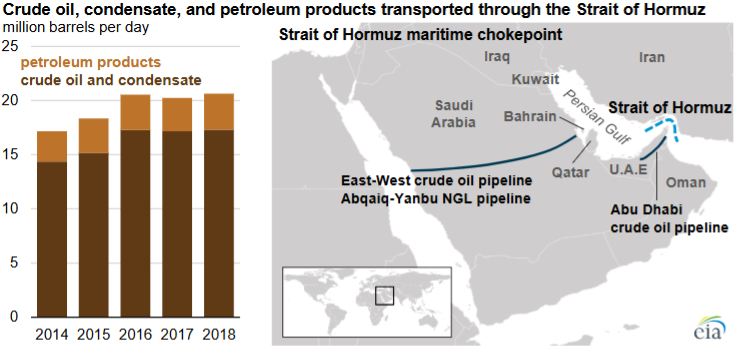
The Middle East has long been a powder keg, but the current standoff between Israel and Iran is dangerously close to boiling over. In just the past few weeks, both countries have launched strikes against each other’s critical infrastructure — with rumors swirling that Iran may attempt to choke off the Strait of Hormuz, a narrow passageway through which nearly 20% of the world’s oil supply flows daily.

An image of a map of the Strait of Hormuz as well as a chart depicting the percentage of global oil shipments transported through the Straight each day. Source: U.S. Energy Information Administration and ClipperData, Inc.

Even the threat of disruption in that region sends shockwaves through global markets. Why? Because oil, unlike most commodities, is deeply intertwined with geopolitics. When producers or transport routes are at risk, traders rush to price in that uncertainty — and that means higher prices across the board.

As this latest conflict escalates, it’s not just a regional issue. It’s a global supply risk. And when global supply is in question, demand shifts to where oil is safest and most accessible: the good old U.S. of A.

Domestic Oil Is Suddenly Worth a Whole Lot More

What investors are realizing — and what you should be paying close attention to — is that U.S.-based oil production becomes far more valuable in times like this. It’s not subject to international shipping lanes, foreign sanctions, or political sabotage. It’s drilled, piped, refined, and sold domestically.

And that’s why the spotlight is turning toward smaller, more nimble U.S. producers that operate exclusively on American soil. They don’t have to worry about supply chains being bombed or refineries being targeted. They just need to keep pumping — and enjoy the rising prices.

Let’s look at three companies that are about to ride this wave.

Devon Energy: The Established Powerhouse

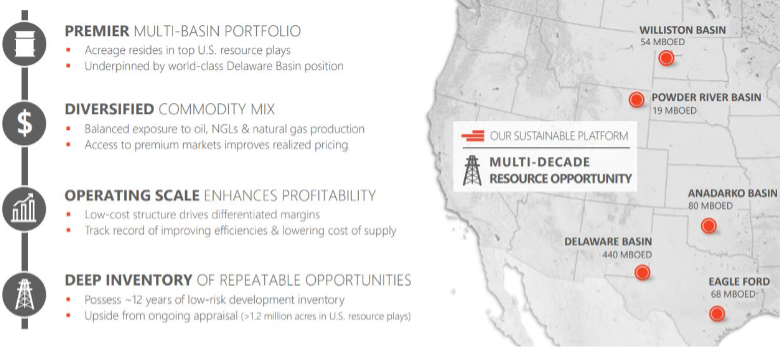
Devon Energy (NYSE: DVN) is far from a penny stock — it’s a heavyweight in the U.S. oil patch. With operations across the Permian Basin, Eagle Ford, Anadarko Basin, and Powder River, Devon has one of the most diversified domestic asset portfolios in the industry. It’s a major producer, churning out more than 800,000 barrels of oil equivalent per day.

But here’s the key: it’s all U.S.-based…

An image of a recent map of Devon Energy’s domestic oil production asset base. Source: Devon Energy Q3 2023 Earnings Presentation

That means Devon gets the full benefit of higher oil prices without taking on the geopolitical risk that international producers face. While oil majors with global exposure have to worry about shipping routes and foreign governments, Devon just keeps drilling — and banking higher profits.

The company has been laser-focused on shareholder returns lately, with billions in free cash flow and a generous dividend. Rising oil prices only supercharge those cash flows, giving Devon more ammunition to return value to investors.

U.S. Energy Corp.: The Underdog with Upside

Now, let’s shift to a much smaller name with big leverage to rising prices — U.S. Energy Corp. (NASDAQ: USEG). This is a lean, nimble oil and gas company operating exclusively in the United States, with a focus on low-decline, high-margin assets in the Rockies and Gulf Coast.

An image of the U.S. Energy Corp. logo Source: U.S. Energy Corp. Investor Relations

Unlike some overextended peers, USEG has no debt and a clean balance sheet, which gives it room to grow production without financial strain. Its current production may be modest — just over 1,000 barrels per day — but when oil prices spike, even small volumes can generate serious cash for companies like this.

The beauty of a small player like USEG is that it’s pure. It doesn’t have downstream assets, international complications, or sprawling corporate overhead. It just drills, sells oil, and keeps the profits. And when the price per barrel jumps like it is now, those profits can rise exponentially.

In a high-volatility market, small domestic oil producers are often the fastest movers — and USEG fits that profile perfectly.

Prairie Operating Company: The Newcomer with Explosive Growth

Finally, we have Prairie Operating Company (NASDAQ: PROP), a newer name that’s starting to attract serious investor interest — and for good reason.

PROP operates primarily in the Denver-Julesburg (DJ) Basin, one of the most prolific onshore basins in the U.S. While still early in its growth curve, the company has aggressive plans for 2025: it expects to bring 25–28 new wells online and ramp production up to 7,000–8,000 barrels per day — nearly triple its 2024 output.

An image of the U.S. Energy Corp. logo Source: U.S. Energy Corp. Investor Relations

That kind of growth is impressive on its own, but in a rising oil price environment, it becomes potentially explosive. PROP is guiding for more than $100 million in EBITDA next year — and that estimate could prove conservative if oil continues its upward march.

For investors looking for a high-upside domestic play with momentum on its side, Prairie might be the dark horse that delivers the biggest gains.

The Takeaway: This Is America’s Energy Moment

While international oil producers scramble to manage risk in the Middle East, American companies with domestic-only operations are sitting in the catbird seat. They don’t have to worry about tankers being targeted or pipelines being blown up halfway across the world.

Instead, they’re focused on drilling, producing, and cashing in on a price surge they had no hand in creating — but will fully benefit from.

Devon Energy is the reliable giant with a long track record. U.S. Energy Corp. is the small-cap sleeper with leverage to every price uptick. And Prairie Operating is the growth rocket, ready to capitalize on a perfect storm of rising production and surging oil prices.

If you’re looking for a way to profit from global instability without global risk, these are the names to watch.

Want the Full Picture?

If you’re serious about understanding how America’s domestic oil producers are seizing the moment — and which company is the best-positioned to surge in the coming months — don’t miss our free, in-depth research report on U.S. energy dominance.

Inside, you’ll discover:

  • The #1 American oil stock set to spike
  • Why American energy is poised to dominate the global markets
  • And how smart investors are using this window to build real wealth

It’s free, it’s actionable, and it’s yours for the asking.

👉 Get the report today and start positioning yourself before the next big move.


Neither The Investment Journal nor the author have a financial position in any of the companies mentioned in this article. An affiliate of The Investment Journal has been retained for marketing services by Prairie Operating Co. between June and August, 2025; however, this is not a sponsored post. This content is for informational purposes only and should not be considered investment advice or a solicitation to buy or sell any securities.    

The stock market did something amazing in 2024.

Something it hadn’t done in a quarter century…

No kidding. 

The market, as measured by the S&P 500 put in back-to-back 20% or higher gains.

In 2023 the S&P 500 closed up 24%. Last year it added another 23%. 

Want to be even more impressed?

Since the index was founded in 1957, it has only accomplished this incredible feat of strength six times. That’s around once a decade on average.

So what does that portend for the coming year?

Let’s look at a couple influencing factors.

That Last Time…

The last time investors were popping the bubbly over back-to-back gains like this was in good old 1999.

We suspect every investor over 40 remembers what happened after that…

The turn of the millennium brought with it the bursting of the internet bubble and ushered in the era of what’s fondly become known as the “tech wreck” — the kickoff of a decade-long bear market. 

Now to be fair, the initial bear leg bottomed after only two years and a 47% washout. And while the ensuing rally attempt got off to a great start gaining 26%, the next four years put in more modest gains ranging from 3% to 14%.

The building optimism, however, was short-lived when the market was clubbed like a baby seal in 2007 by yet another exploding bubble — the housing/mortgage bubble and the disaster known as the Great Financial Crisis — which cost the market 37%.

All in all, the years between 2000 and 2009 were nothing to write home about. From the final high to the final low, the index lost nearly 50% of its value.

And it all came on the heels of back-to-back 20%-plus gains.

Is it time to get nervous? 

Sons of the Tech Bubble

When we look back at those dismal years, it’s important to note that four of those six 20%-plus performances were all put in between 1995 and 1999. THAT… is unprecedented.

Of course the tech bubble was the era of the new investing paradigm. When insane valuations didn’t matter anymore because it was all about the internet — and that was going to change everything. 

Of course it didn’t. 

Hundreds of stocks trading at thousands times earnings will never be profitable. Ever. The pretenders were dispatched in short order. 

And in a potentially great irony, today’s multi-year performance might actually be considered an offshoot of that bubble. Because it’s being driven by a select number of mega-tech companies that survived the bust and grew up out of the boom.

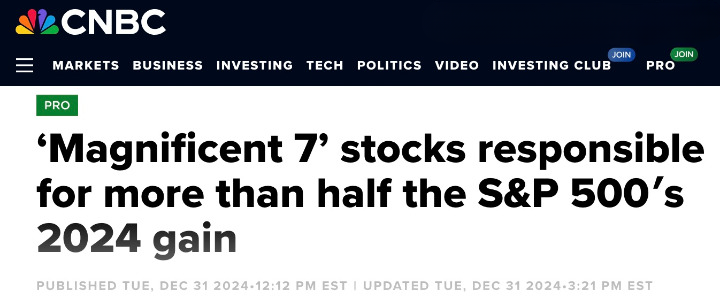
You know them today as the “Mag 7” — multi-trillion dollar market cap monsters. (With Tesla and Meta playing catch-up.)

These “big dogs” have fully been the driving forces behind both years’ successes.

Source: CNBC

They’ve been such forces they’ve been able to push the market higher even in the face of the Fed’s manic rate hike cycle. 

They’re able to do this because they’ve got so much cash in their war chests, they don’t give a hooey about higher rates. Case in point, Microsoft has already indicated they plan to spend a cool $80 billion on data center expansion in 2025. That’s a 44% increase from last year. 

And that’s not all. According to Morgan Stanley Amazon could spend $96.4 billion… Google could spend $62.6 billion… and Meta could spend $52.3 billion.

Fed looking to dial back rate cuts in 2025? They don’t seem to care.

And why not?

Because they’re all jockeying for position in what might well become the next great bubble… 

AI.

Investments in the nascent technology have been pretty rampant, and with good reason:

The industry is still in its infancy, but Wall Street’s forecasts suggest AI could add anywhere between $7 trillion and $200 trillion to the global economy during the next decade.

Those are big numbers. 

But they’re also forecasts (best guesses). 

And in chasing their share of the pie, the valuations of these companies driving these supers-sized gains are starting to become a little rich. 

The 2024 PE for the Mag 7 came in around 40 vs 27 for the entire index. Forward PEs see valuations coming off a bit to 32.3 and 23.2 respectively. 

Now, these rising PEs aren’t exactly 1990s tech bubble rich, but rich nonetheless. And the extensive capital expenditures will have the effect of eating into future margins. As reported in Reuters…

“I think what investors are missing is that for every year Microsoft overinvests – like they have this year – they’re creating a whole percentage point of drag on margins for the next six years,” said Gil Luria, head of technology research at D.A. Davidson.

Typically investors don’t see a bubble until it’s in their rearview mirror. And what would one look like in this case anyway? A move to more reasonable valuations within the Mag 7 would likely make for a year (or more) of struggles in the broader market. 

On the other hand, if the index can complete the 20% trifecta this year that means S&P 500 levels around 7050.

Stay tuned…

They were NEVER buying it!

The year 2024AD was supposed to be the year of rate cuts. Until the fly of sticky inflation early on flew into that ointment.

By September, the Fed figured it couldn’t wait any longer and got down to business. They assured everyone that…

Our patient approach over the past year has paid dividends: Inflation is now much closer to our objective, and we have gained greater confidence that inflation is moving sustainably toward 2 percent.

Then they tried playing catch up by cutting rates 50 basis points. 

With that they embarked on their quest for their next holy grail — “neutral.”  According to the Fed, “neutral” a theoretical interest rate level that neither slows the economy nor lets it overheat. Like we said, it’s the holy grail. 

It’s also a level they admit they don’t have a clue about.

No matter. They’re paid to do this kind of thing.

They’ve insisted they need to do this because their focus has shifted to the employment side of their mandate. According to Chair Powell…

As inflation has declined and the labor market has cooled, the upside risks to inflation have diminished, and the downside risks to employment have increased. We now see the risks to achieving our employment and inflation goals as roughly in balance, and we are attentive to the risks to both sides of our dual mandate.

Translation: “Don’t worry. We got inflation. Now we have to do employment. After all, we can’t be pushing the economy into a recession…” 

The Reality Behind the Search for “Neutral”

This, of course, is all “narrative” — that is to say mostly BS. Inflation is still sticky by any number of measures. The real reason they need to lower rates is because levels above 5% are literally killing the Treasury. 

In 2024, the US Treasury rolled over roughly $8 trillion of debt. And not just any debt. It was roughly 2% debt that was being refinanced into nearly 4% debt (assuming maturities stayed relatively the same). You don’t need to be a math genius to realize this is a lousy trade where debt goes. 

But always the crafty one, Treasury Secretary Janet Yellen forged a workaround by rolling more than 84% of it (old debt plus new financing) into short-term bills — securities maturing in 6 months or less. 

Basically she was willing to pay up for a few months until Powell and company came up with a story to get rates lowered. The plan is not faring so well.

Because this year (2025) about another $3 trillion in debt will be coming due… Along with a bunch of debt rolled into short term paper last year.

Putting this in simple terms… The Treasury has another boatload of borrowing to do this year. 

In any case, the Fed had been spinning their story of conquered inflation and bringing rates down to neutral levels and feeding it to the media. Who in turn have been dutifully parroting it in all their reporting.

But… there has been one huge disbeliever in the whole bunch… 

The Bond Market

Back in September, when the Fed was insisting that they had it all under control and rates (including yields on Treasury debt) could safely come down — the bond market effectively flipped them the bird.

You can’t make this up… The very day the Fed commenced cutting, bond yields in the 10-year (the benchmark lending instrument) bottomed and started their trek higher. 

Source: Trading Economics

The other factor is the massive amount of debt that will eventually be hitting the market this coming year.  Supply and demand are still a thing.

Lately the Fed has been trying to walk back rate cut expectations for 2025. It seems they’ve come to grips with the reality that maybe it’s not quite time to go out in search of “neutral.” 

The bond market never bought it in the first place.

While financial gurus like to sound like they have some special insight into the market, no one has a crystal ball.

We’ll be the first to admit it.

Investing is about doing your due diligence.

Of course there are tools that can give a savvy investor some inside clues about the market.

It’s a little known technical indicator that measures an important statistic known as “market breadth” called the Advance/Decline Line.

It’s a tool that actually can give you a glimpse at the internal strength or weakness of any market. And best of all, it’s super-simple to use…

A Look “Inside” the Market

Market “breadth” shows the relative participation in a market move by measuring the number of shares that are moving higher versus the number moving lower — in other words whether a rally is broadly-based or being driven by a few big stocks. 

The math on this is ridiculously simple.

You just take the number of shares going up (usually over a trading session)  and subtract the number of shares that went down. Then add that number to the previous day’s number. 

Voila! Instant market insight.

The A/D line (as it’s known) can be a leading indicator by showing a deterioration in market strength if it starts to lag as prices are making new highs. It can also show accumulating strength in a bear trend by holding previous lows while prices are still heading lower.

Now that you understand the principles behind this indicator, let’s take a look at the A/D lines for four major indexes…

Four Indexes — Four A/D Lines

Let’s start with the big dog…

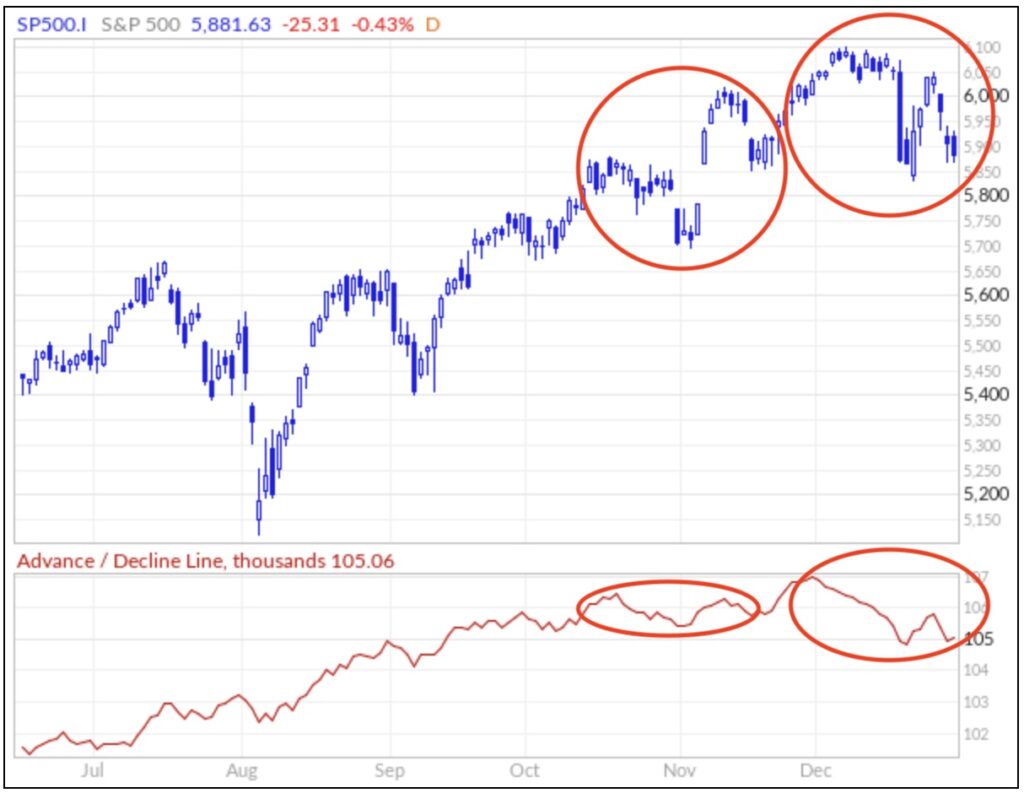
S&P 500

Source: MarketInOut

Look at the A/D line in the first circle compared with the price action. Market breadth appeared to be weakening as the A/D line couldn’t reach a new high with the market. It eventually did post a new high, but then fell off sharply as the market stalled. 

Right now the indicator appears to be relatively in line with the price action of the market. But continued weakness into the new year could mean more internal weakness. 

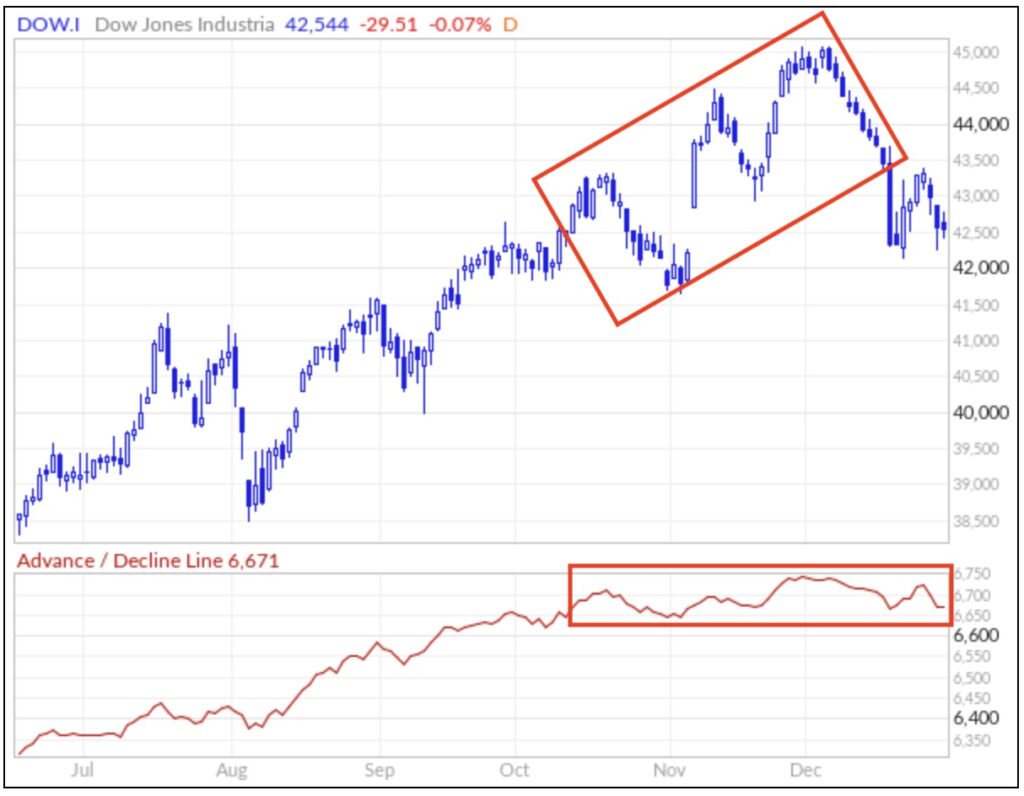
Dow Industrials Average


Source: MarketInOut

The Dow Industrials is only a 30 stock index, but it also contains $12.5 trillion in market cap with Nvidia, Apple, Microsoft and Amazon. So it’s got some pretty mega-tech companies to drive it. 

You can see the upward price bias throughout November, while the A/D line stayed basically flat. Year end profit taking pulled prices a bit back in line. But absent a confirmation by the indicator, new highs in the market should be viewed cautiously. 

NASDAQ Composite

Source: MarketInOut

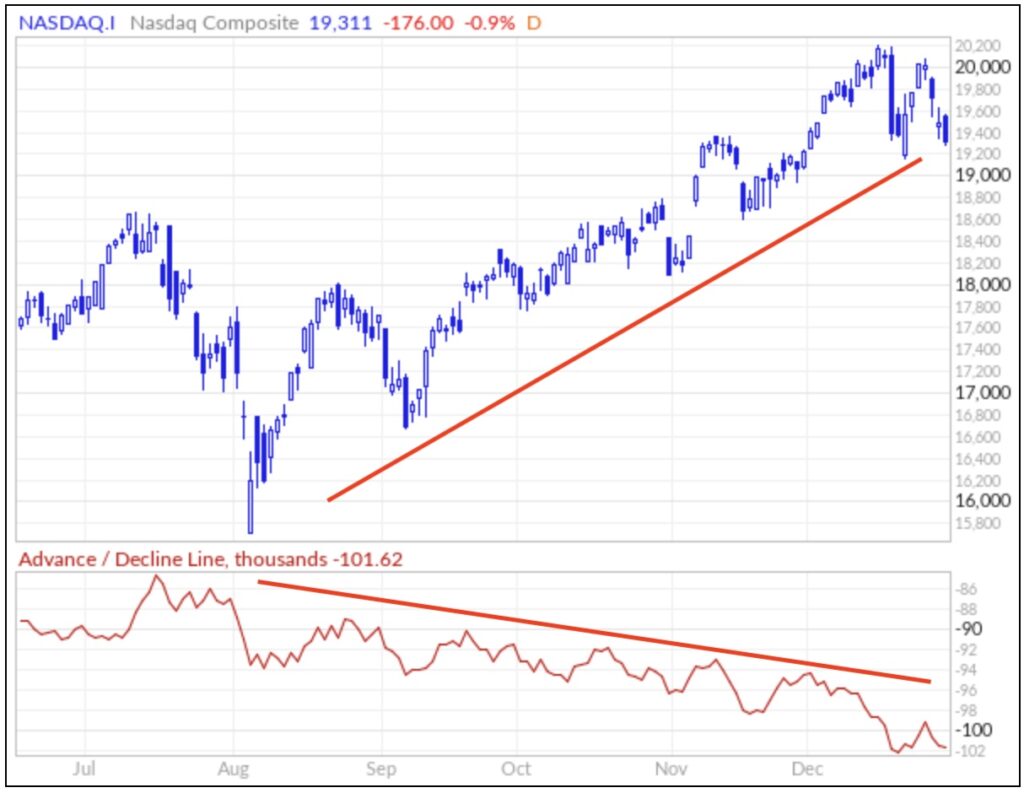
If you want a look at a troubling chart, look no further than the Nasdaq Composite. The Nasdaq is a capitalization-weighted index of 2,500 companies that lean heavily toward the tech sector. 

The index was up over 30% in 2024 while its A/D line had been heading significantly lower for most of the year. 

The price action is closer to what we’ve seen in the S&P 500 (another market-cap weighted index) but given the index contains 5-times as many stocks, this divergence between price and AD line drives home the fact that the rally is still in the hands of a handful of mega-tech companies. 

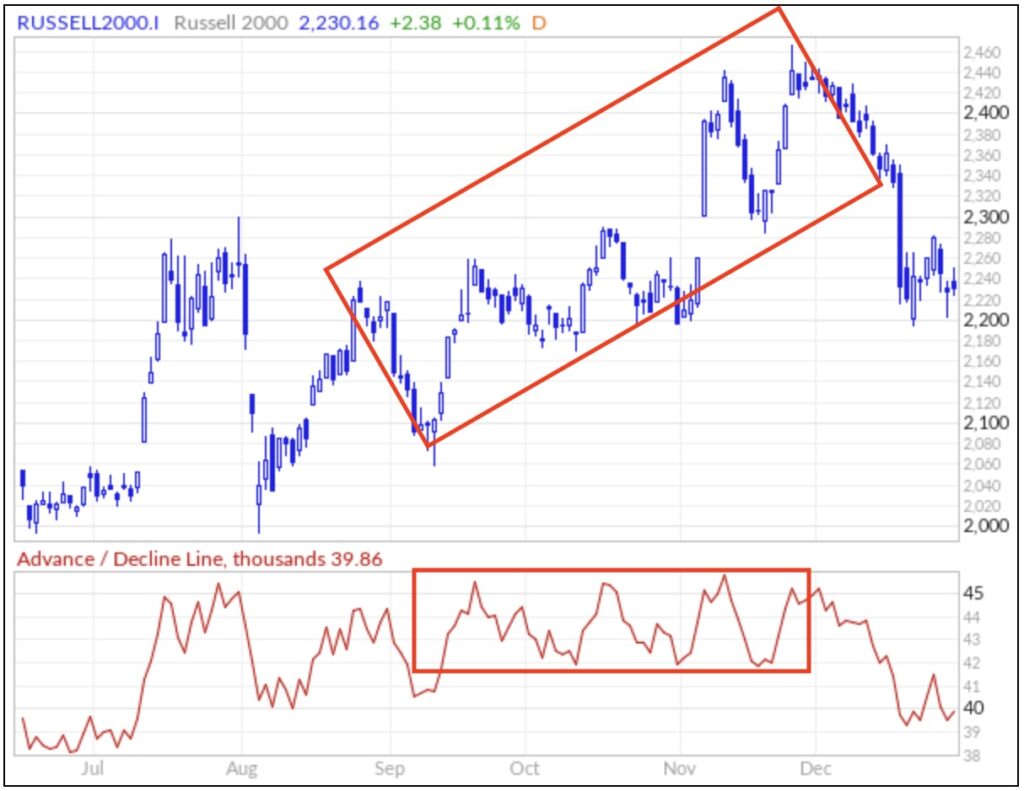
Russell 2000

Source: MarketInOut

The Russell 2000 is an index of small cap companies. 

Small caps have been struggling. While the S&P 500 gained over 24% last year, the Russell Index managed less than half that rallying 10.8%. Here you can clearly see the divergence between the A/D line and the price action of the index. New price highs were made, but market breadth didn’t support it. 

The pullback has brought prices back into line somewhat, but the fact that the A/D line has moved so far below previous lows may be indicating the market is still under some stress. 

As Always: One Caveat…

To be sure, this indicator is not the “holy grail” of investing. There are no sure things

When it comes to the markets, “only price pays” — no matter what your indicators may be telling you, price is the only indicator that really matters!

Everything in your technical arsenal could be screaming “sell, sell, sell,” but if the market keeps going higher… It’s going higher. (Have another look at the Nasdaq Composite chart!)

It’s no secret that for the past two-plus years, it’s been basically a handful of stocks — the AI/mega-tech sector — that has been pulling the market higher. And they’ll continue to be an influence.

But all that said, technical indicators like the advance/decline line can offer important insights into what may be building internally in the market. 

And that’s always important for a smart investor to know.