The US consumer is the bedrock of our economy. 

If that’s truly the case — (and it is) — then signals are flashing everywhere that the economy is headed for trouble. 

Case in point…

Source: ZeroHedge

The Tylers over at ZeroHedge reported:

Bloomberg Intelligence’s Joel Levington published a new report Monday, citing new data from CarEdge that showed a staggering 39% of vehicles financed since 2022 carry negative equity, including 46% of EVs

What this basically means is that balances on people’s auto loans are more than the value of the vehicle they’re paying on. 

Now falling car values shouldn’t come as a surprise to anyone. 

A car is not an asset in any “investment” sense of the word. It’s a means of transportation.

In the world of business, vehicles are recognized as “depreciating assets” (over the “useful life” of the vehicle) on a business’ taxes. They have a tax-reducing effect on their bottom line. 

Depreciation refers to the decrease in value of long-term assets over time. Depreciation is spread over the useful life of the asset and is intended to realistically reflect the actual value of the asset and the profit. Furthermore, it is designed to have a tax-reducing effect. Depreciation of vehicles is done on a linear basis, meaning the vehicle’s value is evenly spread over its useful life. The vehicle’s useful life plays a crucial role in this process. The amount of depreciation depends on the purchase price and the vehicle’s useful life.

There’s a maxim that says cars depreciate by over 10% the minute you drive it off the dealer’s lot. So you’re pretty much starting in the hole.

So, again, the fact that the value of American’s cars are falling shouldn’t be any surprise. What is troubling is the fact that consumers still owe so much on their vehicles.

Consumers Are Sinking Fast

The Federal Reserve just reported that the average finance charge for a new car in Q3 2024 was 8.76%! But that’s not the really shocking part. What really catches your attention is that’s the rate being charged for a 72 month loan! 

Six years to pay off a car? Not long ago four years was pretty much the financing limit.

The problem stems from a combination of factors.

Back during the pandemic stimulus spree, the extra free money (not to mention the near zero financing cost) at the time made trading in the old car seem like a good idea. 

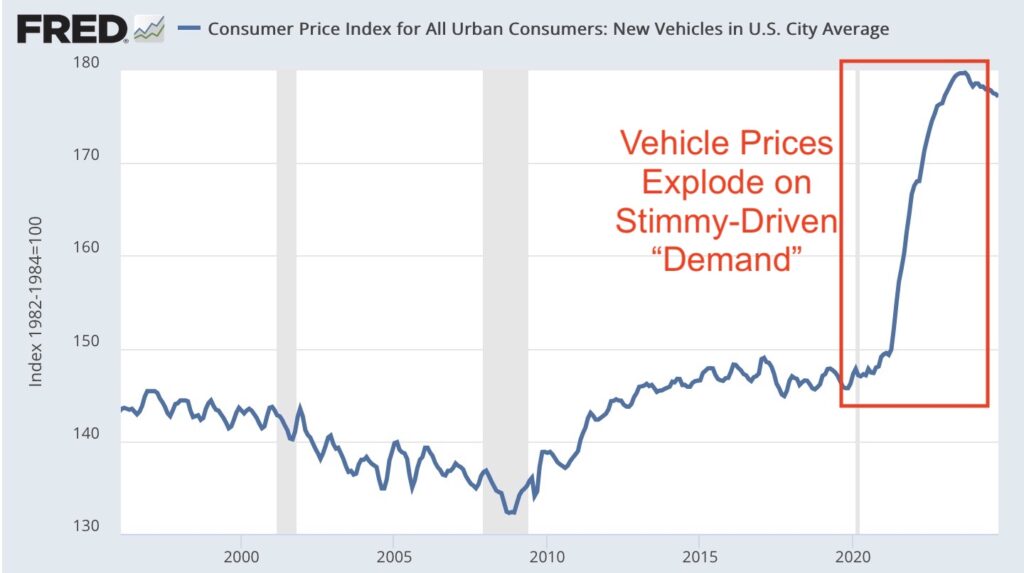
The stampede to the local car dealer (along with the supply fiasco) drove new car prices through the roof. 

Source: Federal Reserve Bank of St. Louis

After some 20-plus years of relative price stability in the new car market, prices exploded by over 20% in a span of three years thanks to all the “free” money.

Today, thanks to the sharply higher prices, auto loan balances rose by $18 billion in the last quarter alone, and now stand at $1.64 trillion — the highest category of non-housing debt.

These unaffordable prices are what’s behind the longer and longer financing terms. 

Further according to Experian 33% of monthly car payments stand between $500-$700 per month. And, hold on to your hats, over 16% are over $1,000.

This would be fine if everyone could afford it. But 90-plus day delinquency rates on auto loans just upticked again to 4.6%. (Which might not seem bad compared to credit card delinquencies which have reached 11.1%!)

There’s an idea floating around that the economy is doing just fine. 

But when you look past the headlines (and you don’t have to look far) you can see the strains building.

It accounts for 70% of the country’s GDP.

Consumer spending. 

Makes sense. Healthy consumers are obviously necessary for a healthy economy. 

But good health isn’t always apparent on the surface. Trouble can be quietly developing under the surface.

Like the heart disease candidate whose arteries are filling with plaque. They may look perfectly fine… until they’re lying on the ground clutching their chest. 

Today’s economy is something like that.

Last October, the BEA announced that real GDP rose at an annualized rate of 2.8%.

That is an impressive number. 

To take it at face value (much like the Fed has been insisting we do) you’d have to say that the economy, and consumers in particular, are doing just fine. So have another piece of cheesecake.

The reality underlying the situation, however, isn’t so good.

A Shift in Buying Preference 

In a broadly healthy economy, a rising GDP should lift all boats. (Or most anyway.) You expect to see retailers posting great numbers across the board. Blood is pumping through those arteries. 

But that’s not what has been happening. And it hasn’t been happening for some time…

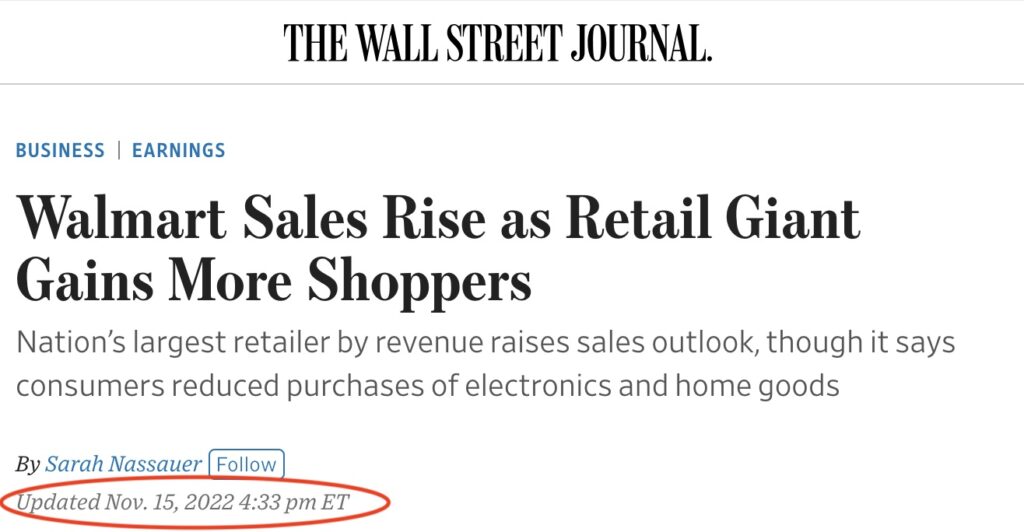
All the way back in November 2022, the Wall Street Journal reported:

Source: The Wall Street Journal

“Walmart gains more shoppers” sounds like good news. But article reported strains in the consumer sector:

The country’s largest retailer by revenue said Tuesday that households continue to face pressure from rising food prices, and lower-income shoppers are eating into savings.

Inflation was still roaring at the time and CPI for that month came in at 7.1%. And you’d expect that kind of news from lower-income shoppers. But what you might not expect…

During the most recent quarter, households earning $100,000 or more helped push Walmart grocery sales higher, executives said.

Sales data had indicated that higher-income consumers had begun to trade down searching for bargains. When inflation begins to reach the middle to upper income brackets, stress is beginning to build. 

Still, with prices soaring over 7% annually, it’d be reasonable to argue that most households would be looking to save a buck or two.

But now with inflation “well on track back to 2%,” if you believe the Fed, things should be shifting back to normal. But they’re not.

In fact, they’re going in the opposite direction…

The Trade Down Continues

This November Walmart released its earnings. Not only did they beat revenue and earnings estimates, they raised their forward guidance. 

In particular, management noted…

While average transaction growth slowed, customers are buying more at each visit, driving ticket sizes. A lot of that growth was driven by upper-income households making $100,000 a year or more as increasingly more affluent households trade down. That cohort made up roughly 75% of share gains for the quarter.

Two years later, the $100K and up cohort is still shopping at Walmart. And they’re doing it more and more. 

This suggests clear strains in the economy. In a recent webinar, Goldman Sachs noted:

Our focus on the webinar centers around discussing high-end and low-end consumers trading down. This phenomenon occurs as macroeconomic headwinds mount, including elevated inflation and high interest rates due to backfiring ‘Bidenomics.’ More importantly, trading down occurs when incomes don’t keep up with inflation or when purchasing power decreases.

So the trade down phenomenon itself is suggesting trouble. But there’s more…

The bargain hunting isn’t carrying across the board. 

Target, who released their earnings the same day as Walmart, missed everywhere with their stock dropping 21% on the news. 

This suggests that the trade down to discount stores isn’t even widespread. (Even Dollar General collapsed on its latest earnings report.)

The bottom line: The trade down and concentration of retail customers suggests they’re taking a seriously defensive position as economic conditions become more and more uncertain.

Could be tough times ahead. 

It’s official, the president-elect is going scorched earth.

A little over a week past the election, he’s put forth a string of cabinet picks that have, to say the least, raised a few eyebrows.

Senator Marco Rubio for Secretary of State. Marco’s a conservative “politician” who should have no trouble getting confirmed. 

Pete Hegseth for Secretary of Defense. A Fox reporter?!?! Turns out Hegseth is a decorated 20-year veteran who served in multiple forward areas. He’s also written extensively on the military. Guess you can’t judge a book by its cover.

Matt Gaetz for Attorney General. The head of the DOJ. Gaetz has been a hard core Trump loyalist from day one and has made his share of enemies on Capitol Hill. Watch the fireworks over this one!

And then there’s the department of Health and Human Services — HHS. 

Make America Healthy Again

The incoming 47th president just nominated none other than Robert F. Kennedy Jr. 

“He’s going to help make America healthy again. … He wants to do some things, and we’re going to let him get to it,” Trump said during his victory speech.”

RFK is a noted vaccine critic. We won’t debate the value of vaccines. By 1994, the polio vaccine eradicated the disease in the Americas. On the other hand, you have to admit there are many, many other required vaccines that don’t have nearly the same success.

Vaccine stocks trembled at the nomination. 

But that’s not all. RFK wants to go after the food industry as well. When the sugar lobby sponsored studies that effectively made fat the main culprit where heart disease goes, the American way of life started to change. 

We got sicker. 

And fatter. 

And required more — wait for it — pharmaceutical interventions to keep us healthy. 

We think RFK might be onto something. How much progress he’ll make remains to be seen. But this shake up in the health industry may be offering some opportunities for investors. One notable one… Adidas (OTC: ADDY.Y). 

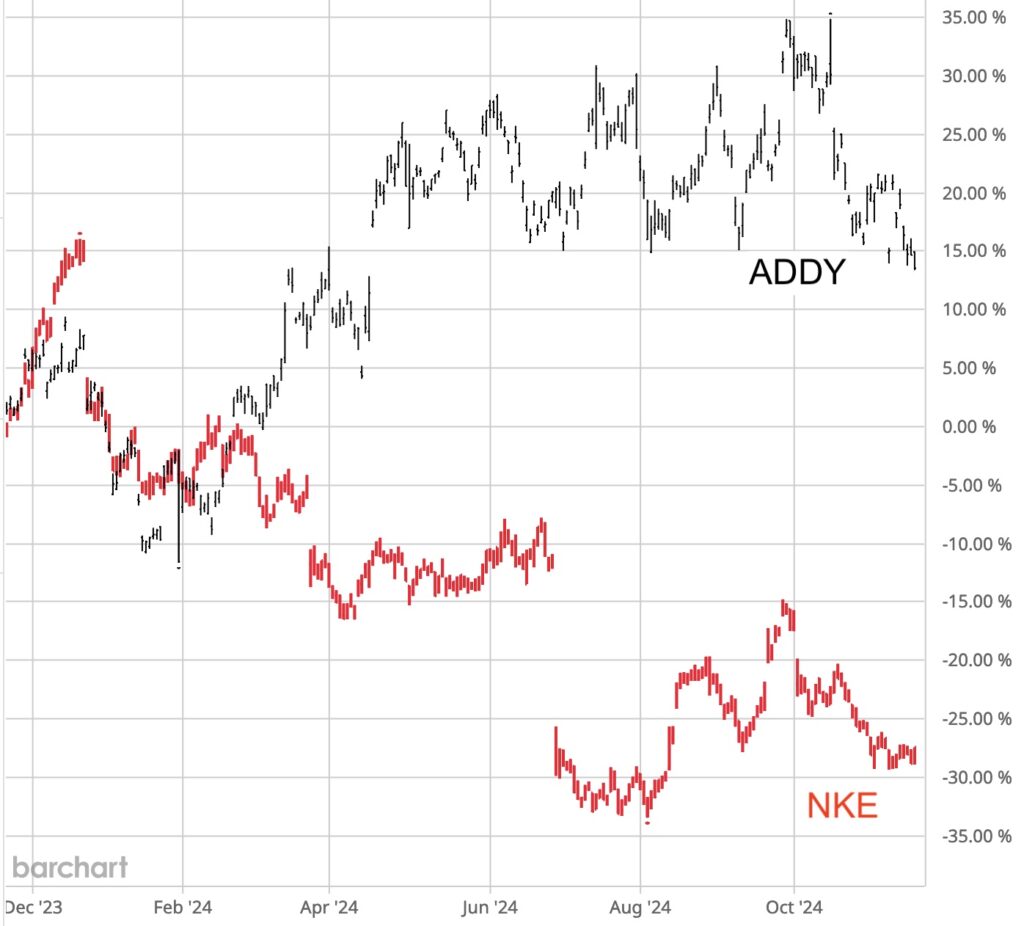
Everyone knows Adidas. They’re the popular runner up to Nike. (Who’ve been having their own troubles over the past couple years.) And now with a focus on health coming back into the picture with this administration, they could well benefit. 

The company falls into the “consumer discretionary” category which typically performs better during good economic times. Their most recent earnings report (Q2 2024) beat estimates with earnings rising 11%. Additionally the company raised its guidance for all of 2024 expecting operating profits to reach €1 billion up from €700 million. 

Given the recent pullback, they have moved to a better valuation level.

Adidas v. Nike (1 Year)

Source: Barchart

And in addition to shoe sales, Adidas’ lifestyle and performance businesses are also seeing signs of growth.

Given these developments, Adidas could be worth a look to get your portfolio in shape.

On August 30, Warren Buffett — the one and only Oracle of Omaha — turned 94!

Ninety-four!!

His former business partner, Charlie Munger, left this earth nearly a year ago at the age of 99!

Is it something about being connected to Berkshire Hathaway that adds candles to leadership’s birthday cakes?

Who knows. But in his 70-some years at the helm, his (and Munger’s) rules for investing have amassed an investment juggernaut that investors have looked to emulate over the decades. 

But now things appear to be changing…

Buffett’s Fire Sale?

Buffett, who still actively manages Berkshires’ portfolio, has been a net seller of stocks for the past eight quarters, significantly rearranging his portfolio. Here’s the rough breakdown of recent sales according to US News:

He sold over 380 million shares of Apple (AAPL) reducing his position by over 49%. He dumped 104 million shares of Bank of America (BAC) shaving 10% off that position. He pitched 2.6 million shares of Capital One (COF) taking that position down 21%. And finally he sold 4.3 million shares of Chevron (CVX).

He unloaded his entire holdings of Snowflake (SNOW) — a cloud based data storage and management facility — and the media, streaming and entertainment company Paramount Global (PARA).

But while he’s been a net seller, there have been additions to his portfolio. He increased his holdings of Occidental Petroleum (OXY) 7.2 million shares and Chubb Ltd. (CB) by 1.1 million shares.

Plus he added two new holdings in Ulta Beauty (ULTA) and aerospace, defense and electronics manufacturer Heico Corp. (HEI).

The company also stopped buying back its BRK.B shares this year as well.

Add it all up and Buffett has raised Berkshire’s cash position to $320 billion versus just $272 billion in stocks. 

What the Heck is He Thinking?

That is, of course, the $64,000 question.

Buffett has been nothing but legendary in his investing smarts for longer than many investors today have been alive. Since 1965 when he took over Berkshire, he grew the value of the company by 19.8% annually through 2023. 

Frankly, we can’t think of anybody who comes close to that.

So is the man who buys “great companies at fair values” (something he learned from Munger) and holds them forever signaling some sort of change in the air? 

He’s not saying. Or at least what he is saying isn’t satisfying a lot of people.

As Buffett told the Berkshire faithful: “If I’m looking at a 21% rate this year and then we’re [paying] a lot higher percentage later on, I don’t think you’ll actually mind the fact later on that we sold a little Apple this year.”

Selling for tax purposes is a legitimate legitimate reason. But coming from the guy who, for years, has lamented that he pays less in taxes than his employees do…

In 2011, Buffett wrote an op-ed in the New York Times called “Stop Coddling the Super-Rich.” In the article, Buffett said that his taxes amounted to “only 17.4 percent of my taxable income — and that’s actually a lower percentage than was paid by any of the other 20 people in our office.

And even going further according to CNN in 2013…

Buffett has been advocating for a minimum tax on top wage earners — those like himself who benefit from the fact that capital gains are taxed at a lower rate than regular earnings. His proposal, popularly known as the Buffett rule, has the support of the Obama administration but is strongly opposed by Republicans in Congress.

…well, that’s a bit rich. 

But there are other reasons to consider Buffett’s actions. From Reuters:

“Berkshire is a microcosm of the broader economy,” said Cathy Seifert, an analyst at CFRA Research in New York. “Its hoarding cash suggests a ‘risk-off’ mindset, and investors may worry what it means for the economy and markets.”

Is the Oracle calling a top? It’s certainly not impossible. Buffett is the king of buying value — great companies fairly priced. If valuations are exceeding what he deems reasonable, he may be building a cash store to take advantage of a major correction.

That said, it’s important to realize that Buffett is NOT, and has NEVER been, a market timer. The rally could easily continue for another six months or even a year.

Then again, he may have other intentions in mind — like building cash to acquire another target company in a massive deal.

Speculating is all well and good, but the truth is we won’t know until something happens. 

In the meantime, we’re keeping an eye on the Oracle.

Trust us… They’ll be screaming that it’s all because of Trump’s tariffs.

But it won’t.

We’re referring to a potential resurgence of inflation.

For months leading up to the election, when they weren’t blasting him as the second coming of Hitler, Stalin and Mussolini…

Source: The Atlantic

…the Democrat side blasted his tariff talk as an outright financial assault on Americans.

“It would be a sales tax on the American people,” she [Harris] said in an interview with MSNBC on Wednesday. “You don’t just throw around the idea of just tariffs across the board, and that’s part of the problem with Donald Trump… He’s just not very serious about how he thinks about some of these issues.”

They’ll want you to believe that any uptick in prices will be all on him. But should inflation begin to reheat, you need to know that it’s been building for some time.

Inflation is Under Control

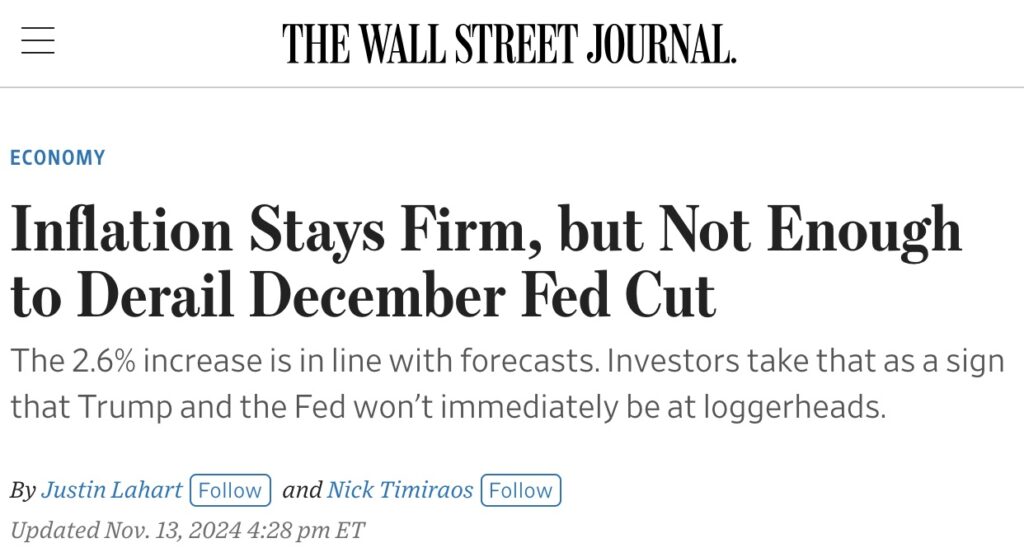
The Consumer Price Index came out last week and the numbers were reported in line across the board. 

The headline number was up 2.6% year-over-year in line with estimates but 0.2% higher than the previous month’s report. The infamous “core” measure (minus food and energy costs) hit expectations and was flat from the previous yearly reading.

The media rushed to emphasize this was all good news…

Source: The Wall Street Journal

The only problem is that the core number is stuck at 3.3%.

If you buy the Fed’s talk about them seeing inflation back under control so they can start moving rates back to neutral, you’d be hard pressed not to notice that the core reading hasn’t been below 3% since March 2021

Ordinarily the talking heads try to explain away any high print in CPI by saying “well look at the core measure” and blaming it on food and energy prices. It’s true, those prices are volatile. And when they’re pressuring the headline index higher, it’s a legitimate observation. 

But when the opposite happens, like now, it’s just as legitimate. 

In fact, for the past several months, it has been food and energy prices that have been pressuring the index lower. And when you take them out you get a clearer picture of the overall price situation as it stands.

Prices are stubbornly stuck well above the 3% level. Which, in inflation terms, is nowhere near the 2% level the Fed views as its mandate.

That’s called persistent inflation.

And it’s a problem.

Or Is It?

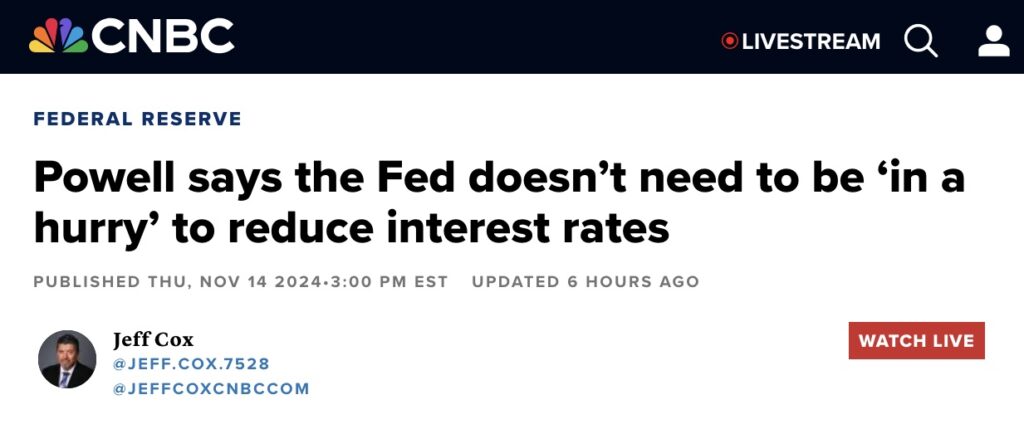
Two days after the Journal headline trumpeted that everything on the inflation front was still A-OK, Jay Powell came out at a speech in Dallas and dumped cold water on it.

Source: CNBC

“The economy is not sending any signals that we need to be in a hurry to lower rates,” Powell said in remarks for a speech to business leaders in Dallas. “The strength we are currently seeing in the economy gives us the ability to approach our decisions carefully.”

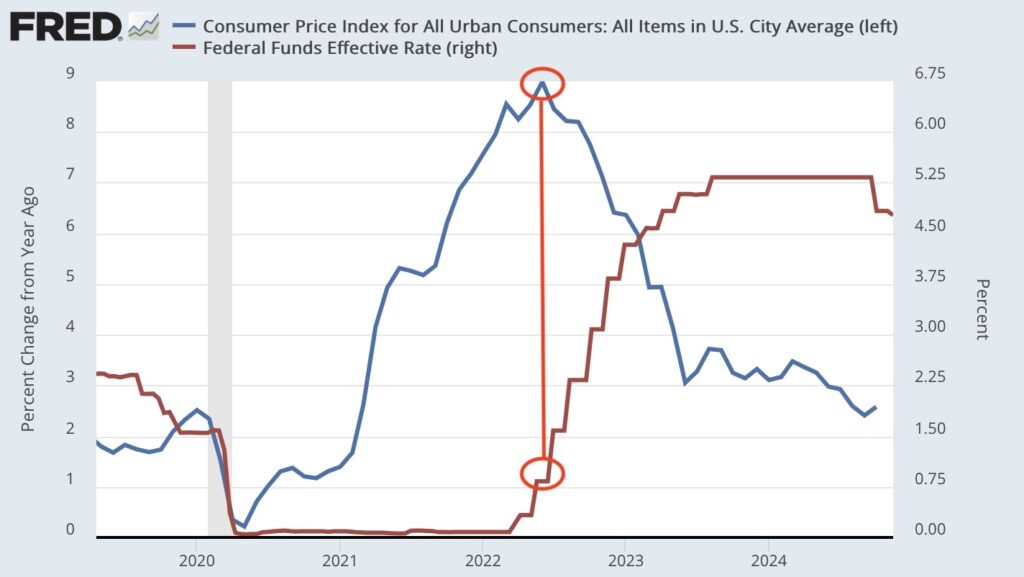
Remember that three years ago, as prices were accelerating like a Space X super heavy rocket, the Fed (and that sage of the Treasury, Janet Yellen) all insisted that it was “transitory.” Not long after scraping that egg off their face, the FOMC kicked rate hikes into high gear. 

After doing nothing for two whole years and watching inflation skyrocket to 9.1%, they want you to believe that their massive rate hike of three-quarters of one percent was the thing that struck fear into the heart of rising prices and brought inflation to heel.

Source: The Federal Reserve Bank of St. Louis

It wasn’t. (Businesses reopened and the broken supply chain worked itself out.)

But when you consider that all the indexes in the CPI are subject to “seasonal adjustments,” that the data doesn’t account for costs like interest rates, homeowners insurance, shrinkflation and other assorted rising costs, that financial conditions (according to the Chicago Fed’s National Financial Conditions Index) were never meaningfully tightened and that money supply (M2) is back on the rise looking to test its all-time high of $21.7 trillion you get the idea that we’re not out of the inflation woods by a long shot.

The inflation beast is something that’s been developing for the past three years. If it takes a turn back to the upside — which is a possibility — it shouldn’t be on Trump.

An important lesson that investors need to always keep in mind is that market indexes don’t necessarily represent the market.

There are nearly 6,000 companies that are publicly traded on US stock exchanges. 

Standard & Poors’ index only tracks 500. The Dow Jones Industrial Average only follows 30!

(It can be argued that the Nasdaq composite actually does represent all 3,000 or so stocks listed on its exchange, but it’s a capitalization weighted index giving more influence to its bigger constituents.)

And it’s not uncommon for poorly performing companies to be swapped out for stronger ones. A fate two (formerly big) tech names are facing right now…

Poor Intel

It’s been a bad couple years for Intel.

Once the 800-pound gorilla of the semiconductor industry, the company has stumbled to the verge of bankruptcy. 

They missed out on the mobile revolution. 

Then they whiffed on the AI chip movement.

The $20 billion that was promised from the Biden administration’s Chips and Science Act hasn’t been delivered because they haven’t met the necessary milestones on their two new fabrication plants. 

Now they’re scrambling to split their design and fabrication business to try and generate some outside revenue. 

The company’s stock has been on a steady trend lower, losing as much as half its value year-to-date thanks to consistently falling earnings.

And as you might guess, their performance has been a drag on the Dow Industrial Average. Intel has long been one of the 30 “Industrial” companies that make up the index. 

It’s not any more…

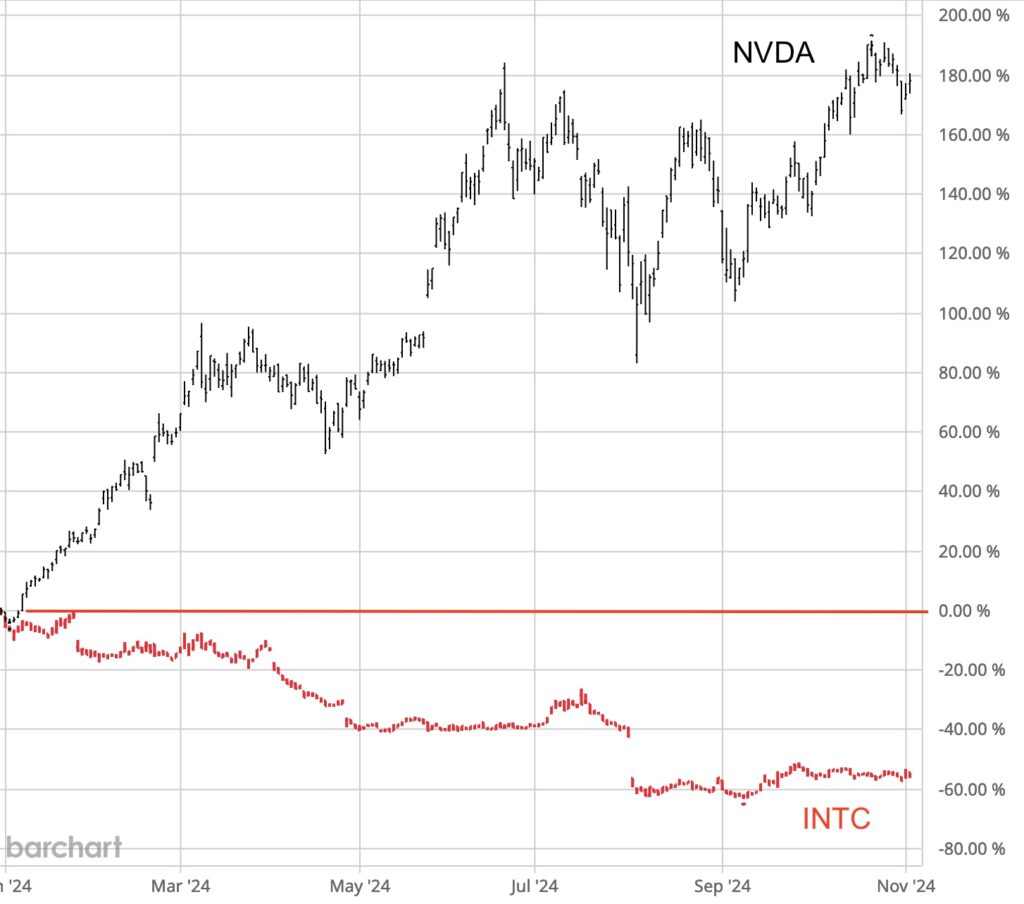
(Reuters) -Intel (INTC) will be replaced by Nvidia (NVDA) on the blue-chip Dow Jones Industrial Average index after a 25-year run, underscoring the shift in the chipmaking market and marking another setback for the struggling semiconductor firm.

Nvidia will join the index next week along with paint-maker Sherwin-Williams , which will replace Dow, S&P Dow Jones Indices said on Friday.

Nvidia vs. Intel (YTD)

Source: Barchart.com

Everyone loves a winner.

More Tech Troubles

Another AI stock is in the dog house in a big way as well.

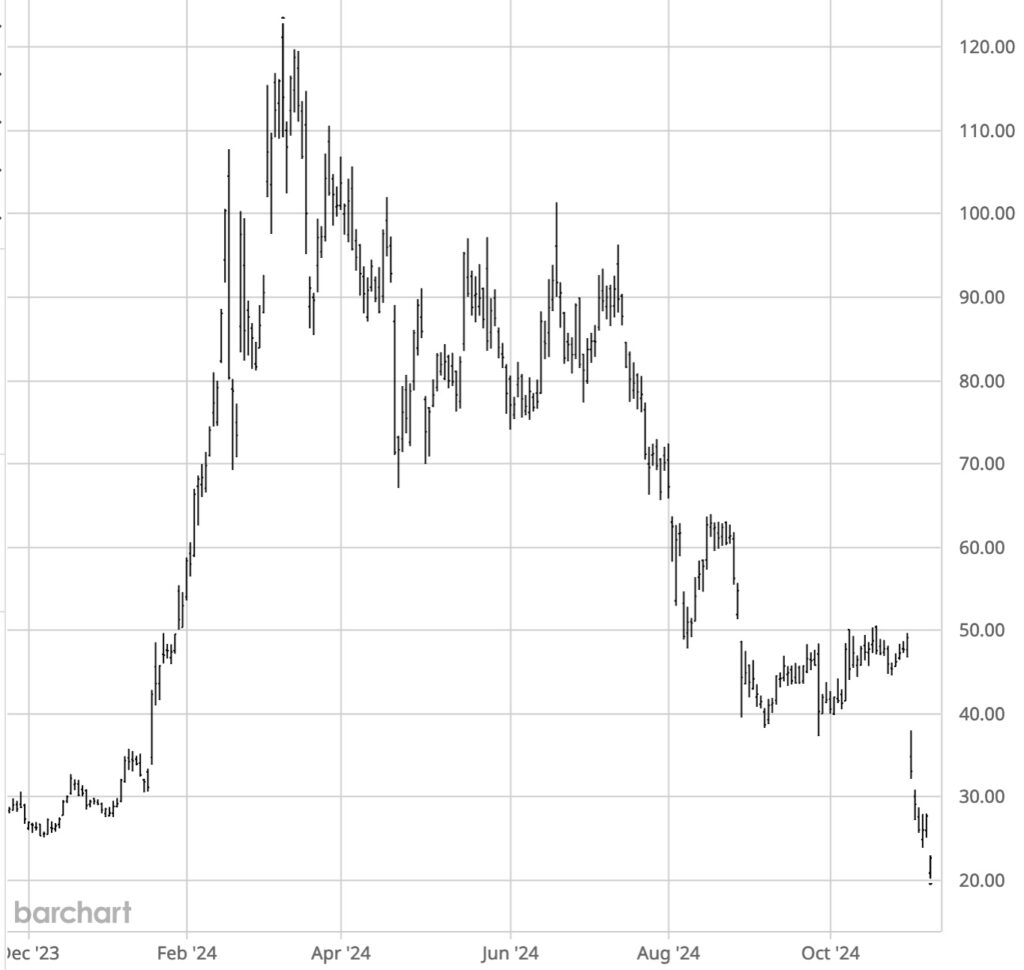
Super Micro Computer Inc. (SCMI) was also once a darling of the AI boom. SCMI produces the server machines which run Nvidia’s chips to train AI algorithms. Trading around $7 at the beginning of 2023 (post split prices), the company’s fortune exploded with the AI boom sending their stock as high as $118 in a little over a year. 

In March it was added to the S&P 500.

A series of serious missteps has cost the company big time. Today the stock is actually facing delisting from the Nasdaq.

Shortly after reaching their all-time highs earlier this year, they tried to raise capital by selling 2 million new shares into the market (diluting current shareholders). 

In mid-April, shares plunged another 23% when the company failed to report preliminary results in its earnings announcement. (Something it had done religiously before.)

In early May, the company nose-dived again when it reported a revenue miss in its Q3 numbers.

Despite these struggles, the company was added to the Nasdaq-100 index in mid-summer. (The BIG tech slice of the broader index.)

In August the company announced flat guidance which disappointed the market yet again. And if that wasn’t enough, around the same time, short seller fund Hindenburg Research alleged “accounting manipulation” at the company which led to the DOJ opening an investigation.

Finally in October…

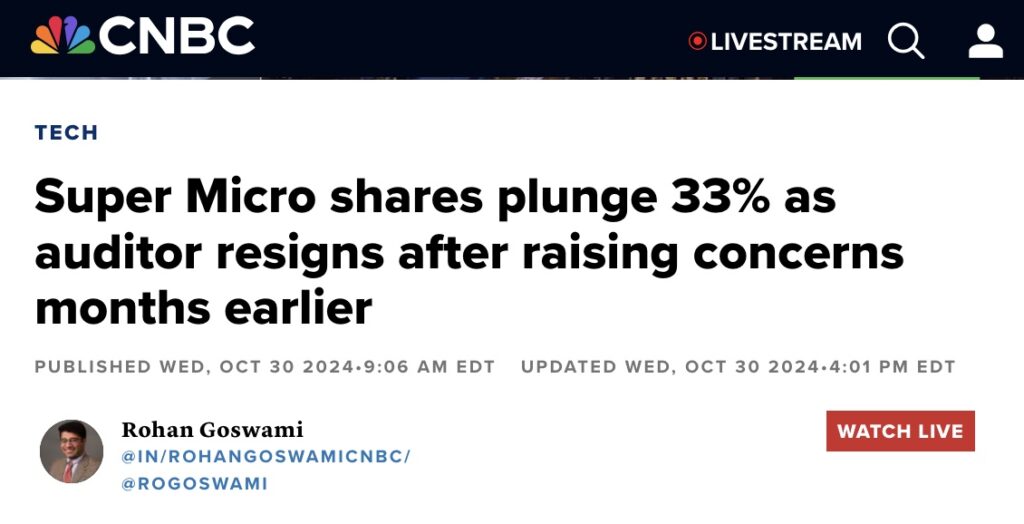
Source: CNBC

Ernst & Young in its resignation letter said it was “unwilling to be associated with the financial statements prepared by management.” The accountancy also raised concerns about the board’s independence from CEO Charles Liang and “other members of management.”

Last week, the company finally reported unaudited Q1 results — which missed expectations. They also reported that an independent investigation turned up no evidence of fraud or misconduct.

That had to be taken with a grain truckload of salt. But the damage has been done.

Super Micro Computer Inc. (SMCI) YTD

Source: Barchart.com

What’s the outcome of all this news?

Where Intel goes, losing its spot in the Dow average is certainly a blow that adds insult to injury. But it could also lead to some further selling pressure in the stock as ETFs that track the Dow will have to sell their INTC holdings and replace them with NVDA. 

Like we’ve said before, Intel has its comeback work cut out for it. 

SMCI on the other hand, has more at risk. 

Facing delisting by the Nasdaq exchange would take them out of both indexes. But more importantly, its current struggles have caused one of its major partners — Nvidia — to shift orders to other suppliers indicating that its internal issues may be affecting business relationships. With competition in the AI niche heating up, the loss of any revenue could be a serious problem.

And the final moral of the story, when companies start to struggle, indexes can just take out the trash.

It’s finally over…

After enduring months of some of the most incredible political theater ever exhibited, including two assassination attempts on a candidate, the citizens of the US finally stepped up and made their voices heard. And boy did they ever.

In what can only be described as the comeback of all time (unless you’re a member of the Grover Cleveland Fan Club), Donald Trump won the presidency in undeniable fashion.

And not only did he win, Republicans also took back control of the Senate — and are gaining ground in the House.

This was a remarkable red wave. The kind that gives the winning candidate a mandate to enact their policies. And since Trump now has that mandate, it’s probably worth taking a look at what the next four years (two years with a friendly congress) might bring for the economy and markets…

Stocks

There was no mistaking the stock market’s opinion of Trump’s victory. The day after the election, the Dow Industrials rallied over 1,400 points. The S&P 500 soared over 130. The Nasdaq composite was up over 500. And the Russell 2000 (the index of small to mid-cap companies) saw the highest percentage gain of all the averages exploding over 120 points. 

The initial explanation is simple: Trump will be a pro-business president. 

You can expect Trump to bring a lighter regulatory touch to his next term. He’s also indicated his preference for lower interest rates (a point of contention with us). This bias should benefit tech where AI (and crypto) are concerned as well as the energy sector. 

Inflation

This is a tough one. Because in all honesty, no one administration can be blamed for the inflationary forces in the economy. 

Inflation isn’t a bug within our financialized economy, it’s a feature. One of the “mandates” of the Federal Reserve is to maintain price stability. They define that as maintaining (creating!) 2% inflation every year. That may not sound like much but it shows up as a 22% increase in prices over the course of 10 years. Nothing compared to what the economy experienced over the last four, but the point is prices rarely ever go down.

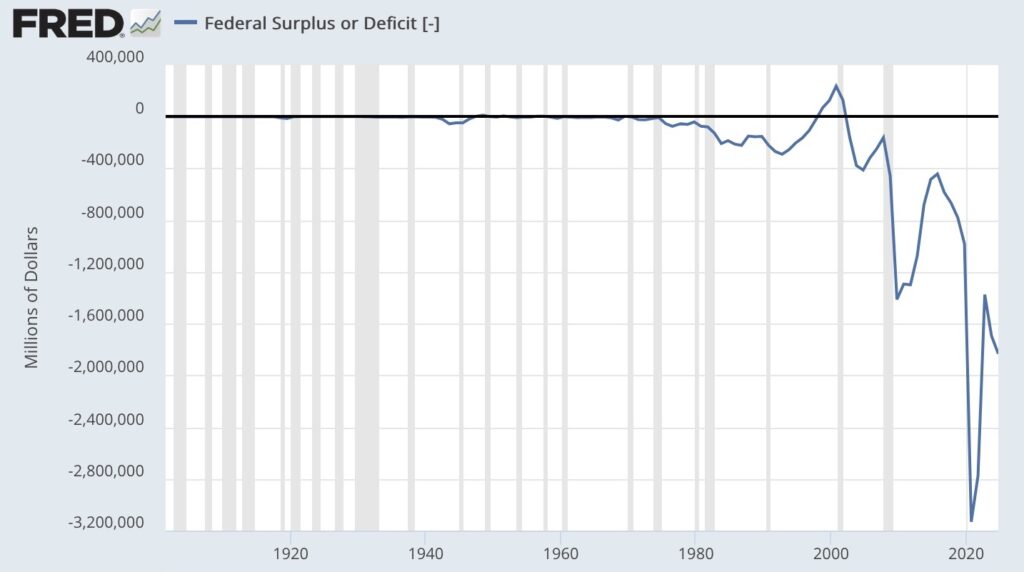
Of course the fiscal side of the ledger carries a lot of blame as well. Deficit spending, theoretically a cure for a struggling economy (not one that’s booming like they tell us ours is), has an inflationary impact on the economy. Thanks to Congress, the US deficit has been running rampant for the last two decades. And given the fact that they suspended the debt ceiling over a year ago, it’s hard to see how anyone can make much of an impact here.

The Federal Deficit

Source: The Federal Reserve Bank of St. Louis

It’s finally over…

After enduring months of some of the most incredible political theater ever exhibited, including two assassination attempts on a candidate, the citizens of the US finally stepped up and made their voices heard. And boy did they ever.

In what can only be described as the comeback of all time (unless you’re a member of the Grover Cleveland Fan Club), Donald Trump won the presidency in undeniable fashion.

And not only did he win, Republicans also took back control of the Senate — and are gaining ground in the House.

This was a remarkable red wave. The kind that gives the winning candidate a mandate to enact their policies. And since Trump now has that mandate, it’s probably worth taking a look at what the next four years (two years with a friendly congress) might bring for the economy and markets…

Stocks

There was no mistaking the stock market’s opinion of Trump’s victory. The day after the election, the Dow Industrials rallied over 1,400 points. The S&P 500 soared over 130. The Nasdaq composite was up over 500. And the Russell 2000 (the index of small to mid-cap companies) saw the highest percentage gain of all the averages exploding over 120 points. 

The initial explanation is simple: Trump will be a pro-business president. 

You can expect Trump to bring a lighter regulatory touch to his next term. He’s also indicated his preference for lower interest rates (a point of contention with us). This bias should benefit tech where AI (and crypto) are concerned as well as the energy sector. 

Inflation

This is a tough one. Because in all honesty, no one administration can be blamed for the inflationary forces in the economy. 

Inflation isn’t a bug within our financialized economy, it’s a feature. One of the “mandates” of the Federal Reserve is to maintain price stability. They define that as maintaining (creating!) 2% inflation every year. That may not sound like much but it shows up as a 22% increase in prices over the course of 10 years. Nothing compared to what the economy experienced over the last four, but the point is prices rarely ever go down.

Of course the fiscal side of the ledger carries a lot of blame as well. Deficit spending, theoretically a cure for a struggling economy (not one that’s booming like they tell us ours is), has an inflationary impact on the economy. Thanks to Congress, the US deficit has been running rampant for the last two decades. And given the fact that they suspended the debt ceiling over a year ago, it’s hard to see how anyone can make much of an impact here.

The Federal Deficit

Source: The Federal Reserve Bank of St. Louis

In 2018 and 2019, Trump levied tariffs on products valued at roughly $380 billion. 

But as you can see in the chart above, inflation remained fairly stable (even declining into 2019). 

That said, the economy was doing better back then than it is today. The ISM Purchasing Manager Indexes for both manufacturing and services were well above the 50 threshold signaling business growth. Today, services are still intact while manufacturing has slipped to more contractionary levels.

A weaker economy might not react as well.

There are other Trump policies the economy will be facing — especially in the area of geopolitics. 

We’ll consider them in future posts.

Is Apple waving the white flag?

The recent news about its mixed reality headset — the Vision Pro — might have some investors wondering. 

A little more than a year after Apple launched the product (to mixed fanfare) tech news site The Information reported:

In recent weeks, Apple has told Luxshare, which is responsible for the Vision Pro’s final assembly, that it might need to wind down its manufacturing in November, according to an employee at the Chinese manufacturer. Luxshare is making around 1,000 Vision Pro units a day, down from a peak of around 2,000 units a day, the employee said.

Source: The Information

There is, of course, a reason for this. Nobody wants to spend $3,500 for a device that doesn’t run what you want it to. According to the WSJ:

There has been a significant slowdown in new apps coming to the Vision Pro every month. Only 10 apps were introduced to the Vision App Store in September, down from the hundreds released in the first two months of the device’s launch, according to analytics firm Appfigures.

As of August, Apple said it had 2,500 apps developed for the headset. If that sounds like a lot, consider the Apple Watch had some 10,000 apps less than six months after its launch. And the iPhone had 50,000 apps developed for it in the year following its release. 

And as far as the competition goes, Meta is quietly dominating in the headset market…

The social-media company is a formidable competitor to Apple, with a market share of all headsets reaching 74% in the second quarter this year, according to Counterpoint Research.

So is this a misstep for the mighty Apple?

Don’t Sell Your Shares Just Yet…

Apple has a knack for finding its place in the market. Consider its last big release…  The Apple Watch.

Digital watches aren’t exactly a new thing. In fact, they’ve been around since the 1970s. For those of you old enough to remember, we give you the Hamilton Pulsar P1 Limited Edition…

(BTW, that baby cost $2,100 in 1972 — that’s nearly $16,000 today!)

This breakthrough was followed by calculator watches, game watches, camara watches, even TV watches.

By the time Apple rolled out their watch in 2015, high tech timepieces had largely become passé. Instead, everyone was doing everything on their personal devices (i.e. their phones) including checking the time. Who on earth would need an Apple Watch?

Despite that looming reality, Apple was undeterred. They put out the slickest product they could — an all new interface with all kinds of apps for all kinds of (silly) purposes (like showing you where all the planets in the solar system were at any given moment).

But a few years later, the health and fitness market started taking off.  And the Apple Watch became the perfect wearable for it. 

Today, despite the growing competition in the wearables market, Apple has become the dominant player. During the first three quarters of 2023, the company sold 26.7 million units which gave them a 30% share of the global smartwatch market. (Industry leader by a mile.) 

So at the risk of sounding like Apple fanboys, while the news from Apple is disappointing at the moment, the Vision Pro game is far from over…

It’s a legacy that’ll likely end up being studied in grad school business books for years to come. 

But whether it’s a story of success or failure remains to be seen.

In its 50-plus year history, Intel has gone from the world’s dominant semiconductor chip producer to verging on the edge of failure.

Not necessarily a reputation you like to hang your hat on.

In our last post, we said the government tends to make bad decisions when it comes to spending investing your money. Early this year, Intel put in and received the promise of a big chunk of Chips Act money to help build new fabrication and research facilities in Arizona. 

If only $20 billion were the solution to all Intel’s problems.

The Big Arizona Bet

By way of a little background, Intel has committed to building two state-of-the-art fabrication plants (known as “fabs”) in Chandler, Arizona that will employ the company’s latest chipmaking process known as “18A.”

Source: Intel

That number describes a 1.8 nanometer-class chip that would effectively compete with the 2nm and 3nm chips currently produced by Taiwan Semiconductor Manufacturing (TSM) — the world’s biggest contract fab. 

Intel’s plan is to further compete with the likes of TSM by splitting their business into design-side and the manufacturing-side entities. CEO Pat Gelsinger explained In a recent company memo:

A subsidiary structure will unlock important benefits. It provides our external foundry customers and suppliers with clearer separation and independence from the rest of Intel. Importantly, it also gives us future flexibility to evaluate independent sources of funding and optimize the capital structure of each business to maximize growth and shareholder value creation.

Some prospective customers have taken note.

Amazon Web Services recently cut a deal with Intel to co-invest in a custom chip design based on the 18A platform for its servers. The deal was “a multi-year, multi-billion-dollar framework,” according to the press release.

On paper, this all sounds like a step in the right direction. Except the road ahead is anything but smooth. Fortune recently reported:

Meanwhile, costs for Intel’s planned Arizona fabs and two more in Ohio have soared past initial projections. The Arizona plants, which Intel is counting on having online in 2025, have been hit by construction delays. 

Which has impacted the availability of $20 billion from the Chips Act: 

In March it was awarded $8.5 billion in direct CHIPS funding and $11 billion in loans. But the money is tied to Intel hitting certain construction milestones, and it has yet to receive any funds.

And if that wasn’t enough…

And in September, Reuters reported that Broadcom, which makes networking and radio chips, had tested Intel’s process and concluded it was not yet ready for full production.

According to the WSJ: “Intel’s manufacturing arm is money-losing and hasn’t gained strong traction with customers other than Intel itself since Gelsinger opened the factories to outside chip designers three years ago. 

Completing the business split and getting the new fabs into production are critical for Intel’s future success. 

White Knights to the Rescue?

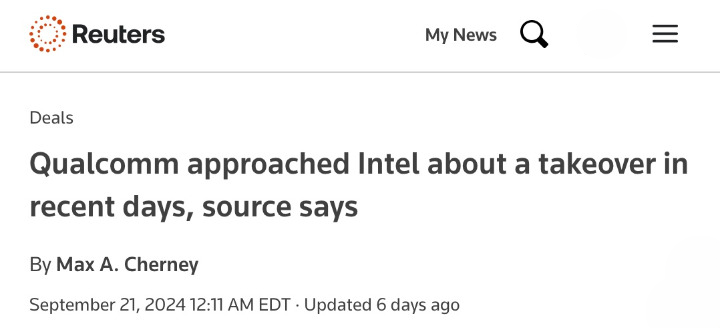
Just two weeks ago, rival chip manufacturer Qualcomm approached Intel to discuss a possible takeover. 

Intel’s stock popped. Qualcomm’s took a hit. 

That’s because the deal would be a major financial stretch for QCOM. 

The deal would be valued significantly above the amount of cash Qualcomm has on its balance sheet and would require taking on significant debt or diluting the company’s shareholders. This deal is viewed as a longshot at best.

Not long after the Qualcomm news broke, Apollo Global Management approached Intel with another offer to support their turnaround efforts: 

Bloomberg reported, citing sources familiar with the matter, that Apollo recently proposed an equity-like investment of up to $5 billion to Intel’s management. The people said Intel execs were mulling over the proposal. There were no definite, as the investment could change or fall apart.

And there’s more good news coming from the government…

The Biden-Harris Administration announced today that Intel Corporation has been awarded up to $3 billion in direct funding under the CHIPS and Science Act for the Secure Enclave program. The program is designed to expand the trusted manufacturing of leading-edge semiconductors for the U.S. government.

This is a DoD targeted program that’s separate from the other $20 billion that’s stuck in limbo.

Can They Be the Comeback Kids?

Intel has a history of being on the wrong side of industry trends. (Like when it opted not to provide Apple with chips for its iPhone and ignored its GPU division as Nvidia was making inroads into the AI trend.)

Yet there’s always hope to right the ship. 

Meta managed to do it — with a disciplined program of slashing costs and refocusing on its core business — after a disastrous investment in the metaverse that cost them three-quarters of their market cap in a little over a year.

But can Intel?

Given their history in the chip business, they’ll certainly be a stock to watch…

Is the end of AI at hand?

For the past several years, tech heavyweights have been pouring billions into AI development. According to CNBC:

…they’re all racing to integrate generative AI into their vast portfolios of products and features to ensure they don’t fall behind in a market that’s predicted to top $1 trillion in revenue within a decade.

It’s been full steam ahead, and a lot of investors have profited handsomely. 

But has the race to dominate that $1 trillion market gotten ahead of itself?

Some analysts are saying yes — and they’re making some reasonable arguments to back them up…

The Case for a Cool Down

Let’s start with Goldman Sachs’ Senior Macro Strategist Allison Nathan. She recently released a client note suggesting the benefits gained from AI weren’t justifying its current costs.

The promise of generative AI technology to transform companies, industries, and societies continues to be touted, leading tech giants, other companies, and utilities to spend an estimated ~$1tn on capex in coming years, including significant investments in data centers, chips, other AI infrastructure, and the power grid. But this spending has little to show for it so far beyond reports of efficiency gains among developers

Billion dollar solutions… that aren’t saving billions of dollars.

Analyst Brandon Smith…

There is no evidence of a single benefit to AI on a broader social scale. At most, it looks like it will be good at taking jobs away from web developers and McDonald’s drive-thru employees

And the costs to train AI haven’t slowed. 

Researchers at Epoch AI discovered the “cost of the computational power required to train the models is doubling every nine months.”

So has AI overpromised on its future? 

In a word… No.

And should investors be concerned about these projections? 

That’s a little more complicated. That answer comes in two parts. 

Don’t Fade the “Bubble”

Back in the late 1990s, any tech company with even a remote connection to some aspect of the internet was being bought hand over fist.  Regardless of whether or not they had produced dollar-one in revenue… or even had a viable business model!

It was the “new paradigm” of investing.

Everyone knows how that ended.

Today, the companies involved in the AI race are all trillion (or near-trillion) dollar companies. Nothing like the “wish and a hope” companies from the 90s.

That makes the AI rally more substantial.

So if you’re invested in AI-related firms and your shares are still headed higher…

Don’t fade the bubble. 

It may be a bubble, but bubbles still make people a lot of money. 

What’s important is to be aware that it is a bubble. What crushed everyone during the tech bust was the absolute certainty that “this time it’s different.” 

It never is.

So that’s number one. The second point, and this is even more important, is to…

Understand the “Long Game”

AI has been a “thing” since the 1950s. But only recently has the technology to actually produce large scale AI applications become available. 

That means the industry is just starting to evolve. 

Some AI applications will undoubtedly tank. Others, however, that can prove their value will be adopted by the market. And those companies will see exponential growth.

This means that going forward you don’t want to think of AI in general terms. You want to consider it in terms of specific areas of application. Areas where serious ROI could actually be realized.

One area that comes to mind is the healthcare industry. 

The healthcare system is plagued by massive inefficiencies: From skyrocketing administrative costs (thanks to a largely broken billing and payment system) to poor patient outcomes that are the result of fragmented treatment and care coordination.

Studies in the National Library of Medicine suggest that if the problems of uncoordinated care, redundant tests, and adverse drug events could be resolved it could save the industry as much as $240 billion

Other estimates have been bigger:

According to research highlighted by Forbes, a quarter of US healthcare spending — almost $1 trillion — is wasted on inefficient or unnecessary patient care. Operational inefficiencies represent a tremendous opportunity for healthcare organizations to increase their retained earnings while bringing in the same revenue.

A number of huge players understand this and have started investing billions to stake claims in the industry.

One example is none other than Google Health. This division of Alphabet is actively developing AI solutions for medical imaging analysis and diagnostics, predictive modeling and health research.

Another player in the current healthcare market is global conglomerate GE Healthcare. They are now working with AI to develop not only diagnostics systems but also patient monitoring systems and hospital operations management tools.

Cerner Corporation (a subsidiary of Oracle) is developing models for clinical decision/pedictive support. They are also focusing on electronic health record (EHR) solutions, revenue cycle management and other operational efficiencies.

But these are all billion dollar companies (trillions in the case of Google) and returns based on their advances in healthcare AI would be tough to realize. To really get a bang for your investment buck, savvy investors should research solid, smaller-cap companies for whom a breakthrough in the market could be transformative.

Tim Collins, Senior Analyst at Streetlight Confidential, recently wrote about a company that fits that description — Healwell AI.

Healwell AI is a small Canadian company that has developed strategic partnerships with seven medical tech companies all working on AI solutions including: 

• Solutions that will allow physicians to rapidly screen and identify patients with rare diseases to facilitate more personalized treatment.

• The development of state-of-the-art EMR or EHR (records management) solutions…

• AI technologies that enable earlier diagnosis and treatment and improved quality of life for the patient

• Applications to target patients that are eligible for specifically approved medications or interventions that can vastly improve patient outcomes…

They’ve also partnered with a leading contract research organization (CRO) specializing in Phase 1 and Phase 2a clinical trials. (Focusing on the field of pharmaceutical development.)

They also have access to one of the most important factors in AI training… data.

The company has partnered with Canada’s largest healthcare provider network, WELL Health, and has exclusive rights to its pool of patient data. WELL Health Technologies Corp. is the largest healthcare technology company in Canada.

All this gives them huge potential throughout the entire healthcare industry.

You can see Tim’s latest research on Healwell AI here.

The bottom line where AI goes is this…

The initial FOMO may be coming to an end. But it won’t be the end of AI. 

There is simply too much potential in this technology for it to just fade away. 

Instead of just counting on Nvidia to keep selling more and more chips, smart investors will have to start looking for areas where AI will actually pay off!